 Sagar
Sagar Introduction: The Motorcycle That Refused to Be Defined — And Won Because of It
When TVS Motor Company launched the Ronin in 2022, they made a deliberate, bold, and somewhat unusual choice: they refused to put it in a box. They didn’t call it a cruiser. They didn’t call it a scrambler. They didn’t call it a roadster or a naked bike or a café racer. They called it a motorcycle that could be all of those things — a machine built for riders who don’t want to commit to a single riding identity, because their life doesn’t ask them to.
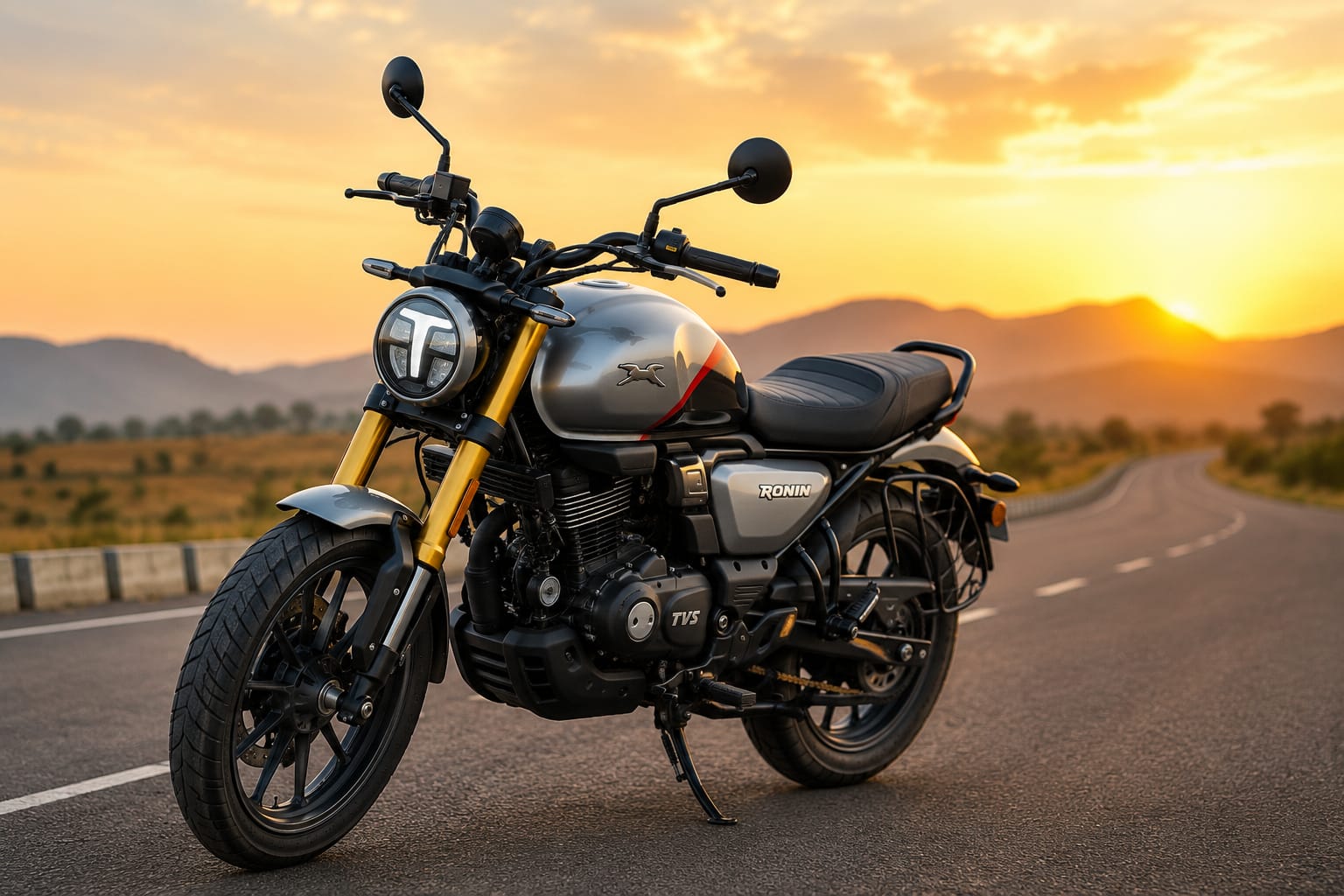
That philosophy, as it turns out, was exactly what a large and underserved segment of the Indian motorcycle market had been waiting for. The TVS Ronin — with its round headlamp, teardrop fuel tank, golden USD forks, and scrambler-meets-roadster stance — captured something genuine about how the modern Indian urban rider actually lives. Someone who commutes in city traffic Monday through Friday, takes a weekend highway run on Saturday, and occasionally hits a rough village road on a spontaneous Sunday. One motorcycle. One character. Endless versatility.
In August 2025, TVS sold 6,623 units of the Ronin in a single month — a figure that represented a meaningful increase over the previous month’s 5,517 units. By September 2025, post-GST revision pricing brought the Ronin down to ₹1.24 lakh (ex-showroom) at the base, with the range topping out at ₹1.69 lakh for the fully-loaded TD variant. The 2025 update added new colours — Glacier Silver and Charcoal Ember — and critically upgraded the mid-spec DS variant with dual-channel ABS, making the entire range more safety-equipped than ever.
What the Ronin has done — and continues to do — is prove that a 225cc motorcycle doesn’t have to choose between character and competence. In this article, we’ll walk you through 15 detailed, honest, research-backed reasons why the TVS Ronin is the most intelligent, versatile, and thoughtfully engineered motorcycle purchase you can make in India under ₹2 lakh in 2025–26.
1. A Design That Blends Multiple Worlds — And Pulls It Off Brilliantly
Design in motorcycles is often about commitment to a single genre. A café racer has clip-on bars and a hump. A cruiser has a low seat and forward pegs. A scrambler has a high fender and knobby tyres. The ronin tvs takes a different approach entirely — it cherry-picks the most appealing design cues from multiple genres and synthesises them into something genuinely original.
The front end is dominated by a round LED headlamp with a distinctive T-shaped pilot lamp (DRL) that sits above it, giving the Ronin a face that’s immediately recognisable from a distance. This combination of the circular main lamp and the T-shaped accent creates a visual signature that no direct rival replicates. The gold-finished 41mm USD (upside-down) forks beneath the headlamp add a premium, performance-oriented contrast that the round headlamp alone might not suggest — it’s a visual tension that works perfectly.
The 14-litre teardrop fuel tank is wide at the top and narrows toward the frame, creating a classic silhouette that references mid-century roadsters without being a direct copy of anything specific. The single-piece seat is well-shaped and supports both rider and pillion without being so flat that it looks like an afterthought. The 9-spoke machined alloy wheels add a contemporary detail to a primarily retro design language, and the colour-coded rim stickers introduced in 2025 add a personalisation element that buyers have responded to with enthusiasm.
For 2025, Glacier Silver features striking golden accents on both the fuel tank and side panels, complementing the gold-finished front forks in a way that feels considered and cohesive rather than randomly assembled. Charcoal Ember brings a sophisticated dual-tone design combining blue and metallic silver, accented with red stripes on the fuel tank and side panels — a combination that reads as premium and modern simultaneously.
What makes the Ronin’s design particularly successful is that it doesn’t look like it’s trying too hard. It doesn’t have aggressive styling lines or dramatic winglets or unnecessary chrome flourishes. It simply looks right — proportionally balanced, clearly confident, and entirely its own thing.
2. The 225.9cc Oil-Cooled Engine — Tuned for India, Not Just a Spec Sheet
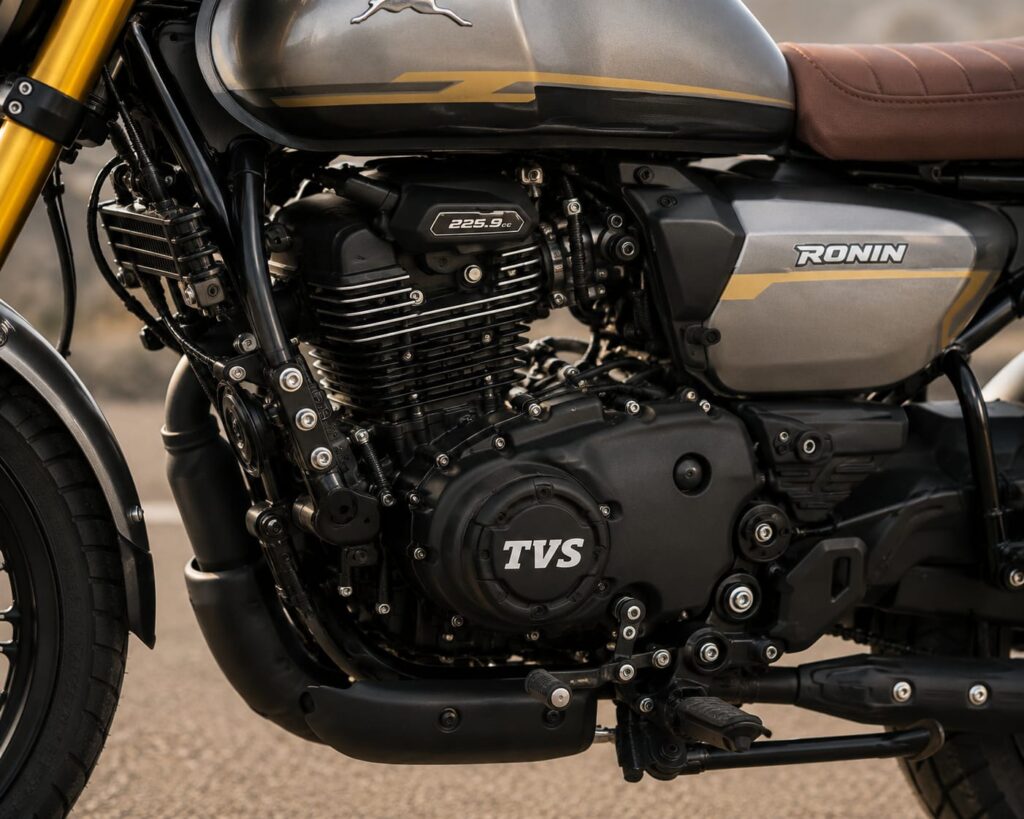
Before we talk about what the TVS Ronin’s engine delivers, let’s address a common misconception: 225cc does not mean underpowered. Not when the engine is engineered as thoughtfully as this one. The Ronin is powered by a 225.9cc, single-cylinder, oil-cooled, 4-stroke, 4-valve SOHC engine that generates 20.4 PS at 7,750 rpm and 19.93 Nm of torque at 3,750 rpm, paired with a 5-speed gearbox and an assist and slipper clutch.
That torque peak at 3,750 rpm is the critical detail here. Most Indian riding — whether in city traffic or on state highways — happens well below 5,000 rpm. An engine that delivers its maximum torque at 3,750 rpm means you’re riding in the fat part of the power band during almost every common riding scenario. You don’t need to rev the engine hard to find the power; it’s there where you actually need it, making the Ronin feel more immediately responsive than its displacement might suggest to buyers who associate small engines with having to work hard for performance.
The oil-cooling system deserves particular attention because it’s a solution that TVS has engineered specifically for Indian conditions. An oversized oil-cooled system keeps engine temperatures consistently managed across the temperature extremes that Indian riding involves — from cold early morning starts in North India’s winter to 45°C summer traffic in Hyderabad. Oil cooling is lighter and more compact than liquid cooling while providing better thermal management than pure air cooling, making it an ideal engineering choice for a motorcycle of the Ronin’s character and price.
The Ronin’s engine is tuned for low and mid-range torque, which gives a smooth ride in the city. Slight vibrations can be felt at speeds above 90 km/h — which is a characteristic of single-cylinder engines at high revs — but these are minor and not unusual for the class. The top speed is a genuine 120 km/h, and the engine pulls confidently up to that figure without feeling strained. For the vast majority of Indian riding use cases, the Ronin’s engine is more than adequate — and it delivers its performance in a relaxed, accessible way that first-time riders and experienced commuters alike find genuinely enjoyable.
3. Glide Through Technology — A Feature That Transforms Daily City Riding
If you were to ask TVS Ronin owners to name the single feature they appreciate most in daily city riding, a significant number would say the same thing: Glide Through Technology (GTT). This proprietary TVS technology is, genuinely and without overstatement, one of the most practically useful features ever fitted to a motorcycle in this price range.
Here’s what GTT does: when you’re riding in slow traffic — the stop-start crawl of Mumbai’s Western Express Highway, the perpetual congestion of Delhi’s Laxmi Nagar, or the packed lanes of Bengaluru’s Outer Ring Road — the Ronin’s GTT system prevents the engine from stalling at low speeds. You engage GTT simply by releasing the clutch in first, second, or third gear and gliding through without accelerating. The system holds the engine at a steady idle-ish speed, allowing the motorcycle to creep forward in traffic without the constant clutch engagement and disengagement that makes urban riding in a manual motorcycle physically exhausting.
To understand why this matters so much in practice, imagine your left hand on a traditional motorcycle in a 45-minute traffic jam. You’re pulling and releasing the clutch lever hundreds of times. Your hand fatigues. Your forearm tightens. By the time you reach your destination, you’ve had a minor workout in your left hand and you’re already slightly irritated before your workday begins. GTT eliminates this entirely for the significant portion of urban riding where traffic is dense enough to require constant clutch work.
This feature enjoys effortless low-speed riding in traffic — simply engage GTT by releasing the clutch in 1st, 2nd or 3rd gear and glide through without accelerating. It’s a simple description for a feature that, experienced over hundreds of commuting days, represents a genuine quality-of-life improvement that most buyers who try the Ronin in traffic immediately notice and appreciate. It’s not a headline specification that sounds impressive in a brochure. It’s a technology that makes you a happier rider every single morning.
4. SmartXonnect — The Most Sophisticated Connectivity System in This Price Segment
Technology in motorcycles under ₹2 lakh in India has historically meant a digital speedometer and perhaps a USB charging port. The TVS Ronin’s SmartXonnect system, available on the top TD variant, represents a completely different level of motorcycle connectivity — one that would have seemed futuristic at this price point even a few years ago.
The digital instrument cluster equipped with SmartXonnect offers voice assist, ride assistance, turn-by-turn navigation, ETA display, incoming call alerts and receive function, custom window notifications, and ride analysis through the TVS Connect app. Let’s unpack each of these because the collective value is considerably more than the sum of the individual parts.
Turn-by-turn navigation on your instrument cluster means your phone can stay in your pocket while the map directions appear directly on the screen in front of you. For a rider navigating an unfamiliar city or trying to follow a complex route to a weekend destination, this removes the most dangerous habit in modern motorcycling — glancing at a phone mounted on the bars while in motion. The navigation shows distance, direction, and ETA, keeping your eyes where they belong: on the road.
The voice assist feature is a genuinely impressive implementation. Talk to your bike and it’ll talk back — whether it’s for navigation, call alerts, or bike health updates. You can receive incoming call notifications on the instrument cluster without touching your phone. If you want to accept a call, the system handles it through a connected Bluetooth headset while you keep both hands on the bars.
Ride analysis through the TVS Connect app gives you data about your riding patterns, fuel consumption, and trip statistics — information that helps you understand your riding style and potentially improve your fuel economy over time. The app also enables day-wise vehicle stats navigation for trips of five to fifteen days — making the Ronin a legitimate tool for multi-day touring with intelligent trip tracking.
The Bluetooth connectivity works reliably once paired, though the initial setup requires some patience. This is a fair and honest observation — the system is capable, but like most Bluetooth implementations, the first-time pairing experience can require several minutes of configuration. Once established, however, the connection is stable and the features work as advertised.
5. 41mm Gold USD Front Forks — Premium Hardware at an Unprecedented Price
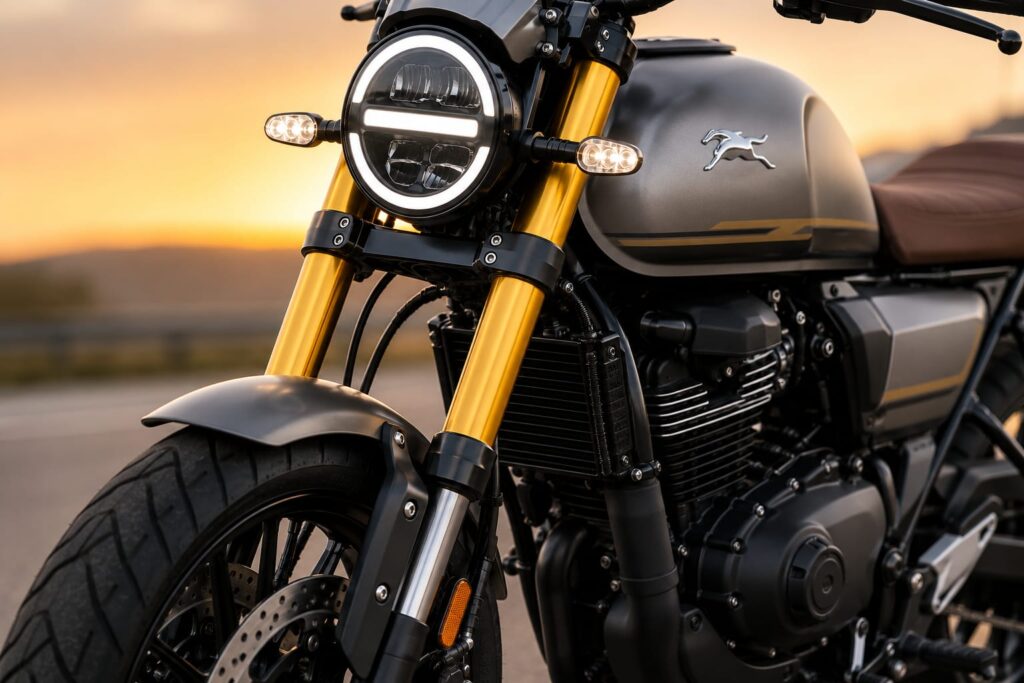
Upside-down forks — USD forks — are a hardware specification that Indian motorcycle buyers typically associate with products costing significantly more than ₹2 lakh. The TVS Ronin’s 41mm USD front forks are one of the most tangible statements the motorcycle makes about its engineering ambitions, and their presence defines both the look and the feel of the bike in a way that cascades through the entire riding experience.
The TVS RONIN’s upside-down front suspension allows better control and stability while riding at various speeds. To understand why this matters, a brief explanation: in a conventional telescopic fork, the larger-diameter tubes are at the bottom (attached to the wheel) and the smaller, sliding tubes are at the top (attached to the frame). In an upside-down fork, this arrangement is reversed — the larger tubes are at the top, attached to the frame, and the smaller sliding tubes are at the bottom. This inversion reduces the unsprung weight (the weight of components that move with the wheel), which improves the suspension’s ability to track road imperfections quickly and accurately.
In practical riding terms, USD forks give the motorcycle more precise steering, better resistance to brake dive (the nose-dipping sensation under hard braking), and improved high-speed stability. The 300mm front disc brake works with more confidence and precision because the forks maintain their geometry better under braking loads. On winding roads, the front end inspires confidence because it communicates road surface texture more accurately to the rider’s hands.
Aesthetically, the gold anodised finish on the forks is a masterstroke. Gold-finished USD forks are typically found on motorcycles costing three to five times the Ronin’s price — motorcycles like the Triumph Speed 400, the KTM 390 series, or performance-oriented variants of premium Japanese bikes. Seeing them on a motorcycle priced from ₹1.35 lakh creates an immediate visual impression of premium quality that buyers notice and remember from their first glance.
6. Dual-Channel ABS With Rain and Urban Modes — Safety That Adapts to Your Road
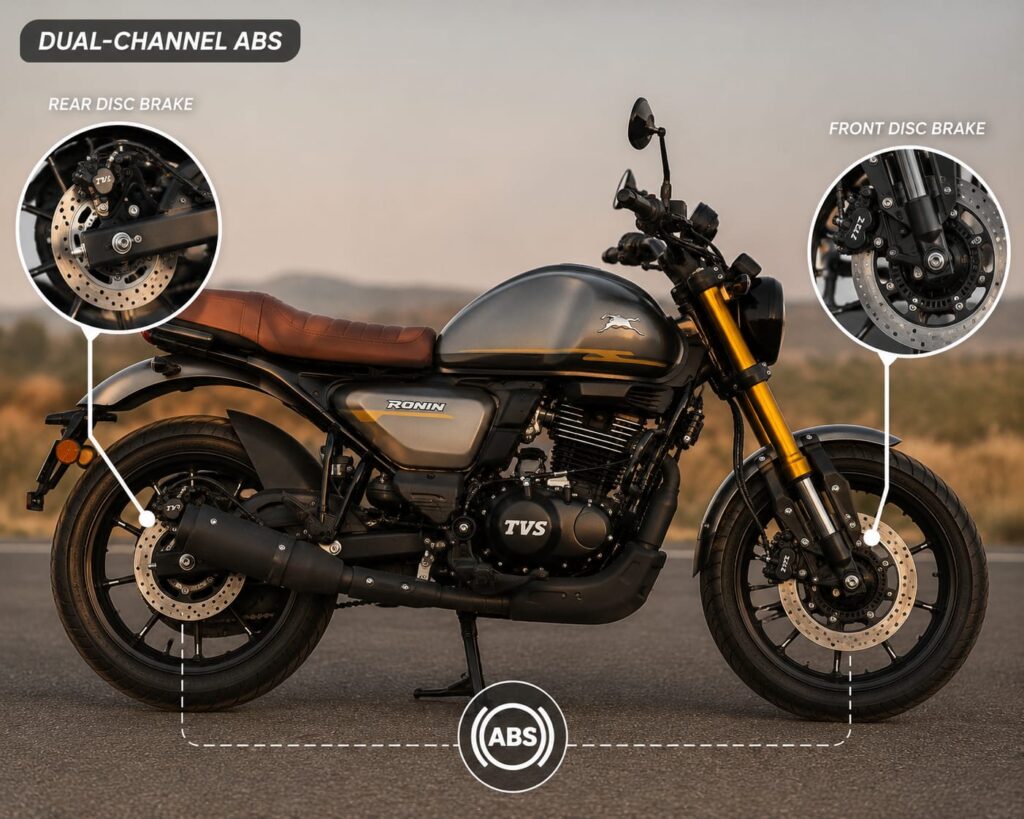
The 2025 update to the TVS Ronin delivered one of the most significant safety upgrades in the motorcycle’s history: dual-channel ABS was added to the mid-spec DS variant as standard. Combined with the rain and urban ABS modes already available on the TD variant, the Ronin now offers a genuinely sophisticated braking safety system at a price that makes it accessible to a broad range of Indian buyers.
Dual-channel ABS independently monitors and manages wheel lock-up at both the front and rear wheels. On a single-channel system, only the front wheel is monitored; the rear can still lock. Dual-channel protection means that in any emergency braking scenario, both wheels are protected, dramatically reducing the risk of the motorcycle becoming unstable and falling during a sudden stop.
What elevates the Ronin’s safety system above simple dual-channel ABS is the availability of two distinct ABS modes — Rain and Urban. In rain mode, the ABS threshold is set lower, meaning the system intervenes earlier and more assertively when it detects wheel slip. This provides stronger braking control on wet roads where tyre grip is reduced. Urban mode offers a lighter ABS feel — allowing the experienced rider more control in normal dry conditions where the bike’s full stopping power can be harnessed more aggressively. The differences are noticeable, particularly between Rain and Sport modes. Rain mode softens throttle response considerably, which proves genuinely useful in slippery conditions.
This mode-switching capability reflects a level of rider-consideration that goes beyond tick-box safety compliance. TVS has recognised that the same rider riding the same motorcycle on different days, in different conditions, benefits from different ABS calibrations. This is thoughtful engineering applied to a real-world problem, and it genuinely improves safety outcomes for the diverse conditions that Indian riders encounter across different regions and seasons.
7. ARAI-Certified 42.95 kmpl Mileage — Efficiency That Makes Ownership Genuinely Affordable
For a motorcycle that doesn’t position itself as a fuel economy product — a motorcycle with USD forks, dual-channel ABS, riding modes, and a feature list that suggests performance over parsimony — the TVS Ronin’s ARAI-certified mileage of 42.95 kmpl is genuinely impressive and represents one of its most compelling ownership arguments.
In real-world Indian riding, the actual mileage is 30–40 kmpl in the city and 40–45 kmpl on the highway. The city figure of 30–40 kmpl is particularly relevant for the majority of Ronin buyers who use it primarily for urban commuting. At 35 kmpl real-world city average and a 14-litre tank, the Ronin offers a city range of approximately 490 km before requiring a fuel stop — meaning weekly fuel costs, even in India’s major metro cities, remain entirely manageable.
To put this mileage in direct competitor context: the Royal Enfield Hunter 350 returns approximately 35 kmpl, while the Jawa 42 Bobber manages around 30 kmpl. The Ronin, with its lighter 159 kg kerb weight and efficiently tuned 225cc engine, genuinely outperforms both on fuel economy — which matters because over a five-year, 60,000 km ownership lifecycle, the difference in fuel costs between the Ronin and a Hunter 350 at current petrol prices can amount to a meaningful sum.
The 14-litre fuel tank is itself a thoughtful specification. Many 200cc competitors use 12-litre tanks to save weight, which limits range and requires more frequent refuelling on long rides. The Ronin’s 14-litre capacity provides a range buffer that makes the motorcycle more practical for the highway touring that many of its buyers will regularly undertake.
8. The Assist and Slipper Clutch — Premium Feel in Every Gear Change
The assist and slipper clutch in the TVS Ronin is a feature that transforms the motorcycle from merely competent to genuinely enjoyable to ride. Experience fewer jerks and less clutch use with the slipper clutch that helps in smoother transitions between gear shifts — this is the official description, and it understates the actual benefit significantly.
An assist and slipper clutch serves two functions simultaneously. The “assist” mechanism reduces the spring pressure on the clutch pack when engaging (pulling the lever), meaning the clutch lever effort is dramatically reduced. Riders coming from entry-level motorcycles with heavy clutch pulls will notice this immediately — the Ronin’s clutch feels feathery light, requiring minimal hand strength to operate, which compounds the GTT system’s contribution to reducing traffic fatigue.
The “slipper” function engages during aggressive downshifting, when the engine compression would otherwise cause the rear wheel to slow more rapidly than the rider intends. On a standard clutch, aggressive downshifting at speed can cause a momentary rear wheel wobble or even a skid. The slipper mechanism allows the clutch plates to slip slightly during these aggressive downshifts, preventing the rear wheel from receiving a harsh compression spike. The result is smoother, more controlled deceleration during spirited riding — and significant additional confidence for newer riders who haven’t yet fully learned the art of smooth rev-matched downshifting.
For a motorcycle priced from ₹1.35 lakh, having a slipper clutch fitted as standard is genuinely unusual. It’s a component that TVS’s engineering team clearly believe contributes meaningfully to the riding experience — not as a headline spec but as a day-to-day improvement in how the motorcycle feels and behaves in every gear change, every day.
9. Three-Step Adjustable Levers — Ergonomic Flexibility for Every Hand Size
Here is a small detail that reveals something significant about the TVS Ronin’s engineering philosophy: the 3-step adjustable levers on the clutch and front brake. Get better handle grip, on or off the road, with 3-step adjustable levers that come with custom adjustments for the clutch and front brake.
Motorcycle levers are typically fixed in their reach from the handlebar grip. If you have large hands, the lever sits comfortably close. If you have small or average-sized hands, the lever sits further away than your natural grip, requiring you to stretch your fingers slightly to pull the lever fully — a compromise that causes fatigue over long rides. Adjustable reach levers allow the rider to set the lever distance to match their individual hand size perfectly.
On the Ronin, the adjustment is a simple 3-step click mechanism — no tools required, no complex setup. You simply click the adjuster to the position that puts the lever exactly where your fingers naturally fall when wrapped around the grip. For female riders, riders with smaller hands, or any rider who has previously found motorcycle lever ergonomics uncomfortable, this feature is meaningfully practical.
It’s the kind of thoughtful detail that doesn’t appear in a headline specification but contributes enormously to daily riding comfort. TVS clearly spent time observing the diverse range of Indian riders — different heights, different hand sizes, different grip styles — and designed a solution that works for the broadest possible audience rather than an assumed average.
10. The 7-Step Adjustable Rear Monoshock — A Suspension That Can Match Your Riding Style
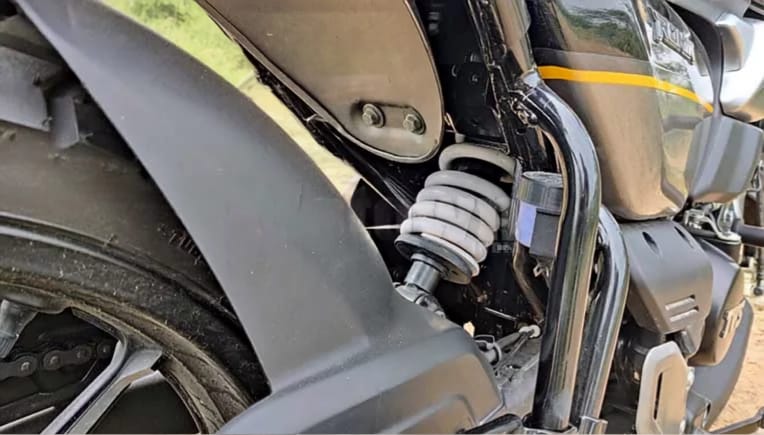
Suspension adjustability in motorcycles under ₹2 lakh is usually either absent or limited to a single preload ring that requires a spanner and some optimism to change. The TVS Ronin’s rear monoshock offers 7-step adjustable preload — a meaningful range that allows genuine customisation of the motorcycle’s ride character for different rider weights and riding preferences.
The suspension setup — USD forks up front and a monoshock at the rear — leans toward the softer side, which prioritises ride comfort over aggressive handling. On smooth roads, the bike flows nicely through corners with predictable behavior. The 17-inch wheels at both ends contribute to this stable, confidence-inspiring character.
The 7-step preload adjustment allows a lighter rider to soften the rear spring preload for a more compliant, comfortable ride over city roads. A heavier rider, or one carrying a regular pillion passenger, can increase the preload to prevent the rear from sitting too low and bottoming out over speed breakers. A rider who wants a more track-focused handling character for weekend mountain runs can increase preload for a stiffer, more responsive feel. These are genuinely different riding experiences accessible through a simple adjustment that takes under two minutes to change.
For the Indian road context — where a single ride might involve a smooth expressway section, a patch of broken tarmac, a speed breaker cluster, and then more smooth road — the ability to tune the suspension to the rider’s preference and the dominant road type of their route is a practical benefit that translates to better daily ride quality. The ground clearance of 181mm, combined with the adjustable rear suspension, means the Ronin handles the variety of Indian road conditions with more adaptability than most competitors at this price point.
11. The Agonda Edition — A Special Variant That Speaks to a Lifestyle
In the premium lifestyle motorcycle segment in India, special editions are typically reserved for brands with significant heritage and pricing power. TVS, with the Ronin Agonda Edition, has demonstrated that a well-conceived special edition can be just as compelling at ₹1.31 lakh as it is at ₹3 lakh.
Inspired by Agonda beach in Goa — one of India’s most beloved destinations for relaxed, soul-enriching escapes — the Agonda Edition features a white colour scheme with retro-themed stripes that immediately evoke the sun-bleached, salt-washed aesthetic of coastal motorcycle culture. Unique Agonda badging and a new seat cover distinguish it from the standard range while remaining mechanically identical to the base variant, meaning no sacrifice in engineering quality for the visual upgrade.
TVS has announced their intention to release more special editions in the future, with the Agonda Edition marking the beginning of what they call a “custom-inspired Ronin subculture.” This language reflects a genuine understanding of what makes lifestyle motorcycles successful in India: they need to be products that their owners feel personally connected to, that reflect a sensibility and a set of values, not just a specification sheet.
The Parakram Edition, unveiled in July 2024, is another example of TVS using limited special editions to deepen the Ronin community’s engagement with the brand. These special editions don’t change the motorcycle’s engineering — they change its story. And for a significant segment of Indian motorcycle buyers, the story of a motorcycle matters as much as its specification.
12. 795mm Seat Height and 159kg Kerb Weight — Accessible to Every Rider
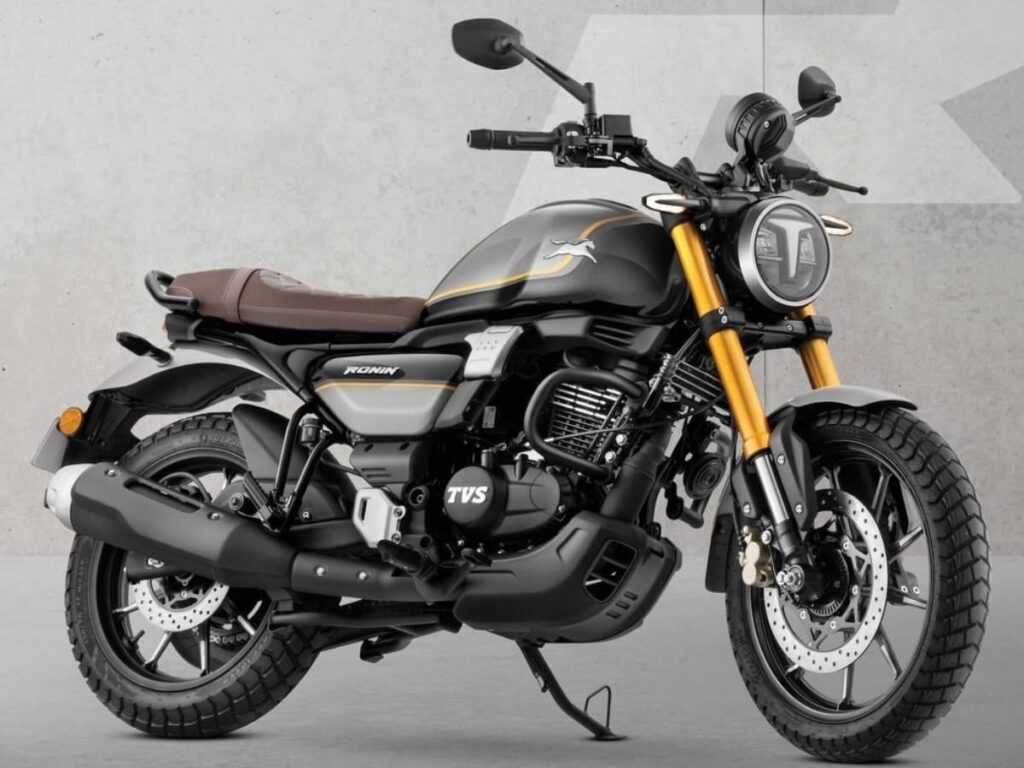
Practical motorcycle ownership begins with one fundamental question: can you actually control this bike with confidence? Two specifications define this more than any other — seat height and kerb weight. And the TVS Ronin’s numbers on both are genuinely excellent for the widest possible range of Indian riders.
At 795mm, the seat height is comfortably accessible for riders of average Indian stature. Most riders between 5’5″ and 6’2″ can flat-foot or near-flat-foot the Ronin without difficulty — and a rider with one foot fully planted and the other on the pegs has full control over the motorcycle at standstill. At traffic lights, on inclines, in slow parking maneuvers, this accessibility dramatically reduces the anxiety that taller or heavier motorcycles can create.
The kerb weight of 159 kg is particularly impressive for a motorcycle of the Ronin’s features and capability. Compare this to the Royal Enfield Hunter 350 at 181 kg or the Jawa 42 Bobber at 185 kg — the Ronin is significantly lighter than both direct competitors. That 22–26 kg difference is palpable in daily riding. The bike is incredibly flickable and light when handling — perfect for urban riding and tight city traffic. Getting the bike off the side stand, navigating a U-turn in a tight lane, or filtering through congested traffic becomes significantly easier when the motorcycle is this light.
In rider’s own words from a 2025 purchase experience: “From day to day ride experience, the good straight posture, wide handlebar and adjustable mirror, the comfortable seat, in city traffic felt less stress on wrist, also the comfort as a pillion is awesome.” This owner testimonial captures something that specifications alone can’t — the Ronin’s numbers translate to a genuinely easier, more relaxed ownership experience that riders notice from the first week.
13. Full LED Lighting With a Class-Leading Headlamp — See and Be Seen
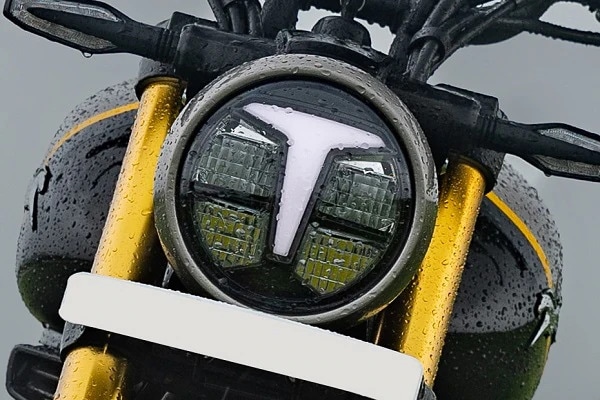
The TVS Ronin’s lighting system is one of the most thoroughly LED-equipped setups in the 200cc motorcycle segment, and the quality of its headlamp illumination has received consistent praise from both expert reviewers and everyday owners.
Full LED lighting includes the main headlamp, the T-shaped DRL, the tail lamp, the indicators, and the instrument backlighting — making the Ronin one of the most visible motorcycles on Indian roads after dark. Modern LED lighting consumes significantly less power than halogen equivalents, reduces the electrical load on the charging system, and lasts considerably longer without requiring replacement.
The headlight deserves specific mention because it performs at a level that genuinely impresses in real-world use. The LED headlamp features a low beam with a wide spread that illuminates the lateral edges of the road effectively — important for spotting pedestrians and animals that approach from the side — and a high beam with commendable throw that allows confident highway speeds after dark. The quality of the light pattern is noticeably superior to the halogen units fitted to several rivals, making night riding in the Ronin more relaxed and safer.
The T-shaped DRL that sits above the main headlamp serves a dual function: it creates the Ronin’s distinctive visual signature in daylight conditions, making the bike recognisable from a considerable distance, and it ensures the motorcycle is visible to other road users during the twilight periods when accidents are statistically more likely. Road visibility is a safety matter, not just an aesthetic one, and the Ronin’s full LED system contributes meaningfully to both the safety and the character of the motorcycle.
14. Pricing After GST Revision — ₹1.24 Lakh Onwards Makes This a Genuinely Outstanding Value
In September 2025, the Indian GST revision resulted in a price reduction on the TVS Ronin that made one of the already competitive offerings in the 200cc segment even more difficult to ignore. Post-GST, the Ronin is now priced from ₹1.24 lakh (ex-showroom), with the full variant range offering outstanding value at every price point.
Here’s the complete variant breakdown and what each level delivers:
- SS Base — from ₹1.29 lakh: The entry point into the Ronin ownership experience. Gets the full design package, the 225.9cc engine with slipper clutch, Glide Through Technology, full LED lighting, the adjustable levers, the 41mm USD forks, and single-channel ABS. The base Ronin is genuinely well-equipped by segment standards — you’re not buying a stripped-out motorcycle. The Lightning Black and Magma Red colour options at this level are clean and understated.
- DS Mid — from ₹1.49 lakh: The sweet spot of the range for most buyers. The 2025 update added dual-channel ABS as standard to this variant — a safety upgrade that alone justifies the step up from the base. Adds the new Glacier Silver and Charcoal Ember colour options, which are among the most visually distinctive in the segment. This is the recommended variant for the majority of buyers who prioritise both safety and everyday practicality.
- TD Top — from ₹1.62 lakh: The fully-loaded Ronin experience. Adds SmartXonnect Bluetooth connectivity, turn-by-turn navigation, voice assist, call and message alerts, ride analytics through the TVS Connect app, the rain and urban ABS modes, and a premium instrument cluster experience. For buyers who want the most connected, most tech-forward 200cc motorcycle available in India, this is the only answer.
- Agonda Edition — ₹1.31 lakh: The lifestyle special. Agonda-white with retro stripes, unique badging, and a new seat cover at a price just above the base variant. For buyers who want to stand out for reasons of personality rather than specification, this is the compelling choice.
15. The Competition — Why the Ronin Wins the Overall Equation in 2025–26
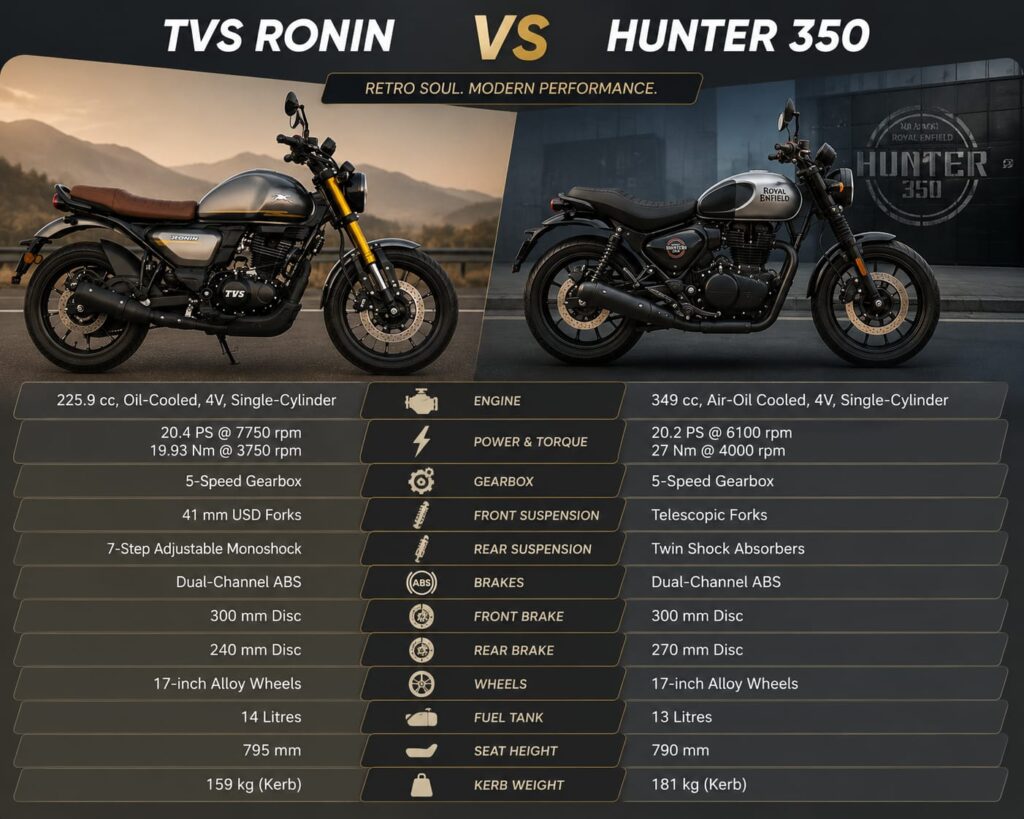
The TVS Ronin’s closest competitors in the Indian market are the Royal Enfield Hunter 350 and the Jawa 42 Bobber. Both are excellent motorcycles with genuine strengths and distinct identities. An honest assessment of the Ronin must address all three sides of this competitive triangle.
The TVS Ronin vs Royal Enfield Hunter 350:
The Hunter 350 has a larger 349cc engine, Royal Enfield’s legendary brand heritage, a more extensive service network, and the option of Tripper Navigation in higher variants. It’s heavier (181 kg vs 159 kg), returns lower mileage (35 kmpl vs 42.95 kmpl), and is priced slightly higher (starts at ₹1.38 lakh vs ₹1.29 lakh). The Hunter is a more comfortable, more refined motorcycle for long-distance riding due to its smoother 350cc engine character.
The Ronin leads on technology (SmartXonnect, GTT, rain/urban modes), mileage efficiency, kerb weight and agility, the quality of its USD front suspension hardware, and adjustable ergonomics. For urban-focused buyers who commute daily and want more technology and lighter handling, the Ronin is the more compelling package. For buyers who prioritise brand heritage, pillion comfort on long rides, and the Royal Enfield community, the Hunter makes more sense.
The TVS Ronin vs Jawa 42 Bobber:
The Jawa 42 Bobber has a bigger 334cc liquid-cooled engine with more power and torque, a far more distinctive and polarising design aesthetic, and the specific appeal of the bobber subculture. The Ronin leads on technology (no comparable connectivity in the 42 Bobber), mileage (42.95 vs 30 kmpl), and pricing (starts lower by a significant margin). The 42 Bobber is the better choice for buyers who have decided they want a bobber specifically — its design is singular and its character unmistakable. The Ronin is the better choice for buyers who want more versatility, more technology, and lower running costs.
Where the Ronin leads the segment comprehensively:
- Technology density: SmartXonnect with voice assist, navigation, and ride analytics — nothing comparable is available at this price
- Fuel efficiency: 42.95 kmpl ARAI, 30–45 kmpl real world — segment leader
- Kerb weight: 159 kg — lightest in its competitive set
- Hardware quality: Gold USD forks, 7-step adjustable monoshock — beyond segment standard
- Versatility: GTT for city, rain mode for monsoon, urban mode for daily, adjustable suspension for touring — one motorcycle, every use case
The TVS Ronin doesn’t need to be the best in any single area to win the overall buying equation. It wins by being genuinely excellent across the widest range of criteria simultaneously — and at a price that makes the technology, hardware, and character accessible to the broadest possible Indian buyer audience.
TVS Ronin 2025–26: Full Specifications at a Glance
| Parameter | Detail |
|---|---|
| Price Range | ₹1.24 lakh – ₹1.69 lakh (ex-showroom, post-GST revision) |
| Engine | 225.9cc, single-cylinder, oil-cooled, 4-stroke, 4-valve SOHC |
| Power | 20.4 PS @ 7,750 rpm |
| Torque | 19.93 Nm @ 3,750 rpm |
| Gearbox | 5-speed with assist and slipper clutch |
| Mileage (ARAI) | 42.95 kmpl |
| Real-World Mileage | 30–45 kmpl (city/highway) |
| Top Speed | ~120 km/h |
| Fuel Tank | 14 litres |
| Seat Height | 795 mm |
| Kerb Weight | 159 kg |
| Front Suspension | 41mm gold USD (upside-down) forks |
| Rear Suspension | 7-step adjustable preload monoshock |
| Front Brake | 300mm disc |
| Rear Brake | 240mm disc |
| ABS | Single-channel (SS) / Dual-channel with Rain & Urban modes (DS, TD) |
| Tyres | 110/70-17 (front) / 130/70-17 (rear), tubeless |
| Wheels | 9-spoke machined alloy wheels |
| Ground Clearance | 181 mm |
| Instrument Cluster | Fully digital with Bluetooth SmartXonnect (TD) |
| Connectivity | TVS SmartXonnect — navigation, voice assist, call alerts, ride analytics (TD) |
| Special Technology | Glide Through Technology (GTT), 3-step adjustable levers |
| Riding Modes | Rain and Urban ABS modes (TD) |
| Lighting | Full LED (headlamp, DRL, tail lamp, indicators) |
| Variants | SS (base), DS (mid), TD (top), Agonda Edition (special) |
| Colours | Lightning Black, Magma Red, Glacier Silver, Charcoal Ember, Midnight Blue, Nimbus Grey |
| Compliance | BS6 Phase 2 |
| Warranty | 3 years standard |
Who Should Buy the TVS Ronin?
The TVS Ronin has an almost unusually broad buyer appeal for a lifestyle motorcycle — which is simultaneously its greatest strength and a reflection of how thoughtfully it has been designed.
You should buy the Ronin if you are a daily urban commuter who wants a motorcycle that makes traffic not just bearable but genuinely enjoyable. GTT, the light clutch, the 159 kg kerb weight, and the USB charging port collectively make the Ronin the most practical and least fatiguing urban motorcycle in this segment.
You should buy the Ronin if you are a first-time lifestyle bike buyer upgrading from a commuter motorcycle like the Bajaj Pulsar or TVS Apache. The Ronin’s design feels aspirational and premium without requiring an intimidating budget commitment.
You should buy the Ronin if you are a technology-forward buyer who genuinely uses connected features. The SmartXonnect system on the TD variant offers the most sophisticated connectivity available on any Indian motorcycle under ₹2 lakh, and for buyers who genuinely integrate their smartphone into their riding, the navigation and call management features are meaningfully useful.
You should buy the Ronin if you are a versatile rider who doesn’t want to commit to a single motorcycle identity. The Ronin’s design borrows from multiple genres without belonging to any one of them — it’s simultaneously a credible city commuter, a weekend highway cruiser, and a light touring motorcycle. For riders whose riding life doesn’t fit a single category, this versatility is the entire point.
Variant Buying Guide: Which TVS Ronin Should You Buy?
For city commuters on a managed budget: The SS base variant is fully equipped for daily urban use. You get GTT, slipper clutch, USD forks, LED lighting, and adjustable levers — everything that makes the Ronin special in city traffic. The ₹1.29 lakh price point is genuinely difficult to fault for the specification offered.
For most buyers — the recommended choice: The DS mid variant with dual-channel ABS is the clearest value choice in the entire range. The 2025 safety upgrade to dual-channel ABS is the decisive differentiator over the base. At approximately ₹1.49 lakh, you get the full Ronin hardware package plus the superior braking safety of dual-channel ABS in the attractive Glacier Silver or Charcoal Ember colours.
For tech-focused buyers: The TD top variant is for riders who will actively use the SmartXonnect system. If you commute in urban traffic and want turn-by-turn navigation on your instrument cluster, call management without touching your phone, and ride analytics through an app — the TD’s technology premium is well justified at ₹1.62–1.69 lakh.
For lifestyle and personality buyers: The Agonda Edition at ₹1.31 lakh is the choice for riders who want their motorcycle to tell a story. The Goa-beach-inspired white scheme, retro stripes, and special badging give the Ronin a personality that the standard colours don’t quite match.
Final Verdict: The TVS Ronin Doesn’t Ask You to Choose — It Lets You Be Everything
There’s something refreshing about a motorcycle company that trusts its buyers enough to say: you don’t need to fit into a category. The TVS Ronin is built on the premise that the modern Indian rider is multidimensional — that the same person who crawls through Bengaluru traffic on Tuesday evening wants to ride an empty NH-48 on Saturday morning and doesn’t want to own two motorcycles to do both well.
The Ronin delivers on that premise with extraordinary consistency. It makes city riding less exhausting through GTT and a light slipper clutch. It makes highway riding more confident through USD forks and dual-channel ABS. It makes navigation smarter through SmartXonnect. It makes monsoon riding safer through rain mode. It makes every gear shift more pleasurable through the slipper clutch. And it does all of this while returning over 42 kmpl on ARAI testing, weighing only 159 kg, and starting at ₹1.29 lakh.
The TVS Ronin is not the most powerful motorcycle under ₹2 lakh. It is not the most heritage-rich. It is not the loudest or the most extreme or the most aggressive. But it is the most thoughtfully engineered, the most technologically comprehensive, and the most genuinely versatile motorcycle in its price class in India today. And for the motorcycle buyer who wants to ride more and compromise less, that makes all the difference.
Frequently Asked Questions (FAQ)
Q: What is the current price of the TVS Ronin in India in 2025–26?
Following the September 2025 GST revision, the TVS Ronin starts at ₹1.24 lakh (ex-showroom). The variant range spans ₹1.29 lakh (SS base) to ₹1.69 lakh (TD top spec). On-road prices vary by city.
Q: What is the mileage of the TVS Ronin?
The ARAI-certified mileage of the TVS Ronin is 42.95 kmpl. Real-world mileage is approximately 30–40 kmpl in city conditions and 40–45 kmpl on highways, depending on riding style.
Q: What is Glide Through Technology (GTT) in the TVS Ronin?
Glide Through Technology is TVS’s proprietary system that allows the Ronin to creep forward in traffic without stalling, by releasing the clutch in 1st, 2nd, or 3rd gear without applying additional throttle. It significantly reduces clutch fatigue in stop-start city traffic.
Q: What is SmartXonnect in the TVS Ronin?
SmartXonnect is TVS’s Bluetooth connectivity system available on the top TD variant. It offers turn-by-turn navigation, voice assist, incoming call alerts and management, SMS notifications, ride analytics, and custom widget displays on the instrument cluster through the TVS Connect app.
Q: Does the TVS Ronin have dual-channel ABS?
Yes. From the 2025 update, dual-channel ABS is standard on the DS mid variant and the TD top variant. The base SS variant retains single-channel ABS. The TD variant also offers rain and urban ABS modes for different riding conditions.
Q: What engine does the TVS Ronin use?
The TVS Ronin uses a 225.9cc single-cylinder, oil-cooled, 4-stroke, 4-valve SOHC engine producing 20.4 PS at 7,750 rpm and 19.93 Nm of torque at 3,750 rpm, paired with a 5-speed gearbox and assist-and-slipper clutch.
Q: How does the TVS Ronin compare to the Royal Enfield Hunter 350?
The Ronin leads on technology (SmartXonnect, GTT, riding modes), mileage (42.95 vs 35 kmpl), kerb weight (159 kg vs 181 kg), and hardware quality (USD forks). The Hunter 350 leads on engine displacement (349cc vs 225cc), ride comfort on long distances, brand heritage, and pillion ergonomics. The Ronin is better suited for urban riders who prioritise technology and agility; the Hunter suits buyers who prioritise long-ride comfort and heritage.
Q: What is the seat height of the TVS Ronin?
The TVS Ronin has a seat height of 795mm, making it accessible to a wide range of Indian riders.
Q: Which TVS Ronin variant is the best buy?
For most buyers, the DS mid variant with dual-channel ABS is the best value choice. For technology-focused buyers, the TD top variant with SmartXonnect is worth the additional investment.
Q: What are the colours available in the 2025 TVS Ronin?
The 2025 TVS Ronin is available in Lightning Black, Magma Red, Glacier Silver, Charcoal Ember, Midnight Blue, and Nimbus Grey, with the Agonda Edition available in a special Goa-inspired white with retro stripes.

 Sagar
Sagar