 Sagar
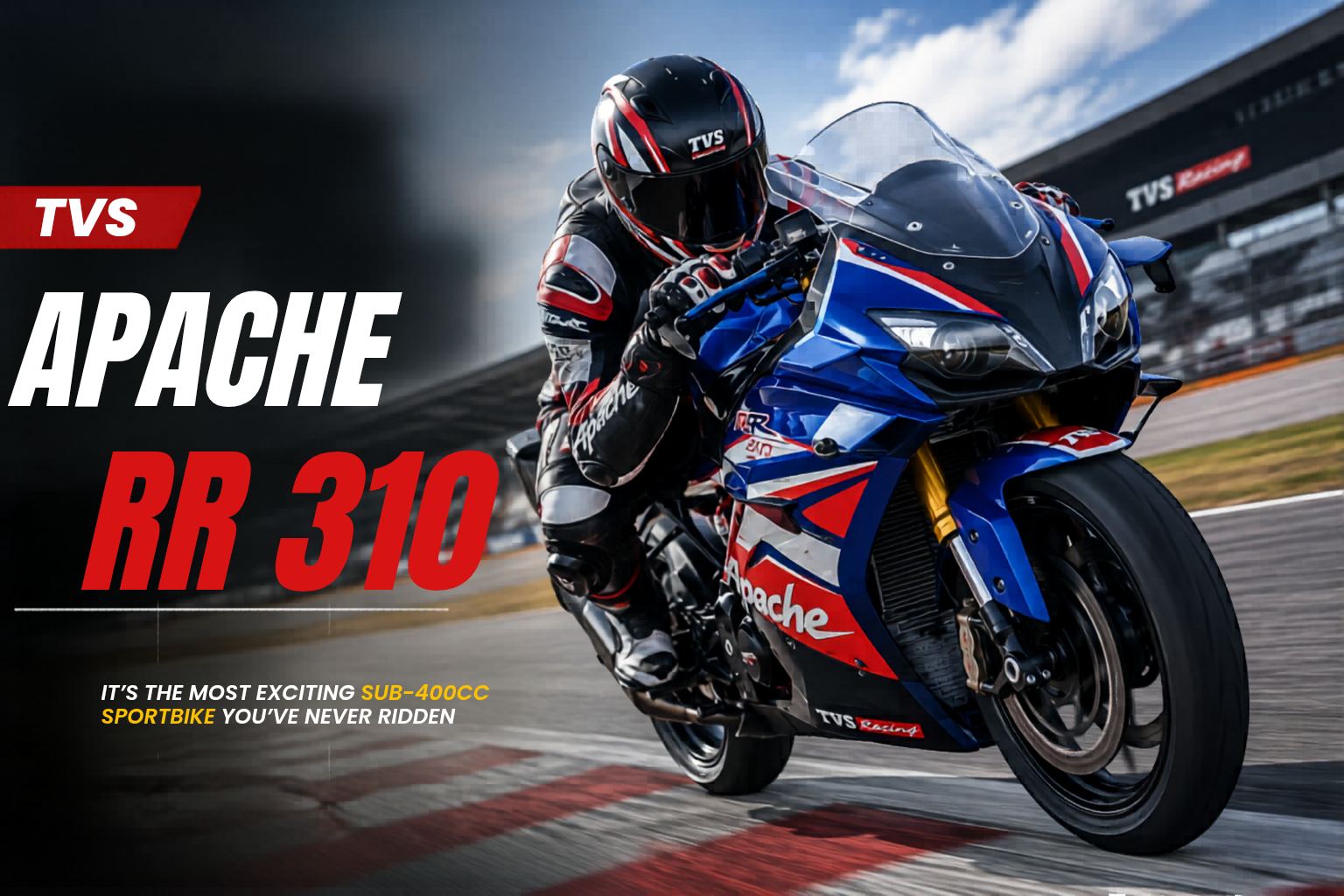
Sagar Most conversations about sub-400cc sportbikes in the United States start and finish with the same few names. The Kawasaki Ninja 400. The KTM RC 390. The Yamaha YZF-R3. These are proven, well-distributed machines with strong dealer networks and long track records in the American market. They are genuinely good motorcycles. But there is a fourth machine in this conversation — one that most American riders have never seen in person, let alone ridden — that, on pure specification and engineering merit, belongs right at the top of this class.
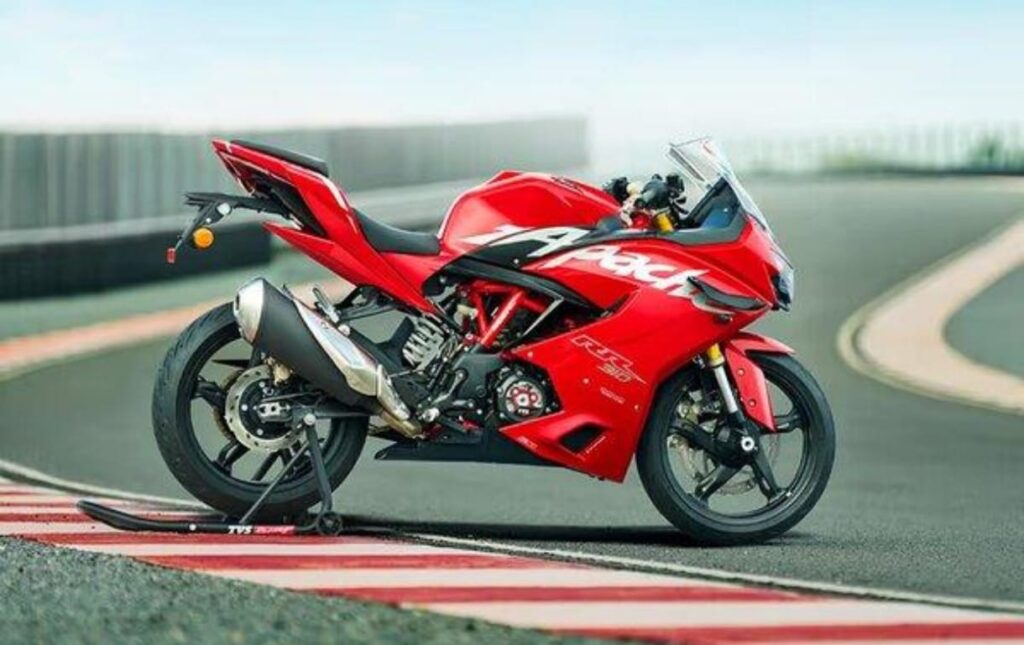
The TVS Apache RR 310 has been winning championships in Asia, setting lap records on circuits like Thailand’s Chang International, and quietly accumulating a technology package that its better-known rivals struggle to match on paper. Built through a genuine engineering collaboration with BMW Motorrad — the same partnership that produced the BMW G 310 R and G 310 GS — the Apache RR 310 is the product of two very different engineering cultures working toward the same goal: the most accomplished, most versatile fully-faired sportbike you can buy under the 400cc threshold.
This isn’t a bike that’s impressive for its price point. It’s a bike that’s impressive by any standard. Here are twelve reasons why.
Built With BMW Motorrad — What That Partnership Actually Means
The TVS-BMW Motorrad partnership is a collaboration that gets mentioned frequently in Apache RR 310 coverage but rarely explained properly. Understanding it changes how you think about this motorcycle. In 2013, TVS Motor Company — one of India’s largest motorcycle manufacturers, based in Hosur, Tamil Nadu — entered a technical collaboration agreement with BMW Motorrad, the Munich-based motorcycle division of the BMW Group. The partnership was built around a shared platform for sub-400cc motorcycles, with the intention that both companies would develop their own products from a common engineering foundation.
The result of that collaboration was a 312.2cc single-cylinder engine architecture — reverse-inclined, liquid-cooled, DOHC, four-valve — that became the basis for both the BMW G 310 R (a naked roadster) and the TVS Apache RR 310 (a fully-faired supersport). Both engines share the same fundamental architecture, the same bore and stroke (80mm × 62.1mm), and the same underlying engineering philosophy. They were not one company licensing technology from the other; they were two companies engineering together, with each bringing specific expertise to the table.
For TVS, the partnership gave access to BMW Motorrad’s deep expertise in engine refinement, vibration management, and performance calibration. For BMW, it provided access to TVS’s manufacturing infrastructure and knowledge of developing-market rider requirements. The Apache RR 310 was and still is a significant milestone for TVS as it was a bold move into the premium supersport segment — and the BMW engineering DNA it carries is not a marketing claim. It is a measurable, verifiable technical reality embedded in every dimension of the engine.
Platform context: The Apache RR 310 is based on the same platform used for the BMW G 310 R and G 310 GS. Although the G 310 models have been withdrawn from certain markets, TVS is continuing to develop its own model series, and the 2025 Apache RR 310 represents the most advanced iteration of that shared platform yet produced by either company.
The Reverse-Inclined Cylinder — Why This Engineering Choice Matters More Than You Think
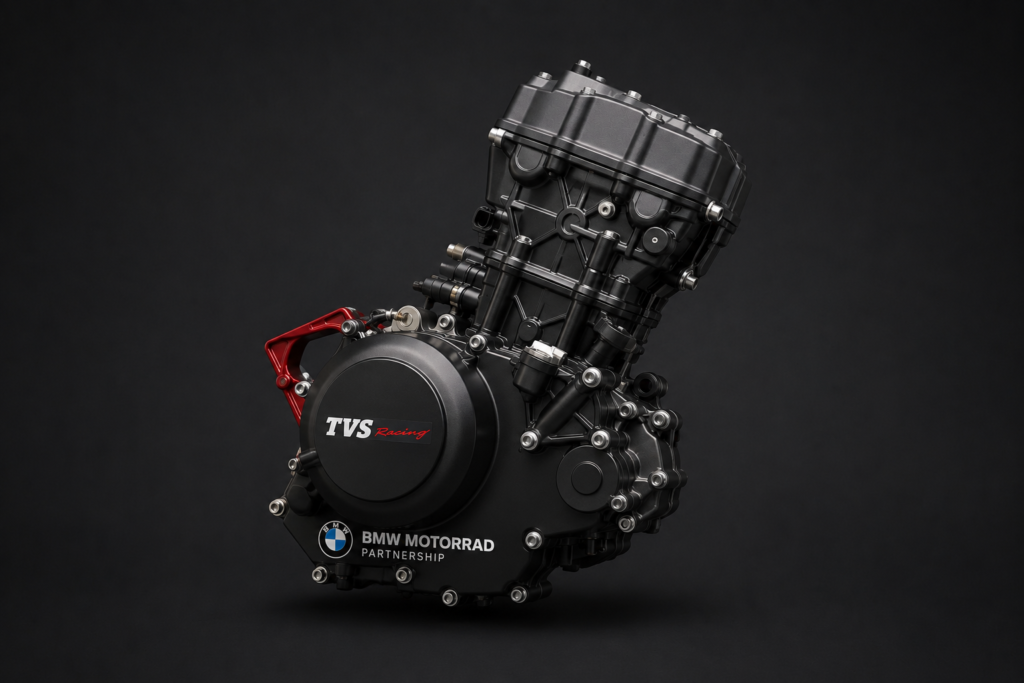
The 312.2cc engine in the Apache RR 310 has a configuration that isn’t immediately obvious from the spec sheet: the cylinder is reverse-inclined, meaning it tilts backward rather than forward. This isn’t an aesthetic choice or an engineering quirk — it’s a deliberate decision with specific performance consequences that distinguish the Apache RR 310 from every other motorcycle in its class.
In a conventional engine layout, the cylinder tilts forward, toward the front of the motorcycle. The combustion gases exit through an exhaust pipe that runs under the engine and toward the rear. In the Apache RR 310’s reverse-inclined layout, the cylinder tilts backward — intake ports face forward, exhaust exits at the rear. This arrangement shifts the engine’s mass toward the centre and rear of the motorcycle rather than concentrating it at the front. The practical result is a lower, more centralised centre of gravity that improves handling agility and cornering stability. Reverse inclined means the engine is tilted backward, allowing for a longer swingarm and shorter wheelbase resulting in excellent stability and flickability.
The engine itself is a marvel of thermal efficiency for its displacement. The 80mm bore and 62.1mm stroke give an oversquare ratio of 1.29 — favouring high-revving performance over low-end torque. The Bosch closed-loop RT-FI fuel injection system with electronic throttle control allows precise fuel delivery across all four ride modes. In Sport and Track modes, the engine produces its full 38 PS at 9,800 rpm and 29 Nm at 7,900 rpm. In Urban and Rain modes, output is softened to 25.8 PS and 26.5 Nm — a genuine power reduction that makes the bike meaningfully more accessible in heavy traffic or wet conditions.
Displacement: 312.2ccBore × Stroke: 80mm × 62.1mmPeak Power: 38 PS @ 9,800 rpmPeak Torque: 29 Nm @ 7,900 rpmTop Speed: 164 km/h (102 mph)Compression: 12.17:1
One reviewer who spent significant time with the 2025 model described the engine character this way: “The engine is so smooth and refined that even at redline there’s no unwanted sound.” That refinement is not accidental — it’s the product of BMW Motorrad’s vibration engineering applied to a platform that both companies know intimately.
215 km/h at Chang International Circuit — The ARRC Race Heritage Behind Every RR 310
The “RR” in Apache RR 310 stands for Race Replica — a designation that TVS takes seriously enough to back it with a full factory racing programme. TVS Racing has been running Apache RR 310-based machines in the Asia Road Racing Championship (ARRC), Asia’s premier FIM-sanctioned motorcycle road racing series, since the bike’s launch. What they’ve achieved with the race version of this platform tells you a great deal about the engineering potential underneath the road-going motorcycle’s fairing.
On the racetrack, TVS Racing used the RR 310 as a base to build their record-breaking ARRC race machine which achieved a top speed of 215.90 km/h while completing a lap of the Chang International Circuit in Thailand in one minute and 49.742 seconds. To put that in context: Chang International Circuit is a 4.554 km FIA Grade 1 circuit — the same class of venue that hosts Formula 1, MotoGP, and World Superbike races. A 312cc single-cylinder motorcycle lapping that circuit at 1:49 is a remarkable achievement that speaks directly to the chassis and engine quality underlying the production bike.
The 2025 ARRC season features 15 elite riders from 12 countries competing in the TVS Asia One Make Championship — a global competition built entirely around the Apache RR 310 platform. For the 2025 race-spec machine, TVS engineering made specific updates: a more compact and lightweight chassis for improved handling, modified gear ratios for quicker corner exits, and an updated rear suspension geometry. In 2024, Sarthak Chavan from India made history as the first Indian rider to secure a top-three international finish in the ARRC. In that same season, Japan’s Hiroki Ono won the championship title — in a TVS Apache RR 310.
Race-to-road technology transfer: The aerodynamic winglets now fitted to the production 2025 Apache RR 310, the suspension calibration, the chassis stiffness tuning, and the high-rev engine mapping all trace their development directly to the ARRC race programme. This is genuine motorsport heritage, not retroactive marketing.
Aerodynamic Winglets Generating 3 kg of Downforce — on a 312cc Motorcycle
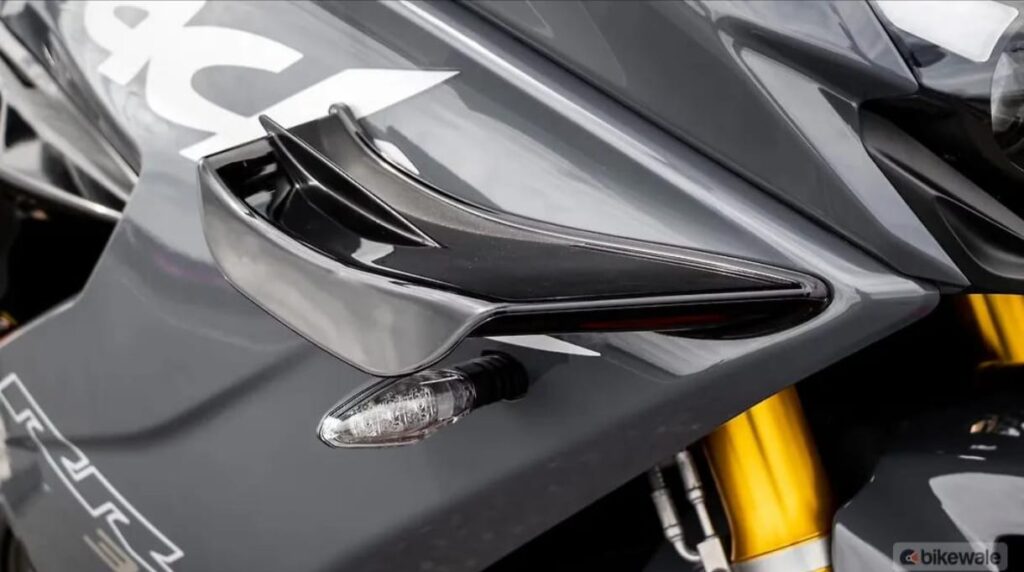
The most visually dramatic change to the 2025 Apache RR 310 is the addition of aerodynamic winglets to the fairing. These are not decorative elements or styling exercises — they are functional aerodynamic devices that generate downforce, improving front-wheel stability at high speeds and during hard acceleration. The addition of winglets on the fairing is the most significant change to the motorcycle’s styling for 2025. TVS claims these aero elements are capable of delivering up to three kg of downforce.
Three kilograms might not sound like much in absolute terms, but on a motorcycle weighing 174 kg, additional front-end load at speed makes a measurable difference to stability and steering feel. In MotoGP, where aerodynamic downforce is now a primary development area, teams measure the benefit of downforce in fractions of a kilogram and fight for every small gain. TVS bringing this technology to a 312cc production motorcycle — a category where aerodynamics are almost never considered — is an engineering statement about how seriously they take the RR 310’s performance credentials.
The winglet design draws visual and technical inspiration from TVS’s ARRC race machines, which have run aerodynamic packages in competition for several seasons. The production versions are necessarily simplified compared to the race units but maintain the functional principle: shaped surfaces generating downforce that pushes the front of the motorcycle toward the tarmac under the aerodynamic loads experienced at the bike’s top speed range. Combined with the reverse-inclined engine’s inherent mass centralisation, the 2025 Apache RR 310 has better front-end stability at speed than any previous generation of the model.
Another visual element unique to the 2025 model is the transparent clutch cover — a window into the working components of the engine that is both aesthetically interesting and practically meaningful. It signals to the rider that the internals are worth looking at, which they are: the slipper clutch mechanism visible through the cover is part of the package that makes the Apache RR 310’s aggressive downshifts controlled and safe.
five Ride Modes, IMU-Linked ABS, and a Full Electronics Suite That Changes Everything
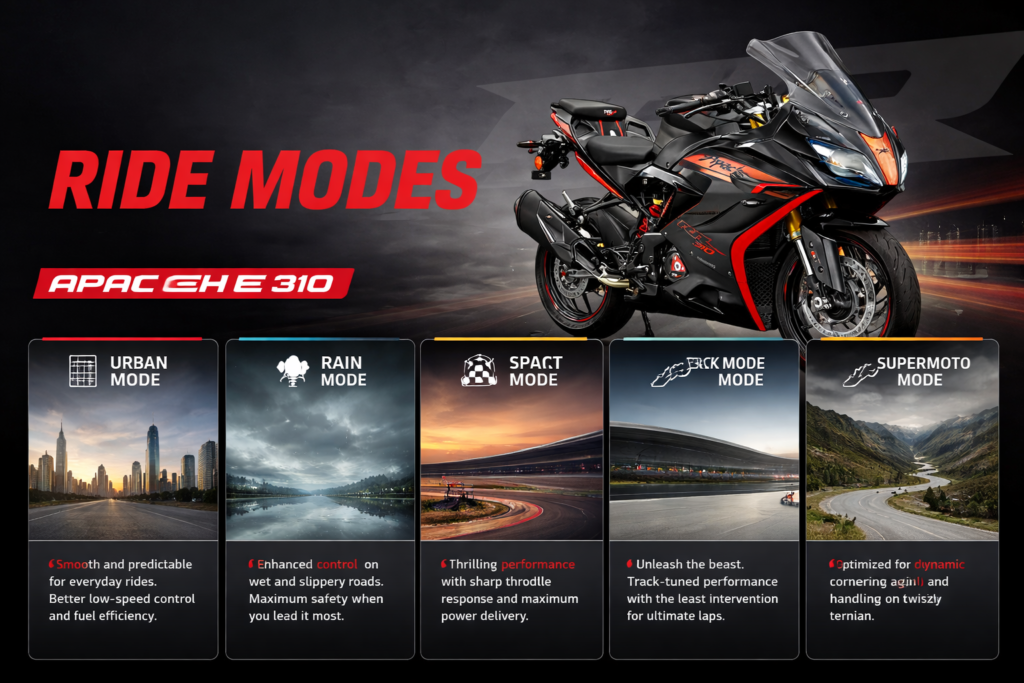
The Apache RR 310’s electronics package is one of the most comprehensive in the sub-400cc segment — and it’s not a comparison that requires careful qualification. The four ride modes — Urban, Rain, Sport, and Track — are not simply different throttle maps applied to the same base settings. They represent genuinely different calibrations of the engine management, ABS sensitivity, and traction control that alter the motorcycle’s fundamental character in each mode.
Urban
25.8 PS / 26.5 Nm. Softened throttle, early ABS. City riding and new rider confidence.
Rain
Gentled power, maximum ABS sensitivity, linear response. Built for wet tarmac safety.
Sport
38 PS / 29 Nm. Sharpened throttle map. Highway and canyon riding sweet spot.
Track
Full 38 PS, race-calibrated ABS and TC. Minimum intervention. For circuit use.
The ABS system uses a six-axis IMU that reads lean angle, pitch, yaw, and acceleration continuously. This means the ABS calibration in each mode is not just a different intervention threshold — it’s a different calculation based on the bike’s actual dynamic state. In Track mode, the system understands that the motorcycle may be leaned at an angle and adjusts braking pressure accordingly, preventing the flat-spotted braking behaviour that conventional ABS systems can produce when activated mid-corner.
Launch control is now available from the base variant — not just the higher-spec BTO options. This is a meaningful democratisation of a technology that typically sits behind option packages or appears only on top-spec trims. The launch control system holds the engine at an optimised RPM while the rider releases the clutch, maximising traction off the line without triggering the traction control unnecessarily. Cornering Drag Torque Control (RT-DSC) works in conjunction with the slipper clutch during aggressive downshifts, preventing rear-wheel hop when braking hard into corners. You can aggressively downshift and the rear wheel won’t skid. Gear shifting is instant and hesitation-free.
Bi-Directional Quickshifter Standard — Clutchless Shifts in Both Directions
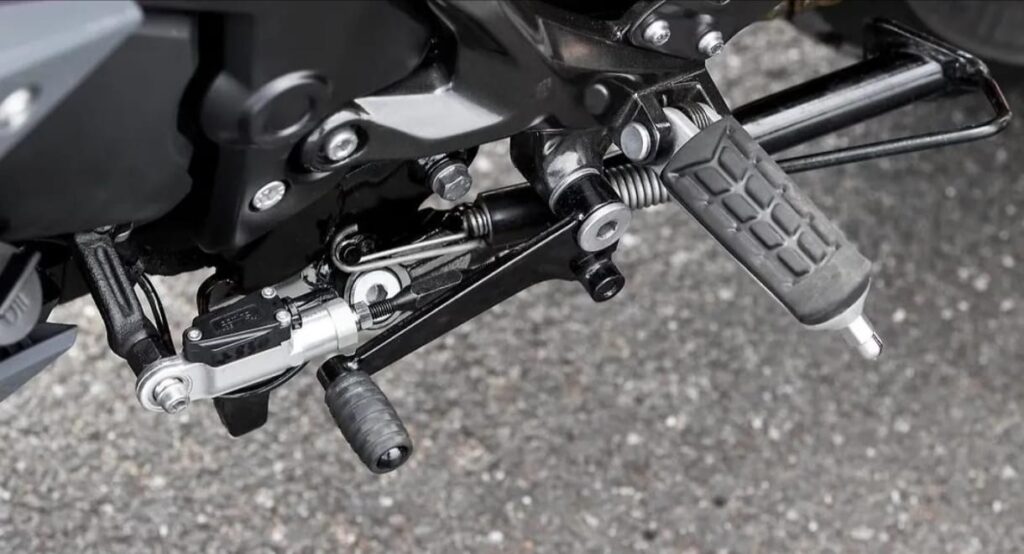
A bi-directional quickshifter is a feature that most motorcycles below $15,000 don’t offer. The Apache RR 310 now comes with one as standard on its upper variants and as a BTO option on the base model. This matters because the experience of riding a motorcycle with a quickshifter and autoblipper is fundamentally different from one without — and not in a subtle way.
Upshifting without a quickshifter requires closing the throttle, disengaging the clutch, changing gear, re-engaging the clutch, and opening the throttle again. At moderate speeds this is second nature; at high speeds and high revs, particularly on a track, each clutch operation introduces a moment where the bike is not under full acceleration — a moment that adds up over a lap. The quickshifter eliminates those moments for upshifts by cutting the ignition for a fraction of a second as the lever is actuated, allowing the gear to engage without clutch input. The result is faster, cleaner upshifts that keep the motorcycle under sustained acceleration.
The autoblipper handles downshifts. On a standard motorcycle, downshifting under braking requires “blipping” the throttle to match engine revs to the incoming gear ratio before engaging the clutch — a skill that takes time to develop and demands attention when you’re simultaneously braking hard. The autoblipper performs this rev-match automatically when the lever is pulled, regardless of whether the clutch is used. Combined with the RT-DSC system, the result is that aggressive downshifting into corners — the kind of braking that sends less-equipped motorcycles into rear-wheel instability — becomes predictable and controlled. The 6-speed gearbox is well-matched to the engine’s rev characteristics, with close ratios in the middle of the range for the high-revving sport use the bike was designed for.
Aluminium Trellis Frame, KYB Inverted Forks, and a Chassis Built for the Track
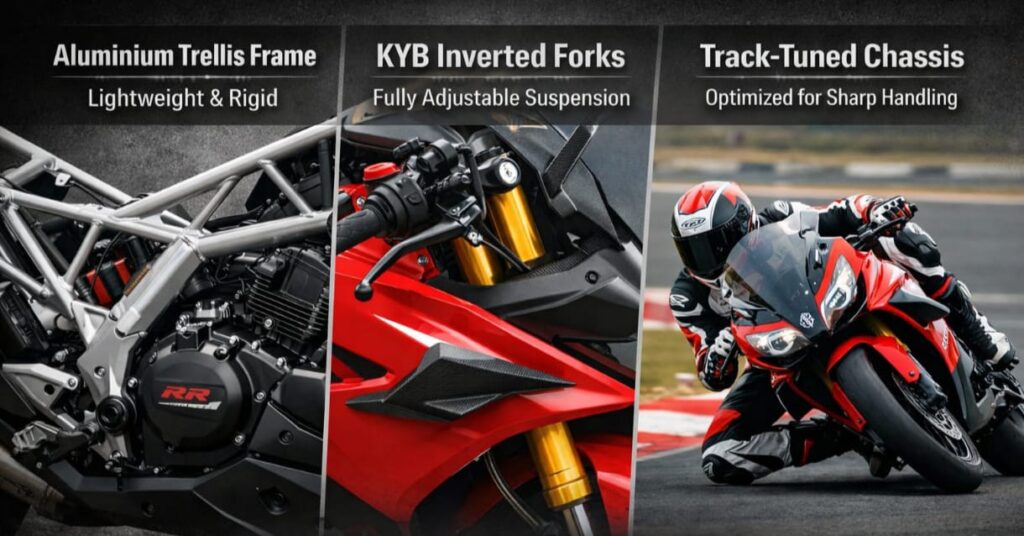
The Apache RR 310’s chassis architecture begins with an aluminium trellis frame — a choice that prioritises both rigidity and weight savings over the simpler steel perimeter or diamond frames found on most budget sportbikes. An aluminium trellis provides high torsional stiffness at the steering head (where rigidity most directly affects handling precision) while allowing the frame tubes themselves to flex slightly in predictable ways that communicate road surface information to the rider. This is the same basic principle that underpins the chassis design of MotoGP machinery, scaled appropriately for a 312cc street bike.
Front suspension is handled by KYB inverted cartridge telescopic forks — upside-down units from one of the world’s leading suspension manufacturers, at a price point where many competitors fit conventional telescopic forks of significantly lower specification. Inverted forks have the larger diameter tube at the top (attached to the triple clamp) and the smaller tube at the bottom (attached to the wheel). This reduces unsprung mass — the weight that moves with the wheel rather than with the chassis — which improves the wheel’s ability to follow road surface irregularities and maintain contact with the tarmac. Better contact means better feedback, better braking, and better cornering grip.
The BTO Dynamic Kit option adds fully adjustable front and rear suspension — 20-step rebound damping on the left fork, 20-step compression damping on the right, and 15mm of preload adjustment on the rear. For riders who want to set up the bike for their specific weight, track surface, or riding style, this option transforms the RR 310 from a well-equipped stock sportbike into a genuinely tunable machine.
- Front: KYB inverted cartridge telescopic fork
- 41mm diameter, 140mm travel. KYB is a Tier 1 OEM supplier to MotoGP and World Superbike teams. Having KYB hardware on a 312cc production bike is unusual and reflects the RR 310’s genuine performance intent.
- Rear: 2-arm aluminium die-cast swingarm with mono tube floating piston gas-assisted shock
- The aluminium swingarm saves weight compared to steel alternatives while providing the rigidity needed for the high-grip cornering the RR 310’s chassis and tyres encourage. The gas-assisted shock provides progressive damping across the suspension travel.
- Brakes: 300mm petal disc (front) with four-piston radial caliper, 240mm petal disc (rear)
- A four-piston radial-mount caliper on a sub-400cc motorcycle is a specification associated with motorcycles well above this segment. Radial mounting increases braking stiffness compared to axial mounting, improving both initial bite and modulation under hard braking.
- Wheelbase: 1,365mm (53.7 inches
- )A shorter wheelbase than many rivals, contributing to the flickability that riders describe as one of the RR 310’s most appealing cornering characteristics. The bike changes direction quickly and precisely without the slow, ponderous feel of longer-wheelbase alternatives.
Michelin Road 5 as Standard — The Tyre That Changes What the Bike Can Do
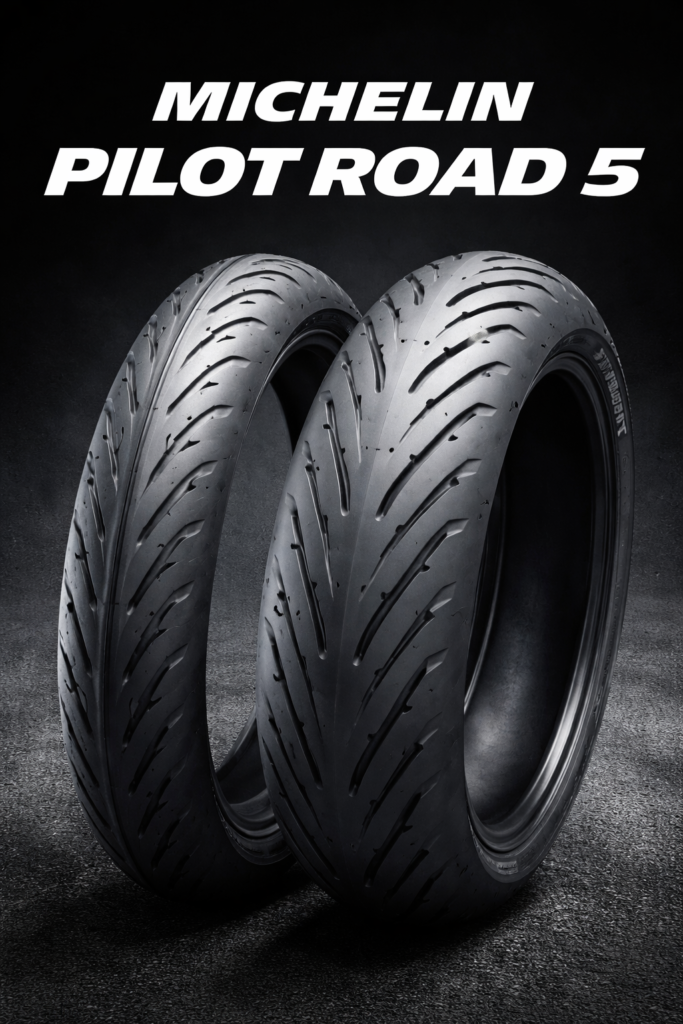
Standard tyre fitment is one of the most revealing indicators of a manufacturer’s attitude toward their product. When a manufacturer ships a performance motorcycle with genuinely premium rubber as standard — rather than adequate-but-unremarkable tyres that buyers swap out immediately — it signals that the whole package has been designed to perform together. The Apache RR 310 ships with Michelin Road 5 tyres as standard fitment. In the sub-400cc class, this is exceptional.
The Michelin Road 5 is a dual-compound sport-touring tyre. The centre tread compound is harder, designed for longevity and straight-line efficiency. The shoulder compound is softer, designed to maximise cornering grip when the tyre is loaded through a lean angle. This means the tyre doesn’t force a compromise between daily use mileage and corner-entry confidence — it provides both, in the same tyre, by using different materials where each is needed.
The practical significance of this fitment becomes clear when you consider what it replaces. At this price and displacement level, most competitors ship with stock-branded tyres of significantly lower performance. Riders who buy those motorcycles and want to exploit the chassis’s cornering capability often spend an additional $200–$400 replacing the standard tyres immediately after purchase. Apache RR 310 buyers start with a tyre that doesn’t need to be replaced to unlock the chassis.
From the clear clutch cover to launch control and cornering drag torque control, this motorcycle packs in features that even bikes double its price often lack. The Michelin fitment is a significant part of that premium-versus-price equation — one of the clearest demonstrations that the Apache RR 310 was built to perform, not just to impress on a spec sheet.
A 5-Inch TFT Display, Bluetooth Connectivity, and Full Instrument Intelligence
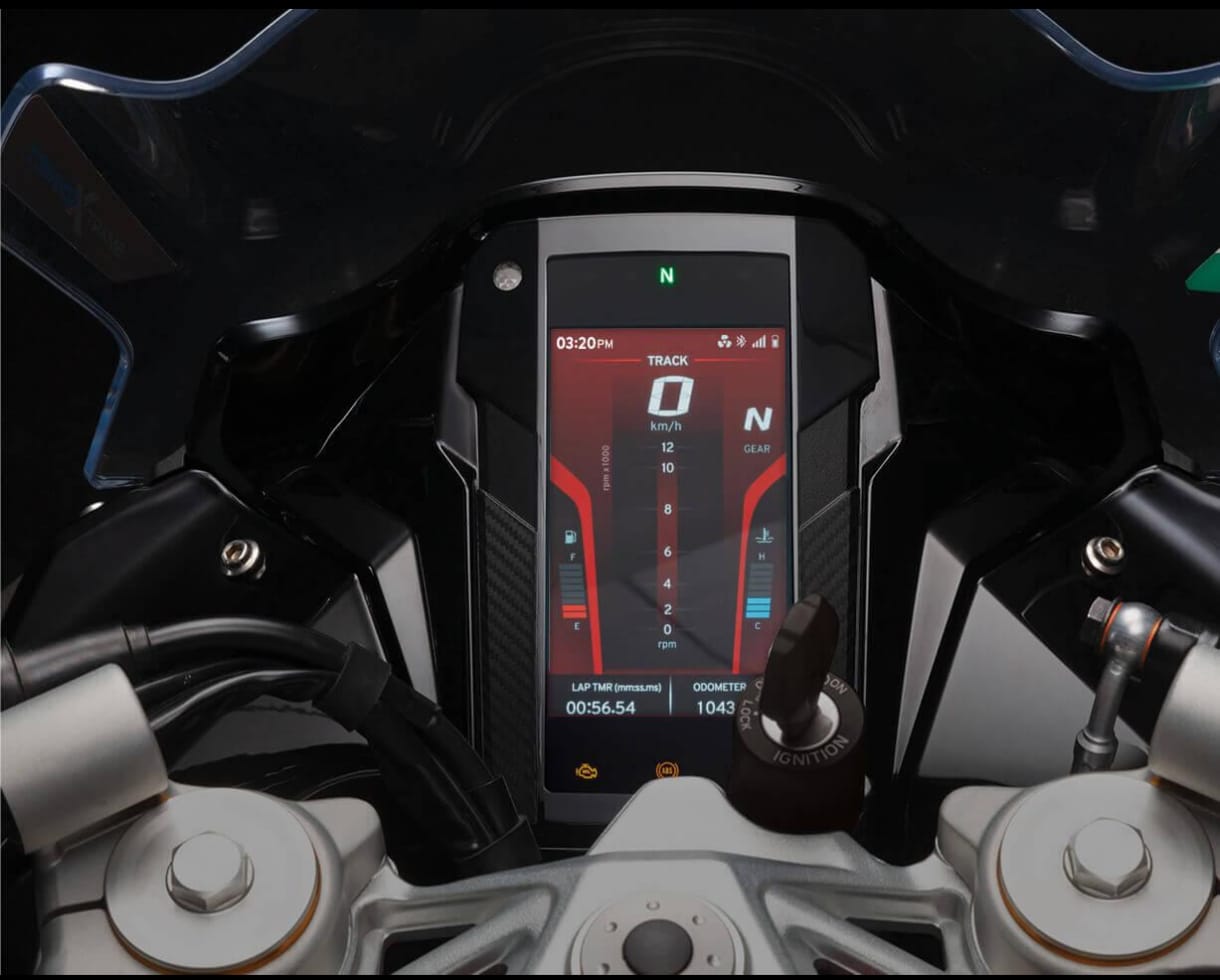
The instrument cluster on the 2025 Apache RR 310 is a fully digital 5-inch TFT display that connects to the rider’s smartphone via Bluetooth through the TVS ARIVE app. What the display shows, and what the app enables, goes well beyond what most riders in this segment are used to dealing with at any price point.
The display shows the full complement of standard riding information — speed, gear position, RPM, fuel level, odometer, trip meters, and clock — alongside real-time ride telemetry that most riders in this class have never had access to. In Track mode, the display prioritises the information most relevant to circuit performance. In Urban mode, it shifts emphasis toward navigation and connectivity. The system can display turn-by-turn navigation directions from the connected app, incoming call notifications, and text message alerts — keeping the rider’s eyes on the road rather than on a phone mounted to the bars.
The ARIVE app integration also allows access to the Built-To-Order platform, where riders can configure BTO kit options, monitor service intervals, and access performance data recorded from their rides. This data capability is unusual in the sub-400cc segment and reflects TVS’s understanding that the riders buying a performance-oriented motorcycle like the Apache RR 310 are interested in understanding their riding — not just performing it.
Cruise control standard: The 2025 Apache RR 310 includes cruise control as standard — a feature almost universally absent in its sub-400cc peer group. For riders who use the RR 310 for longer highway stretches as well as sport riding and track days, the ability to set a cruising speed and rest their right hand is a genuine quality-of-life improvement on a motorcycle with sportier-than-average ergonomics.
Built-To-Order Before It Even Leaves the Factory — a True First in This Segment
TVS’s Built-To-Order platform is one of the most genuinely unusual features of the Apache RR 310 ownership proposition. Instead of choosing from dealer stock — accepting whatever configuration a salesperson has on the floor — RR 310 buyers can configure their motorcycle online before it is assembled, selecting from a menu of performance and cosmetic options that are fitted at the factory rather than added as aftermarket modifications. No other motorcycle manufacturer in the sub-400cc segment offers this.
The 2025 Apache RR 310 is available in two standard variants with three BTO option packages: the Dynamic Kit, the Dynamic Pro Kit, and the Sepang Blue Race Replica paintwork. The Sepang Blue livery is based directly on the ARRC racing motorcycle’s colour scheme — for riders who want a production motorcycle that looks like it just came out of a racing paddock, it is the obvious choice. The Dynamic Kit adds the fully adjustable suspension described in Item 7. The Dynamic Pro Kit adds the bi-directional quickshifter and autoblipper, a sportier riding position with adjustable rear-set footpegs, and track-focused suspension calibration.
- Dynamic Kit — adjustable suspension upgrade
- Fully adjustable KYB forks with 20-step rebound and compression damping plus 15mm preload adjustment. For riders who want to tune their suspension precisely for their weight, track surface, or personal preference. Transforms the RR 310 from a well-spec’d stock sportbike into a genuinely tunable machine.
- Dynamic Pro Kit — track-ready performance package
- Adds the bi-directional quickshifter, track-calibrated suspension settings, and adjustable footpeg positioning. Designed for riders who plan regular track days and want the motorcycle set up for circuit use rather than street use. Factory-fitted, so the calibration is tested and validated rather than improvised.
- Sepang Blue Race Replica — ARRC racing livery
- The paint scheme used by TVS Racing in the Asia Road Racing Championship, available on production bikes as a factory option. Available only through the BTO platform — you cannot walk into a dealer and buy it off the showroom floor. The exclusivity of the livery is part of the point.
For American riders purchasing an Apache RR 310 through international channels, the BTO platform means you can specify exactly the bike you want — down to the suspension calibration and shift mechanism — rather than accepting a compromise imposed by dealer inventory. In a segment where most manufacturers offer two or three variants with fixed specifications, this level of customisation is genuinely unusual.
Apache RR 310 vs Ninja 400, KTM RC 390, and Yamaha R3 — An Honest Assessment
The sub-400cc fully-faired sportbike segment is genuinely competitive in 2025, and an honest assessment of the Apache RR 310 requires acknowledging what its rivals do well alongside what the TVS does better. The Kawasaki Ninja 400, KTM RC 390, and Yamaha YZF-R3 are all strong motorcycles with legitimate claims to being segment leaders in specific areas. Understanding the differences makes you a better-informed buyer regardless of which bike you ultimately choose.
The Kawasaki Ninja 400 (now succeeded in the US market by the Ninja 500 for 2024) was widely considered the all-around sub-400cc leader for several years. Its 399cc parallel-twin engine is smoother than any single-cylinder and produces around 45-49 hp — meaningfully more than the RR 310’s 38 PS. The Ninja 400’s twin-cylinder character also makes it less demanding at low speeds in traffic and more tractable in real-world conditions. The KTM RC 390 offers the most outright performance of the dedicated sportbikes at 43.5 PS from its 375cc single, with a sharp, aggressive character that rewards experienced riders. The Yamaha R3’s 321cc parallel-twin is the smoothest-revving option in the group.
Where the Apache RR 310 wins this comparison is not in raw power — it doesn’t claim to. It wins in electronics depth (four ride modes with IMU-linked ABS, launch control, and RT-DSC versus the Ninja 400’s basic ABS and traction control, and the R3’s ABS-only setup), in tyre quality (Michelin Road 5 standard versus MRF or Bridgestone depending on market), in aerodynamics (functional winglets versus none), and in the completeness of the technology package for the money.
The honest conclusion from this comparison: the Apache RR 310 is not the right choice for a rider who wants the most displacement, the most outright power, or the smoothest low-speed character. The KTM RC 390 is the pick for raw performance. The Yamaha R3 is the pick for twin-cylinder smoothness and reliability track record. The Ninja 400 (or its successor) is the pick for all-around versatility. The Apache RR 310 is the pick for the rider who wants the deepest electronics package, the most track-relevant technology, and the most complete feature set — particularly for track day use where launch control, a quickshifter, and IMU-linked ABS are meaningfully useful tools rather than marketing checkboxes.
| SPECIFICATION | APACHE RR 310 | KTM RC 390 | YAMAHA R3 | NINJA 400 |
|---|---|---|---|---|
| Engine | 312cc Single | 375cc Single | 321cc Twin | 399cc Twin |
| Peak Power | 38 PS | 43.5 PS | 42 PS | 45–49 hp |
| Ride Modes | 4 (+ IMU ABS) | 3 | None | 2 |
| Quickshifter | Bi-directional | Optional | No | No |
| Launch Control | Standard | No | No | No |
| Aerodynamic Winglets | Yes (3 kg DF) | No | No | No |
| Standard Tyres | Michelin Road 5 | Maxxis | Bridgestone | Dunlop |
| Weight (wet) | 174 kg | 172 kg | 170 kg | 167 kg |
| Int’l Price (approx) | ~$7,200 | ~$6,400 | ~$5,499 | Ninja 500 now |
Why the US Market Doesn’t Have It Yet — and Why That’s About to Change
The question American riders ask most often about the Apache RR 310 is this: why can’t I buy one here? The answer is straightforward and, for American enthusiasts, increasingly frustrating: TVS has not yet pursued US market EPA/DOT certification for the Apache RR 310. Official US distribution has not been confirmed. The bike is currently sold primarily in India, with international availability in select markets including parts of Europe and Southeast Asia.
The reasoning behind the delay is not product quality — the Apache RR 310’s engineering absolutely meets the standard required for US market entry. The reasons are strategic: TVS is a large company in India (selling 14 lakh-plus bikes and scooters in a single quarter in 2025), but its international distribution infrastructure is still developing. The European market, where the bike’s price-performance ratio is already attracting attention from motorcycle publications, is the logical stepping stone before North America. Expansion outside of Asia has not yet been confirmed, but appears to be a logical step in view of the high-quality equipment and the attractive price-performance ratio. The concept is convincing: a lightweight sports bike with modern technology, individual options and a racing look — a combination that could find favour in North America, especially in the entry-level segment below 400cc.
For American riders who want an Apache RR 310 now, grey-market import is technically possible but practically complex — EPA and DOT compliance requirements make importing and registering a non-compliant motorcycle in the US a significant legal and logistical undertaking. The more practical path for most riders is to wait, watch TVS’s international expansion, and be ready when official US distribution arrives.
The wait is likely to be worth it. At an international price of approximately $7,200 USD, the Apache RR 310 with its full 2025 specification would represent extraordinary value in the American market. A bi-directional quickshifter, launch control, IMU-linked cornering ABS, aerodynamic winglets, Michelin tyres, and a BMW-co-developed engine — at $7,200 — would make it one of the most technically complete motorcycles available at any price point in the sub-400cc segment, wherever it lands on the dealer floor.
The Bottom Line: Why the Apache RR 310 Deserves Your Attention
The Apache RR 310 is not the fastest sub-400cc sportbike available. It doesn’t have the most power in its class, the longest dealer network, or the most established brand recognition in the United States. What it has is a combination of engineering ambition, racing pedigree, and technology depth that is genuinely unusual in this segment — and a price point that makes everything it offers feel like it was priced for the wrong category.
BMW-co-developed engine. ARRC championship wins. Aerodynamic winglets on a 312cc machine. Michelin tyres standard. Launch control on the base variant. A bi-directional quickshifter and IMU-linked cornering ABS. At $7,200 USD. The Apache RR 310 is, by any objective measure, the most technology-dense motorcycle in the sub-400cc fully-faired segment.
For American riders who attend track days, who take the technical side of riding seriously, and who want a machine that grows with their skill level rather than capping it — the Apache RR 310 is the bike to watch. When TVS eventually brings it to US shores with full certification and dealer support, the conversation in this segment will need to be had all over again.
It’s powerful, refined, versatile, and simply fun to ride. Whether in traffic, on highways, or on twisty tracks — this bike excels. That is not a promotional claim from TVS’s marketing department. It’s the conclusion of riders who have spent time on this motorcycle in the real world. And it’s the conclusion that twelve thousand words of research, racing history, and specification analysis arrives at as well

 Sagar
Sagar