
 Sagar
Sagar If you’ve spent even ten minutes scrolling car forums or standing at a traffic signal in any Indian city, you’ve probably noticed the same SUV everywhere — the Hyundai Creta. It isn’t luck. Since its 2020 relaunch, this SUV has quietly become the benchmark that every rival gets measured against, and the facelifted version has only tightened that grip on the segment.
But “best-seller” doesn’t automatically mean “right for you.” So instead of another generic spec sheet, this listicle breaks down exactly why the Hyundai Creta keeps winning over Indian buyers — and where it genuinely falls short — so you can decide with your eyes open.
1. It Offers a Genuinely Wide Powertrain Choice
Most compact SUVs in India force you to compromise on engine choice. The Hyundai Creta doesn’t. It comes with three separate 1.5-litre engines — a naturally aspirated petrol, a turbo-petrol, and a diesel — each paired with different gearbox options depending on the variant you pick.
- 1.5L NA petrol: Best suited for city driving and daily commutes, offering a comfortable balance of power and mileage with manual or CVT options.
- 1.5L turbo-petrol: Delivers close to 160hp, making it the pick for buyers who want a bit of driving excitement, especially paired with the 7-speed DCT.
- 1.5L diesel: Built for highway-heavy users and long-distance drivers who rack up big monthly mileage and want stronger torque.
This kind of flexibility is rare at this price point, and it’s one of the clearest reasons the Hyundai Creta appeals to such a broad cross-section of Indian car buyers, from first-time SUV owners to seasoned highway travellers.
2. The Feature List Reads Like a Segment-Above Car
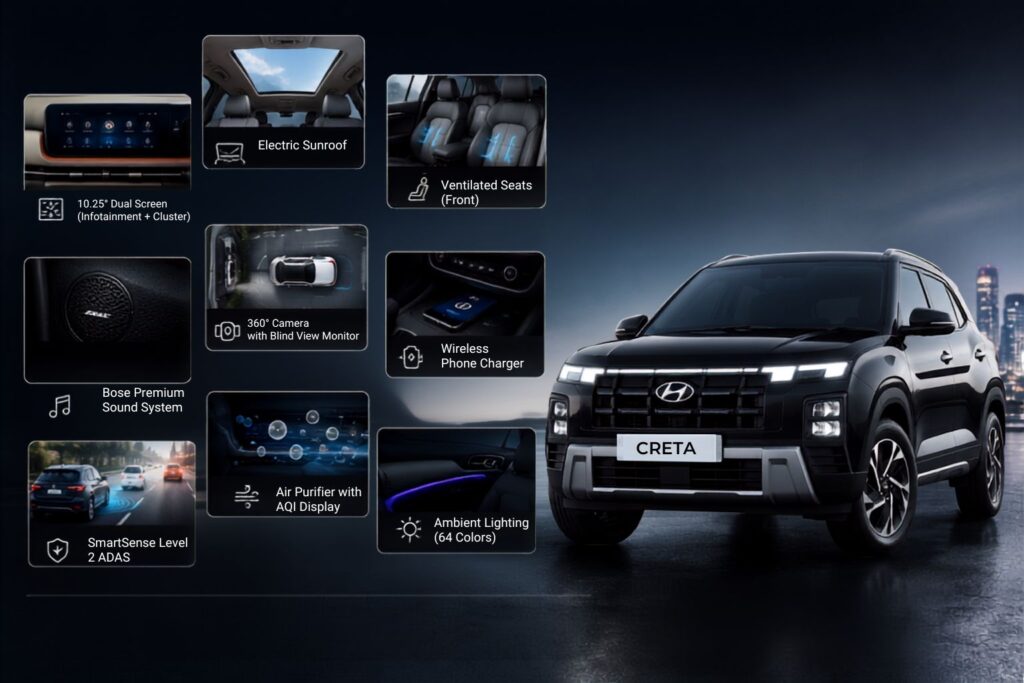
Walk into any Hyundai showroom and ask to sit inside a mid or top-spec variant, and you’ll understand instantly why it commands such loyalty. Depending on the variant, you get a panoramic sunroof, ventilated front seats, dual 10.25-inch screens, wireless charging, and a Bose sound system — features that used to be reserved for cars costing several lakhs more.
Even the connected car technology feels thoughtfully implemented rather than bolted on. You get remote engine start, geofencing alerts, and live vehicle tracking through Hyundai’s app, which genuinely comes in handy for families sharing one car.
3. Safety Tech That Actually Works on Indian Roads
Safety used to be an afterthought in this segment. Not anymore. It comes with six airbags across most trims, along with electronic stability control, hill-start assist, and a tyre pressure monitoring system as standard.
Higher variants step it up further with Hyundai SmartSense, a camera-and-radar-based Level 2 ADAS suite that includes lane-keeping assist, forward collision warning, blind-spot monitoring, and adaptive cruise control with stop-and-go functionality. What makes this stand out is that the system has been tuned specifically for Indian traffic patterns rather than being a lazy copy-paste from a global model, which matters a lot when you’re dealing with unpredictable lane discipline on highways.
4. Space and Comfort for the Whole Family

Indian buyers rarely purchase an SUV just for themselves — it’s almost always a family decision. This is where it earns its keep. The rear seat offers generous knee room, along with thoughtful touches like sunshades, adjustable headrests, and a reclining function on select variants.
- Rear AC vents and USB charging ports keep passengers comfortable on long trips, especially useful during Indian summers.
- Dual-zone climate control lets front and rear passengers set their own preferred temperature.
- Boot space, while not class-leading, is practical enough for weekend getaways, though large suitcases can be a tight fit.
For anyone cross-shopping compact SUVs for a family of four or five, this kind of everyday usability is often more valuable than raw horsepower numbers.
5. A Variant Ladder That Fits Almost Any Budget
One of the smartest things Hyundai has done with the Creta lineup is structuring it across multiple trims — E, EX, EX(O), S(O), SX, SX Premium, and special editions like Knight and King. This means you’re not stuck choosing between a stripped-down base model or an expensive flagship.
The S(O) variant, in particular, is widely considered the sweet spot. It brings in the panoramic sunroof, wireless charging, and six airbags without pushing you toward the priciest trims, making the Hyundai Creta accessible whether your budget is around ₹11 lakh or closer to ₹20 lakh.
6. Strong Resale Value and Trusted After-Sales Network
Buying a car in India isn’t just about the purchase price — it’s about what happens five years down the line. This SUV holds its resale value noticeably better than several competitors, largely because of consistent demand and Hyundai’s extensive service network across both metro and tier-2 cities.
Service costs are also reasonably predictable, and spare parts availability is rarely an issue, even in smaller towns. For buyers who see a car as a long-term investment rather than a short-term purchase, this reliability factor genuinely tips the scale in the Creta’s favour.
7. The N Line Adds a Sporty Personality

Not every buyer wants a purely practical SUV. For those chasing a bit more driving character, the Hyundai Creta N Line offers sharper styling, a firmer suspension setup, and access to the turbo-petrol engine with either a manual or DCT gearbox.
It’s priced at a premium over the standard lineup, but for enthusiasts who still need SUV practicality without switching to a full-blown performance car, it strikes a nice middle ground that few rivals genuinely match.
8. It Keeps Pace With a Fast-Evolving Segment
The compact SUV space in India has gotten aggressive, with rivals like the Kia Seltos, Volkswagen Taigun, Skoda Kushaq, and Maruti Grand Vitara all fighting for attention. Instead of resting on its sales numbers, the Hyundai Creta has continued adding updates — from the panoramic sunroof and connected LED tail lamps to expanded ADAS coverage — to stay relevant.
This constant refinement is exactly why the Hyundai Creta hasn’t been dethroned despite years of intensifying competition, and why it remains a default shortlist entry for most SUV buyers in India.
9. Real-World Mileage That Doesn’t Disappoint
Fuel efficiency is a non-negotiable for most Indian households, and the Hyundai Creta delivers reasonably well across its engine range, with mileage figures ranging from roughly 17 kmpl to nearly 22 kmpl depending on the powertrain and transmission.
- Diesel-manual variants tend to offer the best real-world efficiency for highway-heavy drivers.
- Petrol-CVT variants are tuned more for smooth city driving than outright fuel savings.
- Turbo-petrol variants trade some efficiency for noticeably stronger performance.
While it’s not the most frugal SUV in its class, the balance between performance and running costs remains sensible for most ownership patterns.
10. It’s Backed by a Brand Indians Genuinely Trust
Beyond the specifications, there’s an intangible factor at play — brand confidence. Hyundai has built nearly three decades of credibility in India, and that trust translates directly into strong Hyundai Creta sales month after month. Buyers aren’t just purchasing a set of features; they’re buying into a brand that has consistently delivered on reliability, service quality, and long-term ownership satisfaction.
That said, it’s worth being upfront about the trade-offs too. Some owners note that cabin plastics on lower variants feel a bit ordinary, automatic gearbox choices are limited on certain engine combinations, and the turbo engine is restricted to a single top variant. None of these are dealbreakers, but they’re worth checking during a test drive before you commit.
Frequently Asked Questions About the Hyundai Creta
Is the Hyundai Creta a good choice for a first-time SUV buyer?
Yes. Its range of variants, predictable running costs, and strong resale value make the Hyundai Creta a low-risk, high-confidence choice for someone buying their first SUV in India.
Which Hyundai Creta variant offers the best value for money?
The S(O) trim is widely recommended, since it balances essential features like the sunroof and safety kit without pushing buyers toward the most expensive variants.
Does the Hyundai Creta come with a diesel option?
Yes, the Hyundai Creta offers a 1.5-litre diesel engine, ideal for buyers who drive long distances regularly and prioritise torque and highway efficiency.
Is the Hyundai Creta safe for Indian roads?
It comes with six airbags, ESC, and available Level 2 ADAS features tuned specifically for Indian driving conditions, making it one of the safer options in its segment.
Final Thoughts
The Hyundai Creta didn’t become India’s favourite midsize SUV by accident. It earns that position through a genuinely wide powertrain lineup, a feature list that punches above its price bracket, dependable safety tech, and a variant structure that meets buyers wherever their budget sits. It isn’t flawless — no car is — but few SUVs manage to balance practicality, technology, and trust as consistently as the Hyundai Creta does. If you’re shortlisting compact SUVs in India this year, it deserves to be right at the top of your test-drive list.

 Sagar
Sagar
[…] Hyundai Creta Tata Punch Swift Dzire […]
swift dzire
[…] Hyundai Creta […]
[…] Hyundai Creta […]