 Sagar
Sagar Introduction: The Legend Gets an Electric Heartbeat
Some cars are just cars. And then there are names that carry the weight of entire eras. The Sierra is one of those names. When Tata Motors first introduced the original Sierra back in 1991, it was India’s first truly indigenous SUV — a boxy, glass-heavy adventure machine that carved out its own identity at a time when the Indian auto industry was still finding its footing. It was discontinued in 2000, but it was never forgotten.
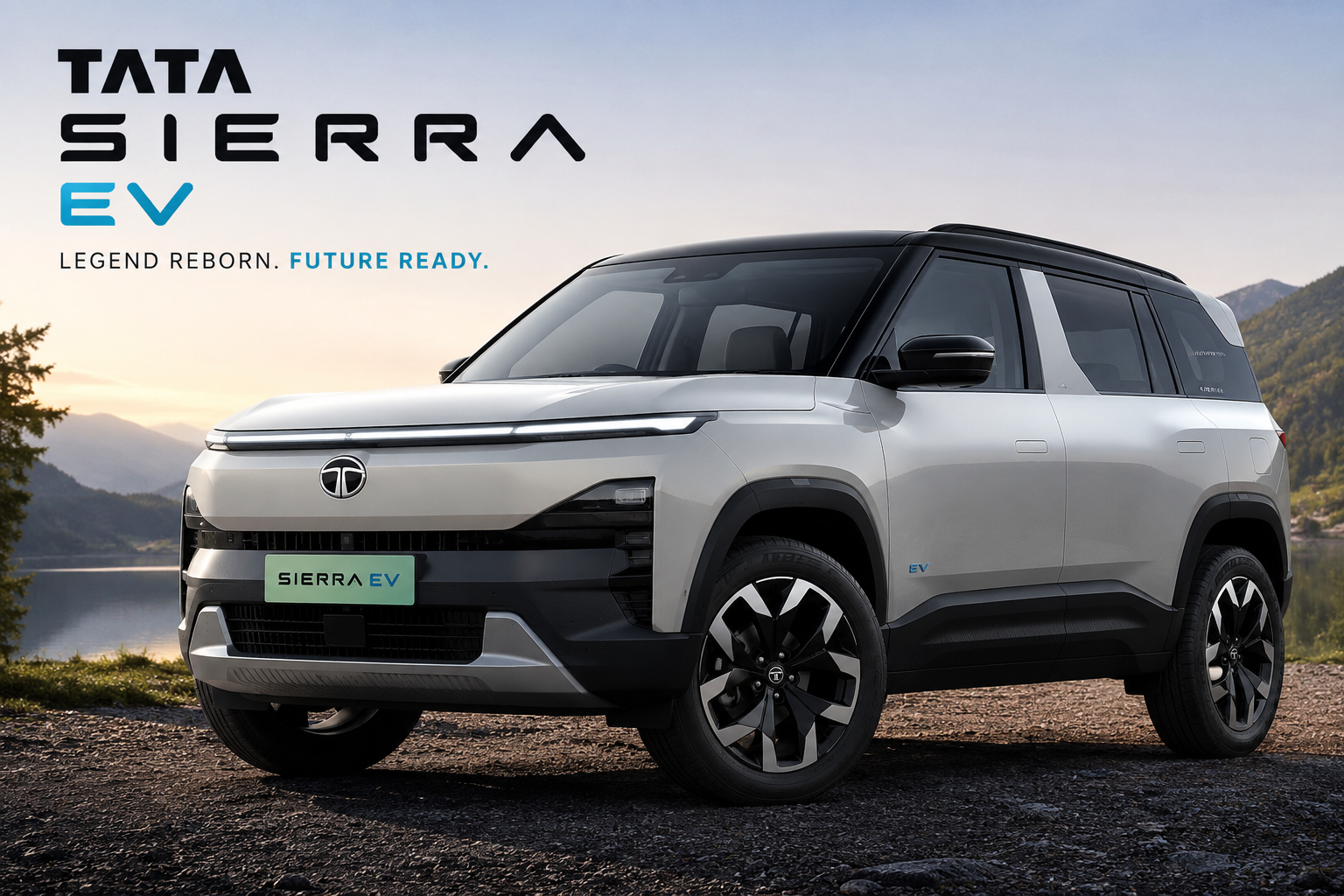
Now, more than two decades later, the Tata Sierra EV has arrived — not as a nostalgia act, but as a full-blooded, technology-first premium electric SUV that happens to carry forward a legendary name. Launched at ₹18.79 lakh (ex-showroom) on June 30, 2026, the Tata Sierra EV is built on Tata’s advanced Acti.EV+ architecture and represents the most ambitious electric vehicle the brand has produced outside of its commercial fleet operations.
For American car enthusiasts, the Tata Sierra EV is a fascinating study in what a domestic EV industry can produce when it combines genuine engineering ambition with smart market positioning. The Sierra EV isn’t available in US dealerships yet, but its spec sheet and positioning offer a compelling window into where global electric SUV development is heading — and how India’s automotive industry has evolved into a legitimate force in the EV space.
Whether you’re tracking global EV developments, part of the Indian diaspora following Tata’s progress, or simply someone who appreciates great engineering and exceptional value, the Tata Sierra EV has something remarkable to offer. Let’s break down exactly why this car deserves serious attention in 2026.
1. The Tata Sierra EV Arrives at a Price That Changes the Conversation
Price is always the first question, and the Tata Sierra EV answers it convincingly. The lineup starts at ₹18.79 lakh (ex-showroom) for the base Pure 63 RWD variant and extends to ₹25.99 lakh for the range-topping Empowered A 75 AWD. Converting to US dollars at current exchange rates, that’s approximately $22,500 to $31,200 — a pricing band that would be remarkable for an electric SUV with these specifications in any market.
For context, the Tata Sierra EV enters the Indian market in direct competition with the Hyundai Creta Electric, Mahindra BE 6, Maruti Suzuki e Vitara, and the MG ZS EV. The Creta Electric starts at ₹18.02 lakh and tops out at ₹24.70 lakh, while the Mahindra BE 6 starts at ₹18.90 lakh and stretches to ₹27.65 lakh. The Tata Sierra EV slots intelligently across that entire competitive range, offering a starting price competitive with the Creta Electric and a top-end price that undercuts the BE 6’s premium versions.
What makes the Tata Sierra EV price particularly compelling is what you get within it. At ₹18.79 lakh, you receive a 63 kWh battery pack, rear-wheel drive, six airbags as standard, Level 2 ADAS features, all-LED lighting, flush door handles, 18-inch diamond-cut alloy wheels, and the structural foundation of a genuinely premium electric SUV. This is not a stripped-down base model designed to manipulate the starting price headline — it’s a genuinely usable vehicle right from the bottom of the range.
2. Two Battery Packs, One Clear Philosophy: Range Without Compromise
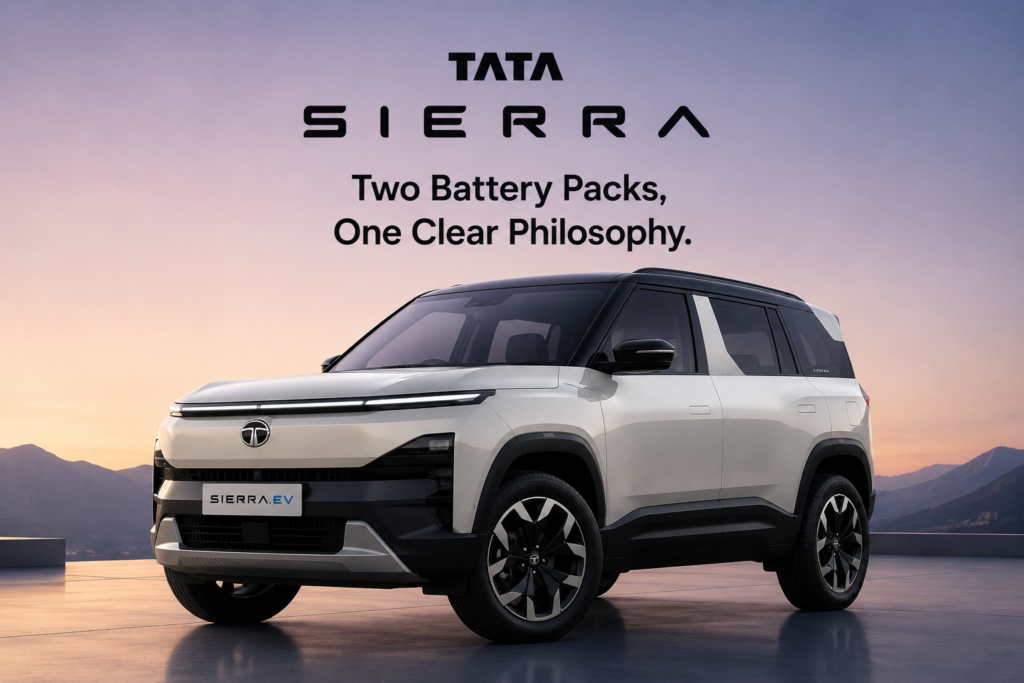
The Tata Sierra EV is offered with two battery configurations, and understanding the difference between them is essential to understanding what this car is trying to achieve.
The 63 kWh battery pack delivers a claimed MIDC range of 535 km to 565 km, with Tata’s more conservative C75 real-world estimate sitting between 440 and 460 km. For perspective, that real-world range is enough to drive from Chicago to Detroit and back without stopping to charge. The 63 kWh variant is paired with a rear-wheel-drive setup producing 253 bhp and 315 Nm of torque — figures that make this no leisurely cruiser.
The 75 kWh battery pack is where the Tata Sierra EV becomes genuinely extraordinary in the range conversation. The rear-wheel-drive 75 kWh variant delivers a claimed MIDC range of 665 km — and even Tata’s C75 real-world estimate sits between 510 and 530 km. That’s the kind of range figure that eliminates highway anxiety for good. You could drive from Los Angeles to San Francisco — a 381-mile journey — on a single charge with meaningful margin remaining. With the dual-motor AWD setup, the QWD variant offers a still-impressive 624 km MIDC-claimed range despite the additional mechanical complexity of the second motor.
This range leadership isn’t accidental. Tata has engineered the Sierra EV’s LFP (Lithium Iron Phosphate) battery chemistry specifically for longevity and thermal stability — characteristics that matter enormously in real-world ownership rather than just in specification comparisons. LFP cells degrade more slowly over time and are inherently more resistant to thermal runaway, which is the primary safety concern with EV batteries in high-temperature markets.
3. Fast Charging That Makes Long Trips Genuinely Practical
Range is only half of the EV usability equation. The other half is how quickly you can replenish that range when you need to, and the Tata Sierra EV’s charging capability is one of the most impressive aspects of the entire package.
The Sierra EV supports DC fast charging at up to 120 kW. At that rate, the 63 kWh battery charges from 20 to 80 percent in approximately 25 minutes. The 75 kWh battery takes about 26 minutes for the same 20 to 80 percent window. But the headline figure that truly matters for road trip usability is this: a 15-minute fast-charging session adds up to 263 km of certified range to the 75 kWh Tata Sierra EV. That’s not a typo — 263 km in 15 minutes. During a normal highway rest stop, you can add enough range to cover the next three hours of driving.
For home charging, the Sierra EV supports 7.2 kW AC fast charging, which brings the 63 kWh pack from 10 to 100 percent in approximately 8.9 hours and the 75 kWh pack in about 10.5 hours. Plugging in overnight means you start every morning with a full battery, regardless of how much of the previous day’s range you used.
Tata has also invested significantly in public charging infrastructure in India, with over 33,000 charging stations available to Sierra EV owners and 24×7 emergency charging support in five major cities. For EV buyers who worry about stranding scenarios, this network coverage substantially reduces that concern for urban and inter-city use.
4. The Quad Wheel Drive System: An EV With Real Off-Road Credentials
One of the most genuinely surprising aspects of the Tata Sierra EV is its off-road capability — not in the way manufacturers typically claim “off-road capability” by sticking a plastic skid plate on a front-wheel-drive crossover, but in a way that involves real engineering.
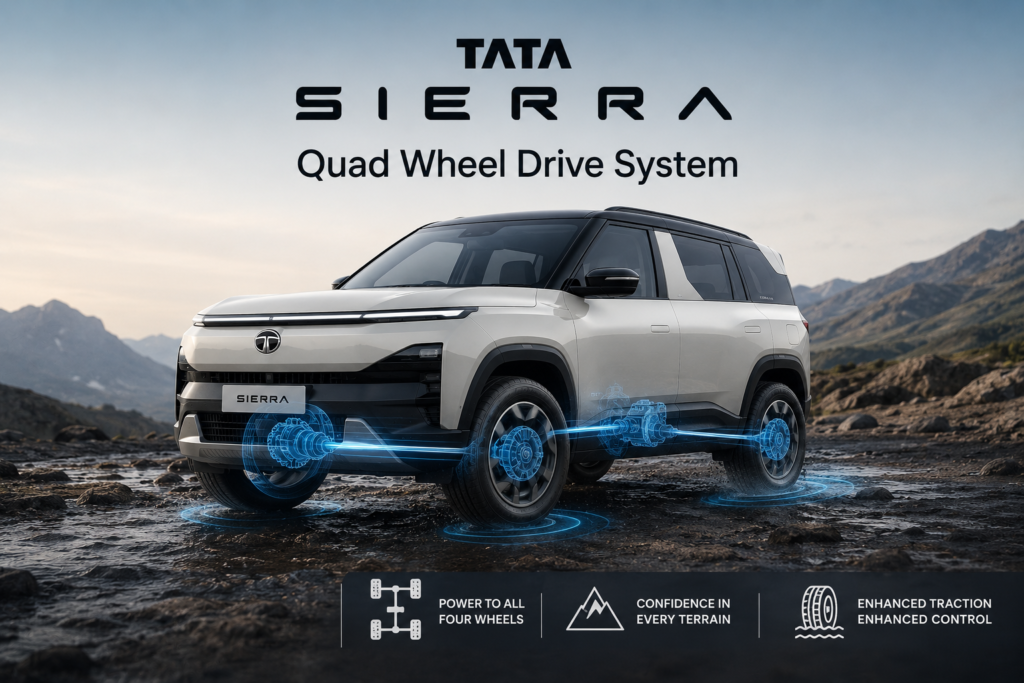
The top-tier Empowered A variant of the Tata Sierra EV features what Tata calls QWD — Quad Wheel Drive — a genuine dual-motor all-wheel drive system that produces a combined output of 313 bhp and 504 Nm of torque. Boost Mode on this variant enables a claimed 0 to 100 kph time of 5.8 seconds, making the Tata Sierra EV one of the quickest Indian-made electric vehicles ever produced.
But the QWD system isn’t just about straight-line acceleration. The Tata Sierra EV QWD variant comes with six dedicated terrain response modes: Normal, Grass/Snow, Mudruts/Gravel, Sand, Rock Crawl, and Custom. These aren’t software-only modes — they’re calibrations of the dual-motor torque distribution, suspension damping, and traction control parameters that genuinely change how the vehicle behaves across different surfaces. The Rock Crawl mode alone is a statement about what this vehicle is designed to do.
Ground clearance of 205 mm further supports the Sierra EV’s off-road credentials. For comparison, the Hyundai Creta Electric offers 190 mm of ground clearance and no AWD option. The Mahindra BE 6 is rear-wheel drive only. Among the Tata Sierra EV’s direct competitors, the combination of dual-motor AWD, six terrain modes, and 205 mm ground clearance makes it uniquely capable for buyers who genuinely go beyond paved roads.
5. The Triple-Screen Interior: A Cabin That Feels Like a Spaceship
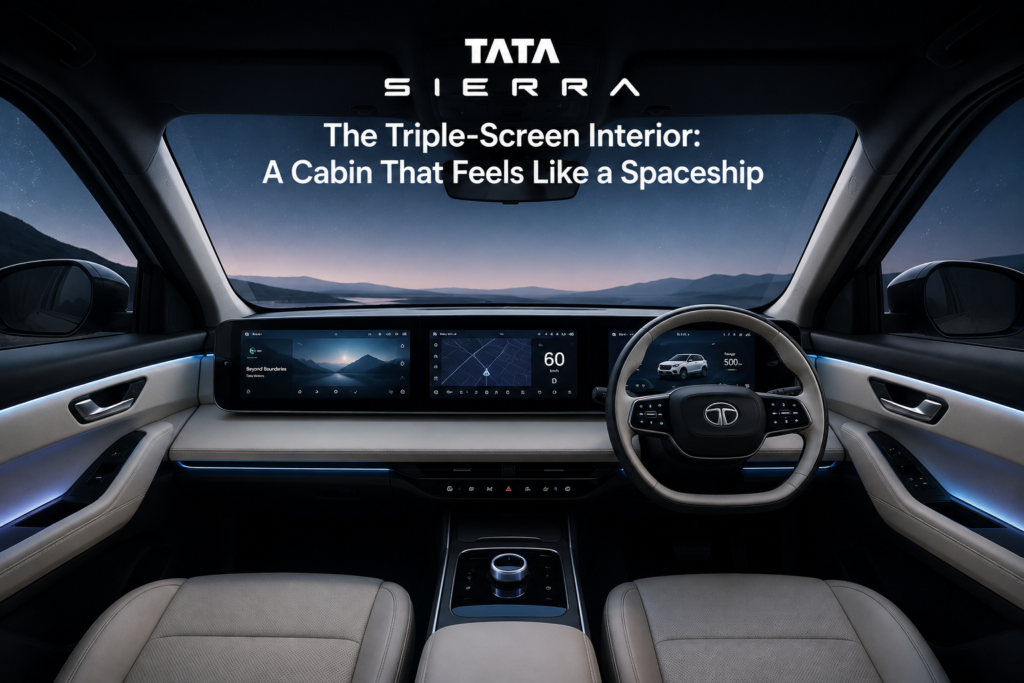
If one single element of the Tata Sierra EV has generated the most conversation among automotive journalists who’ve sat inside it, it’s the cabin. Specifically, it’s what Tata calls the Horizon View Triple Screen architecture — and it’s exactly as dramatic as it sounds.
The dashboard of the Tata Sierra EV features three screens arranged in a continuous horizontal sweep across the full width of the dashboard. A 12.3-inch digital instrument cluster sits directly in front of the driver. A 12.3-inch central infotainment touchscreen dominates the center. And a third 12.3-inch display sits on the passenger side — a front passenger entertainment screen that transforms the front-seat passenger experience entirely. Three large, high-resolution screens working in concert create what Tata markets as the Theater Pro experience, and it genuinely lives up to that name.
The infotainment system is powered by Tata’s Arcade.ev software suite, which includes over 30 curated apps spanning entertainment, gaming via AirConsole, streaming services, browsing, and navigation. The audio system is a 12-speaker JBL Black unit with Dolby Atmos processing and Harman AudioworX technology — audiophile-grade sound engineering in a family electric SUV. Combined with the PanoraMax panoramic sunroof, described as the segment’s largest, and configurable ambient lighting throughout the cabin, the Sierra EV’s interior creates a sensory environment that rivals premium European SUVs costing twice as much.
The iRA.ev connected car system adds 70 connected features accessible through your smartphone, including remote lock and unlock, charge monitoring, trip planning, and over-the-air software updates. Four years of complimentary iRA.ev subscription comes standard — meaning the car continues to improve and gain new features throughout the early years of ownership without additional cost.
6. Boot Space That Actually Fits a Family’s Real Life
Here’s where the Tata Sierra EV makes a compelling practical argument that its sportier rivals cannot match. The boot space of 622 litres in standard configuration is genuinely impressive for a five-seat compact SUV. With the rear seats folded flat, that expands to 1,257 litres — enough room for significant luggage, camping equipment, or the kind of weekend haul that families actually need to carry.
For comparison, the Hyundai Creta Electric offers 433 litres of boot space. The Mahindra BE 6, despite its coupe-SUV silhouette, offers a somewhat compromised boot due to its raked roofline. The Tata Sierra EV’s upright, boxy rear design — deliberately echoing the original Sierra’s distinctive glassy rear — turns out to be a genuine practical advantage rather than just a nostalgia choice.
The Tata Sierra EV also features a front trunk (frunk) for additional storage — useful for keeping charging cables organized and out of the main boot area. The powered tailgate with gesture control makes accessing the boot effortless, particularly when your hands are full of grocery bags. And the rear seatback folding is fully flat, creating a genuinely usable load floor rather than the angled compromise you find in vehicles with under-floor battery packaging that isn’t optimized for cargo versatility.
For families who’ve been hesitant about switching to an EV because of practicality concerns, the Tata Sierra EV directly addresses the most common objection: that electric SUVs prioritize style and tech over the unglamorous but essential business of carrying stuff.
7. Level 2+ ADAS: 22 Safety Features That Work in the Real World
The Tata Sierra EV comes equipped with a comprehensive Level 2+ Advanced Driver Assistance System suite offering 22 individual safety and driver assistance features — one of the most complete ADAS packages available in its price segment anywhere in the world.
The ADAS suite includes adaptive cruise control that maintains a set following distance automatically, lane keep assist that gently corrects unintentional lane departures, automatic emergency braking with pedestrian detection, blind spot monitoring, and rear cross-traffic alert. These are the five foundational ADAS features that matter most in everyday driving, and the Tata Sierra EV offers all of them as part of a single integrated system calibrated specifically for Indian road conditions — which, in terms of complexity and unpredictability, represent some of the most demanding driving environments on earth.
The additional Intelligent Speed Assist feature reads road signs and provides speed limit warnings, reducing the cognitive load on highway driving. The e-Valet parking assistance system goes even further — it can autonomously park the car in a designated space, summon it back to you, and retrace its path when needed. This level of autonomous parking assistance was, until recently, the exclusive territory of vehicles costing several times more than the Tata Sierra EV.
Standard safety equipment across all variants includes six airbags, all-wheel disc brakes, electronic parking brake with auto-hold, ABS with EBD, electronic stability program, tyre pressure monitoring, and a 540-degree HD Surround View System with Transparent Mode on higher variants. The transparent mode feature — which overlays a real-time see-through view of the vehicle’s immediate surroundings — is a technology typically reserved for premium European luxury vehicles.
8. V2L and V2V: The Sierra EV Powers Your World, Not Just Your Drive
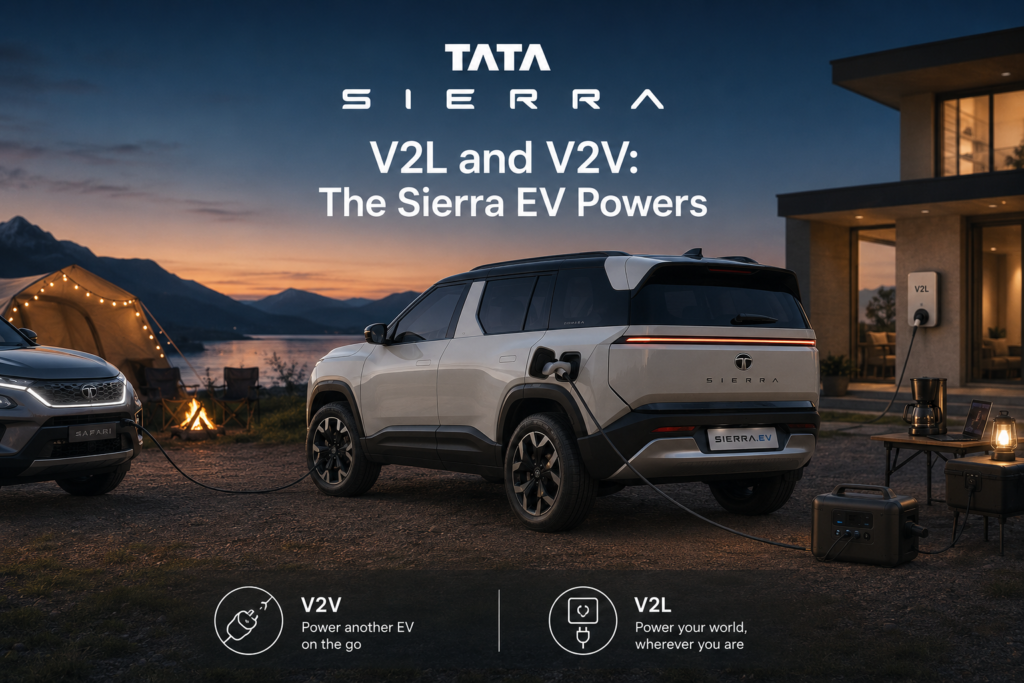
One of the most underappreciated capabilities of the Tata Sierra EV is its bidirectional charging functionality — specifically, Vehicle-to-Load (V2L) and Vehicle-to-Vehicle (V2V) charging. These features transform the Sierra EV from a personal transportation device into something closer to a mobile power station.
Vehicle-to-Load capability on the Tata Sierra EV provides up to 3.3 kVA of power output to external electrical equipment. That’s enough to run a laptop, charge multiple phones and tablets, power a portable projector for an outdoor movie night, run camping equipment, or even operate power tools at a remote work site. For outdoor enthusiasts, adventure travelers, or anyone who spends significant time away from reliable power infrastructure, V2L functionality adds a dimension of utility that goes far beyond driving.
Vehicle-to-Vehicle charging takes the concept further. The Tata Sierra EV can share energy with another compatible electric vehicle at up to 5 kVA — essentially functioning as a portable charger that can help a fellow EV owner in an emergency. In the early days of EV adoption, range anxiety and charging availability remain genuine barriers for many potential buyers. The ability to give or receive emergency charge from another vehicle addresses that concern in a way that no charging network expansion can replicate immediately.
These bidirectional capabilities are part of Tata’s broader vision for the Sierra EV as a component of a connected energy ecosystem rather than simply a mode of transportation. V2L and V2V come standard on the Pure S variant and above — meaning most Sierra EV buyers will have access to this functionality without needing to choose a premium trim specifically for it.
9. Lifetime Battery Warranty: The Confidence That Changes Everything
No discussion of the Tata Sierra EV is complete without understanding its battery warranty, because it’s the kind of commitment that changes how you should think about the total cost of EV ownership.
Tata offers a lifetime high-voltage battery warranty on both the 63 kWh and 75 kWh battery packs in the Sierra EV, defined as 15 years from the date of first registration, for the first registered private owner. An 8-year or 1,60,000 km motor warranty provides additional protection for the drivetrain components. Together, these warranties offer a level of ownership confidence that simply doesn’t exist at this price point anywhere else in the global EV market.
Battery replacement is the single largest potential cost in EV ownership. Depending on the vehicle and the battery capacity, replacement packs can cost anywhere from a third to nearly the full original purchase price of the car. By guaranteeing the battery for 15 years, Tata has effectively neutralized the biggest financial risk associated with buying an electric vehicle. You know that the most expensive component of the car is protected for longer than most buyers will own it.
This warranty makes the Tata Sierra EV’s slightly higher purchase price — compared to petrol or diesel alternatives in the same space — a substantially clearer financial proposition. When you factor in lower running costs on electricity versus fuel, the eliminated risk of battery replacement, and the comprehensive warranty coverage, the long-term total cost of Sierra EV ownership is competitive with or lower than conventionally powered alternatives over a 5 to 10 year ownership cycle.
10. Design: Honoring History While Looking Forward
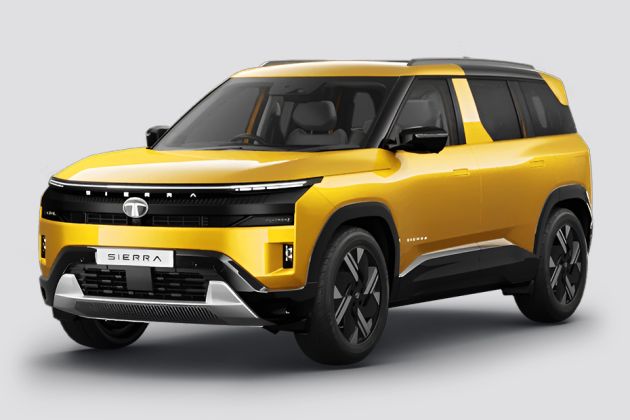
Great automotive design doesn’t shout. It speaks clearly and confidently, acknowledging where it comes from while pointing unmistakably toward where it’s going. The Tata Sierra EV’s design does exactly this, and it’s one of the reasons the car has generated such strong emotional responses at every public appearance since its first teaser images.
The Sierra EV retains the original’s most defining visual element — that upright, glassy rear that defined the 1991 car and made it unlike anything else on Indian roads at the time. The split LED headlamps at the front carry distinct visual drama. The blanked-off grille announces its electric identity without screaming about it. Flush door handles, dual-tone alloy wheels in an 18-inch diameter, and EV-specific badging on the front doors and tailgate add contemporary polish without erasing the character.
The Tata Sierra EV is available in seven exterior colors: Pristine White, Coorg Clouds, Andaman Adventure (a striking yellow), Bengal Rouge, Pure Grey, Rishikesh Rapids, and the exclusive Nainital Nocturne — available only on QWD variants. The color naming convention is itself a statement: these are names that evoke adventure, travel, and specific places in the Indian landscape that carry emotional weight for anyone who’s been there.
The design philosophy behind the Tata Sierra EV respects the buyer’s intelligence. It doesn’t try to disguise its proportions with fake vents, aggressive body creases, or the kind of overwrought styling that dates badly within a product cycle. It’s confident, distinctive, and immediately recognizable as a Sierra — which, in 2026, is exactly the kind of heritage currency that money alone cannot manufacture.
11. The Acti.EV+ Platform: Why the Foundation Matters
The Tata Sierra EV is built on Tata’s Acti.EV+ architecture — the same dedicated electric vehicle platform that underpins the Harrier EV — and understanding this platform helps explain why the Sierra EV feels so genuinely engineered rather than adapted.
Dedicated EV platforms differ from adapted ICE platforms in ways that profoundly affect the vehicle’s capability, efficiency, and interior packaging. Because the Acti.EV+ was designed from the ground up for electric powertrains, it places the battery pack optimally within the chassis for the lowest possible center of gravity. This directly improves cornering stability and ride composure — you feel it in how the vehicle handles direction changes at speed, and in how composed it remains over poor road surfaces.
The independent multi-link rear suspension with frequency-dependent damping is a highlight of the Acti.EV+ platform’s engineering sophistication. Frequency-dependent damping allows the suspension to behave differently depending on the type of input it’s receiving — remaining firm and controlled during high-speed cornering while softening appropriately for low-speed bump absorption. The result is a ride quality that manages the usually contradictory demands of comfort and control more effectively than simpler suspension designs.
The platform also enables the Tata Sierra EV’s comprehensive electrical architecture — the over-the-air update capability, the V2L and V2V bidirectional charging, the advanced ADAS sensor fusion, and the connected iRA.ev ecosystem. These aren’t features bolted onto an existing architecture — they’re integrated at the platform level, which means they work together as a unified system rather than as separately managed subsystems that occasionally conflict.
12. How the Tata Sierra EV Compares to Its Key Rivals
Choosing an electric SUV at this price point means comparing several genuinely good vehicles, and the Tata Sierra EV has been carefully positioned to compete with the strongest products in the segment. Here’s an honest assessment of how it stacks up.
The Hyundai Creta Electric is the market leader by volume and consumer familiarity. It offers 42 kWh and 51.4 kWh battery options with claimed range up to 510 km — respectable figures, but significantly behind the Tata Sierra EV’s 665 km maximum claim. The Creta Electric’s 433-litre boot is 189 litres smaller than the Sierra EV’s 622 litres. The Creta doesn’t offer AWD, doesn’t offer V2L or V2V, and doesn’t offer a triple-screen cabin layout. Where the Creta Electric genuinely wins is in Hyundai’s after-sales service network, resale value predictability, and the familiarity factor for buyers upgrading from the petrol Creta.
The Mahindra BE 6 is the performance-focused rival. With up to 682 km of claimed range in its 79 kWh version and a sporty coupe-SUV silhouette, the BE 6 appeals to enthusiast buyers who prioritize driving dynamics and visual drama. Its cockpit-like cabin is genuinely impressive, and the Harman Kardon audio with Dolby Atmos is excellent. The BE 6 is rear-wheel drive only, however — no AWD option exists. Its coupe roofline also compromises rear headroom and boot access compared to the Tata Sierra EV. For buyers who want the combination of genuine AWD capability and a practical family SUV layout, the Sierra EV has no direct competition.
The Maruti Suzuki e Vitara plays at a lower price point, starting from ₹15.99 lakh, and benefits enormously from Maruti’s unrivaled dealer and service network across India. Its positioning is more mainstream and less technology-forward than the Tata Sierra EV, targeting buyers who prioritize ownership familiarity over feature richness.
13. Variant Breakdown: Which Tata Sierra EV Should You Actually Buy?
The Tata Sierra EV is offered in five variants — Pure, Pure S, Adventure, Empowered, and Empowered A — and understanding what each tier actually adds helps identify the genuinely compelling value propositions within the range.
- Pure 63 RWD (₹18.79 lakh):
- The entry point delivers the Sierra EV’s safety foundation — six airbags, ABS, ESP, Level 2 ADAS basics, and the 63 kWh battery. It’s worth noting that most reviewers recommend skipping the base Pure and moving at least to Pure S for the meaningful feature additions it brings.
- Pure S 63 RWD:
- This is where the Tata Sierra EV starts to feel truly complete. Voice-assisted PanoraMax panoramic sunroof, V2L and V2V charging, wireless Apple CarPlay and Android Auto, paddle shifters for regenerative braking, OTA software updates, and iRA.ev connected services all arrive here. For budget-conscious buyers who want the genuine Sierra EV experience, Pure S represents the minimum recommended spec.
- Adventure 63 or 75 RWD:
- The transition to premium territory. The 360-degree HD Surround View System, the full 12-speaker JBL Black audio system with Dolby Atmos, AirConsole gaming integration, integrated navigation, wireless charging, four terrain modes, and enhanced ambient lighting make this trim a dramatically richer ownership experience. For most buyers who’ve worked out their needs carefully, the Adventure 75 RWD is the sweet spot of the entire Sierra EV range.
- Empowered 75 RWD:
- Adds the head-up display, the full Level 2+ ADAS suite with all 22 functions, e-Valet parking assistance with automatic parking, remote park, summon and reverse assist, and the complete 540-degree Transparent Mode camera system. These are genuinely useful additions for regular highway driving.
- Empowered A 75 QWD (₹25.99 lakh):
- The flagship. Dual-motor AWD, Boost Mode, 0 to 100 kph in 5.8 seconds, six terrain modes including Rock Crawl, Off-Road Assist, and the exclusive Nainital Nocturne color. For buyers who genuinely venture off-road or who want the combined performance and range leadership of the 75 kWh QWD setup, this top variant is a remarkable machine at its asking price.
14. The Cultural Significance of the Sierra Name in 2026
Automotive brands carry cultural weight that transcends their mechanical specifications, and the Sierra name carries more of that weight than almost any other nameplate in the Indian automotive story.
The original Tata Sierra, introduced in 1991, was a genuinely groundbreaking vehicle for its time and place. India’s auto industry in 1991 was largely defined by ancient Ambassador sedans and Jeep derivatives. The Sierra arrived with glass-on-three-sides rear visibility, a body-on-frame construction that felt genuinely robust, and a visual confidence that was unlike anything else available to Indian buyers. It sold in modest numbers but created a passionate, lasting community of enthusiasts who maintained their Sierras with extraordinary dedication long after production ended.
When Tata revealed the Sierra concept at the 2020 Auto Expo, the reaction was emotional in a way that few concept car reveals achieve. It wasn’t just automotive enthusiasm — it was genuine cultural recognition that a beloved nameplate was returning. The production version of the ICE Sierra launched in 2025 maintained enough of that concept’s character to satisfy even the most nostalgic Sierra fans.
The Tata Sierra EV takes the nameplate’s second chapter and gives it an electric future — which is, in many ways, exactly the right choice. The original Sierra was innovative for 1991. Making the Sierra’s return to iconic status via electric power is innovative for 2026. The car has always been about doing something different, something bold, something that makes other cars feel a little ordinary by comparison. The Tata Sierra EV maintains that tradition perfectly.
15. Should You Follow the Tata Sierra EV? The Honest Verdict
After 14 detailed sections covering the Tata Sierra EV’s pricing, range, charging capability, design, technology, off-road credentials, interior features, battery warranty, safety systems, and competitive positioning — here is the straightforward, honest assessment.
The Tata Sierra EV is the most comprehensively specified electric SUV in its price segment at launch. That’s not hyperbole — it’s a conclusion supported by the data. The combination of 665 km claimed range, dual-motor AWD, triple-screen interior, 12-speaker Dolby Atmos audio, V2L and V2V bidirectional charging, 22-feature ADAS, a 622-litre boot, and a lifetime battery warranty at a starting price of ₹18.79 lakh represents a value proposition that genuinely has no equal in its class.
For buyers who want a genuinely practical family electric SUV with class-leading range and technology, the Tata Sierra EV Adventure 75 RWD or Empowered 75 RWD represents the best balance of features, range, and value in the entire range. The QWD Empowered A is for buyers who genuinely want all-weather or off-road capability alongside the performance that dual-motor architecture provides.
The few honest caveats worth noting: crash test rating from GNCAP is pending (the ICE Sierra’s strong 5-star Bharat NCAP rating provides structural confidence, but EV-specific testing is still upcoming), and real-world range in heavy traffic conditions will be lower than MIDC-claimed figures. Tata’s C75 real-world estimates suggest 440 to 530 km depending on variant, which remains excellent and far ahead of most competitors.
For American audiences tracking global EV development — and particularly for those in the Indian diaspora who follow Tata’s automotive evolution — the Tata Sierra EV is a landmark moment. It demonstrates that world-class electric vehicle engineering is no longer the exclusive domain of European or American manufacturers. India has arrived in the premium EV space, and it has arrived with something genuinely worth getting excited about.
Frequently Asked Questions About the Tata Sierra EV
What is the starting price of the Tata Sierra EV?
\ The Tata Sierra EV starts at ₹18.79 lakh (ex-showroom) for the base Pure 63 RWD variant. The top-spec Empowered A 75 QWD is priced at ₹25.99 lakh (ex-showroom). At current exchange rates, this translates to approximately $22,500 to $31,200.
What is the range of the Tata Sierra EV?
The Tata Sierra EV offers a claimed MIDC range of 535 km (63 kWh variant) to 665 km (75 kWh RWD variant). Tata’s C75 real-world range estimates are 440–460 km for the 63 kWh and 510–530 km for the 75 kWh RWD variant.
How fast does the Tata Sierra EV charge? The Sierra EV supports up to 120 kW DC fast charging. A 15-minute fast charge session adds up to 263 km of certified range. The 20 to 80 percent charge window takes approximately 25 to 26 minutes. Home AC charging (7.2 kW) brings the 75 kWh battery from 10 to 100 percent in approximately 10.5 hours.
Does the Tata Sierra EV have all-wheel drive?
Yes. The top-spec Empowered A variant offers Tata’s QWD (Quad Wheel Drive) dual-motor all-wheel drive system producing 313 bhp and 504 Nm of torque, with six terrain modes including Rock Crawl and Sand modes.
What battery warranty does the Tata Sierra EV offer?
The Tata Sierra EV offers a lifetime high-voltage battery warranty (defined as 15 years from the date of first registration) for the first registered private owner, on both 63 kWh and 75 kWh battery packs.
Is the Tata Sierra EV available in the USA?
The Tata Sierra EV is currently a market vehicle for India and is not officially sold through Tata Motors dealerships in the United States. US-based buyers and enthusiasts can follow Tata’s international expansion plans for future availability updates.
What are the main competitors of the Tata Sierra EV?
The Tata Sierra EV’s primary competitors in India are the Hyundai Creta Electric, Mahindra BE 6, Maruti Suzuki e Vitara, and MG ZS EV. Among these, the Sierra EV offers the most boot space (622 litres), the only AWD option, the highest claimed range, and the most comprehensive triple-screen interior setup.
.

 Sagar
Sagar