 Sagar
Sagar The Yamaha R15 V4 Is Not Just a Motorcycle. It Is a Racing School With a Headlight.
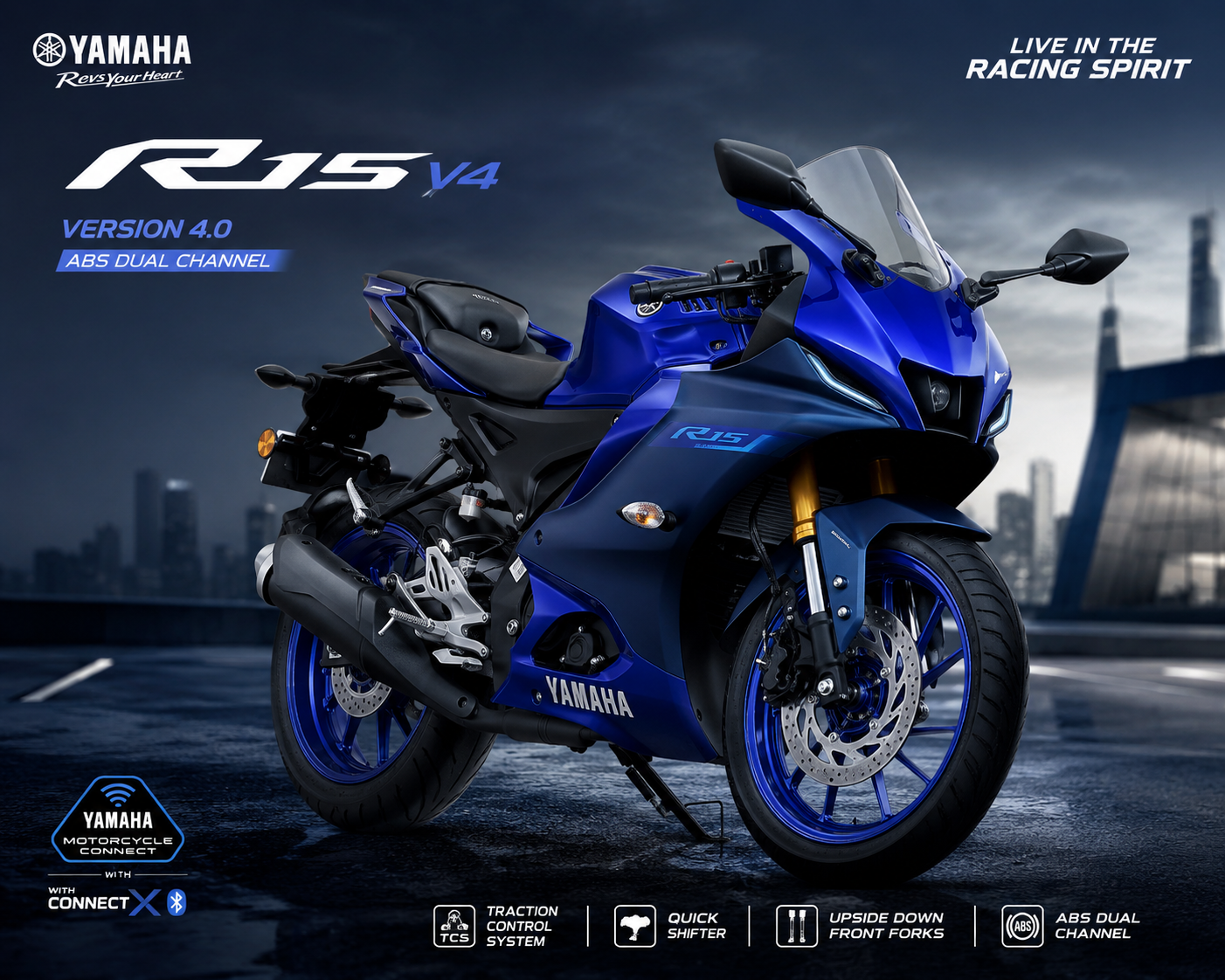
If there is one motorcycle under ₹2 lakh in India that makes a rider genuinely better every single time they ride it — it is the R15 V4. Yamaha didn’t design this motorcycle for casual commuting or relaxed weekend cruising. They designed it as a machine that teaches corner entry, brake control, body position, and throttle management through the honest feedback of a race-derived chassis and a liquid-cooled engine that rewards precision. The result is one of the most purpose-built, most technologically advanced sportbikes available in India at any price near ₹2 lakh.
As of May 2026, the R15 V4 is priced from ₹1.71 lakh (ex-showroom, Delhi) for the standard variant and up to ₹1.97 lakh for the M variant with quickshifter. It competes with the KTM RC 200, Suzuki Gixxer SF 155, and Honda CBR 150R — but consistently leads the group on technology, chassis quality, and the specific quality of its riding experience. Here are 10 specific, thoroughly researched reasons why.
1. R15 V4 Design — Race Inspired, R7 Derived, Unmistakable on Indian Roads
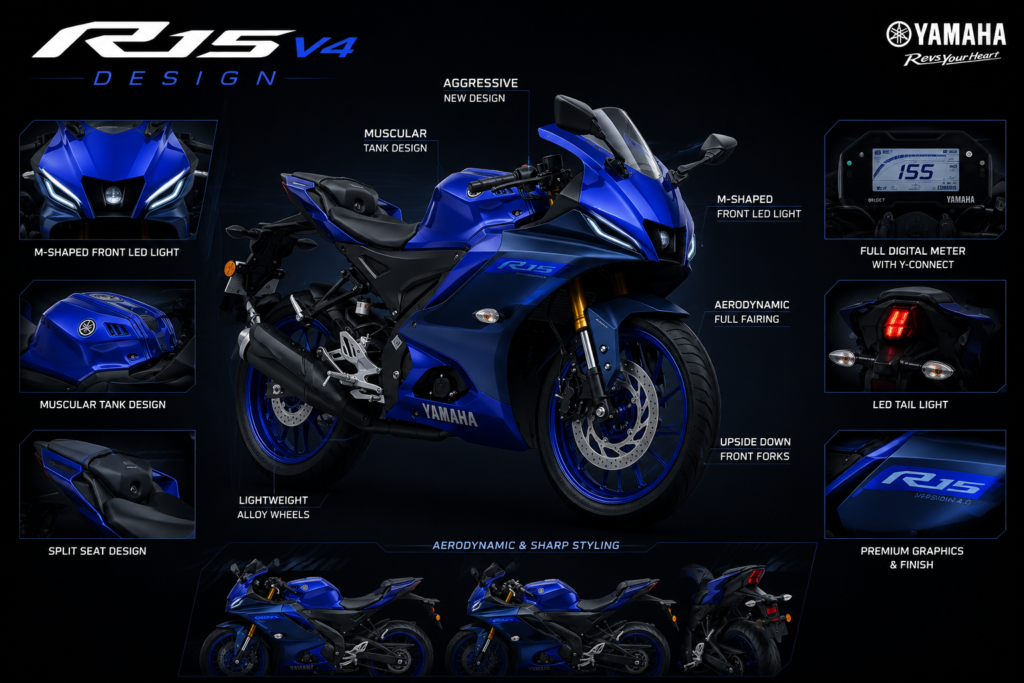
How the R15 V4’s Styling Sets It Apart From Every 155cc Rival
The R15 V4 takes its design inspiration directly from Yamaha’s R7 and, further up the family tree, the legendary R1 superbike. The twin-pod LED headlamp design — a visual signature that references MotoGP racing machines — gives the R15 V4 a face that no one in its price class replicates. The full fairing, the aerodynamic winglets, the sculpted tail section, and the rider’s aggressive forward lean together create a motorcycle silhouette that turns heads whether it’s moving or standing still.
R15 V4 Colour Options That Honour Its Racing Heritage
Yamaha offers the R15 V4 in nine colour options including Racing Blue, Dark Knight, Metallic Black, Intensity White, Metallic Red, Matte White Pearl, and the limited MotoGP Edition and Icon Performance graphics. The Racing Blue and MotoGP Edition, in particular, carry Yamaha’s motorsport identity so faithfully that they generate conversations at traffic signals and parking lots on a regular basis — which is exactly what a motorcycle of this character should do.
2. R15 V4 Engine — VVA Technology That Makes 155cc Feel Much Bigger
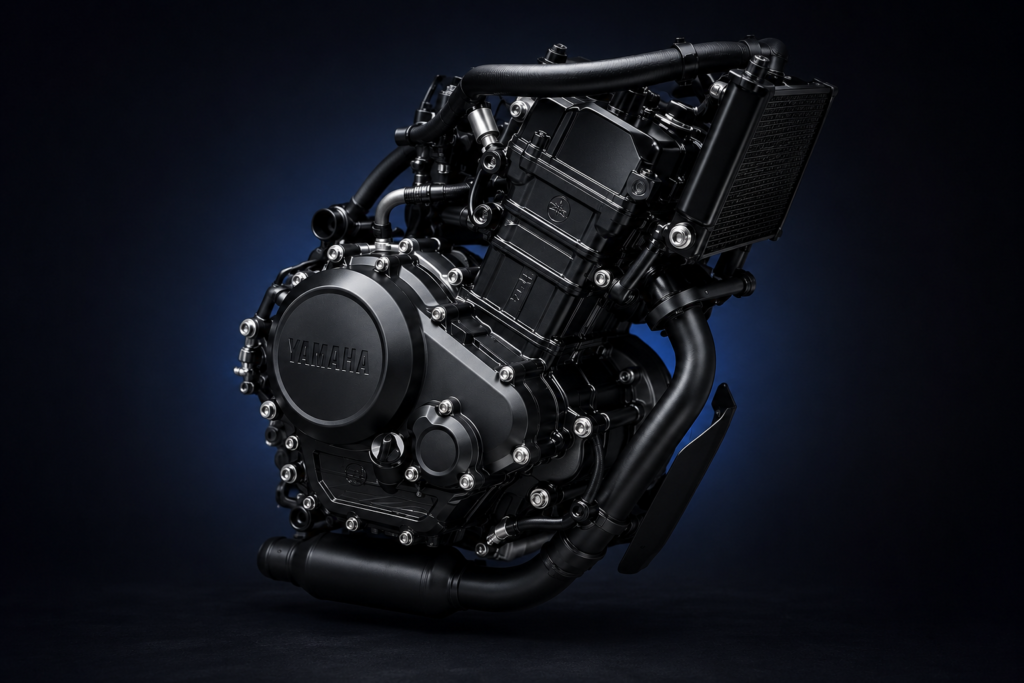
What Makes the R15 V4’s Liquid-Cooled Motor So Impressive
The R15 V4 is powered by a 155cc, single-cylinder, liquid-cooled, 4-stroke, SOHC, 4-valve engine producing 18.4 PS at 10,000 rpm and 14.2 Nm of torque at 7,500 rpm. On paper, those numbers are competitive. In practice, the engine’s defining feature is Variable Valve Actuation — Yamaha’s proprietary VVA technology that switches between two valve timing profiles depending on engine speed.
R15 V4 VVA: How Variable Valve Actuation Changes the Riding Experience
Below 7,400 rpm, the R15 V4 runs on the low-cam profile — optimised for smooth, tractable power delivery in city traffic and low-speed riding. Above 7,400 rpm, VVA switches to the high-cam profile, unlocking the engine’s full performance potential and delivering a noticeable surge of power that makes the top-end rev range feel genuinely exciting. One real owner put it perfectly: “Find me another 150cc in India that can do 145 km/h without getting stressed at all.” That’s the VVA advantage — two different engines in one unit, and the R15 V4 uses both intelligently.
3. R15 V4 Chassis and USD Forks — Race Hardware at a Street Bike Price
R15 V4 Suspension: Why Upside-Down Forks Matter for Every Rider
The R15 V4’s front suspension is a 37mm upside-down (USD) telescopic fork — hardware that is typically associated with motorcycles costing two to three times as much. USD forks reduce unsprung weight, improve front-end communication to the rider’s hands, and resist brake dive more effectively than conventional forks. For a motorcycle that encourages spirited riding and track exploration, USD forks are not just a visual upgrade — they are a functional improvement that the rider feels in every corner.
R15 V4 Delta Box Frame: The Foundation of Everything the Bike Does Well
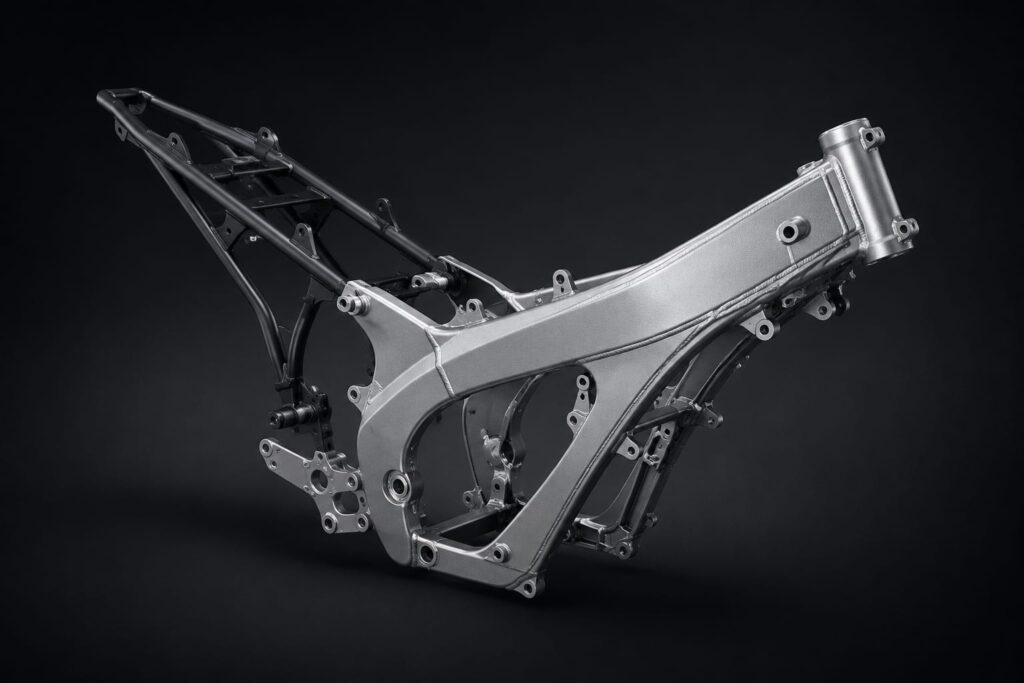
The Deltabox aluminium frame of the R15 V4 is a monocoque-style construction derived from Yamaha’s larger sportbikes. It is lighter than a steel frame, more rigid in torsional loading, and specifically tuned for the kind of quick-direction-changes that sportsbike riding demands. The geometry — with a 65-degree rake and 89mm trail — gives the R15 V4 a steering response that feels razor-quick and confidence-inspiring simultaneously. For the Indian rider who wants to learn the art of cornering, this chassis is both their teacher and their safety net.
4. R15 V4 Technology — Traction Control, Quickshifter, and TFT Display
What Technology the R15 V4 Brings to the Sub-₹2 Lakh Segment
Technology in the R15 V4 goes well beyond what any competitor offers at this price. The standard R15 V4 gets dual-channel ABS, a switchable traction control system, a fully digital TFT instrument cluster with Y-Connect Bluetooth connectivity, a gear position indicator, shift timing light, VVA indicator, and a side-stand engine cut-off switch. The R15 V4 M variant adds an upshift-only quickshifter — the kind of feature found on motorcycles costing five to eight times as much.
R15 V4 Y-Connect: Bluetooth Connectivity That Actually Adds Value
The Y-Connect system links the R15 V4 to your smartphone via Bluetooth, displaying incoming call alerts, SMS notifications, and fuel consumption data on the TFT screen. It also tracks your riding data, provides maintenance reminders, and shows a fuel consumption indicator that helps you understand and gradually improve your riding efficiency. For a motorcycle whose buyer profile includes young, digitally-connected riders who expect their devices to talk to each other, this integration is genuinely well-implemented and frequently used.
5. R15 V4 Mileage — 40 to 45 kmpl From a Performance Engine
R15 V4 Real-World Fuel Efficiency: Why It Beats Expectations
The R15 V4 returns approximately 40–45 kmpl in mixed riding conditions, with most users reporting an average around 42 kmpl over extended ownership. That efficiency from a 155cc liquid-cooled engine with VVA and race-derived hardware is genuinely impressive — and it’s directly enabled by the VVA system’s ability to switch to its efficient low-cam profile when the riding situation doesn’t call for maximum performance.
How the R15 V4 Balances Performance and Economy Daily
For the Indian rider using the R15 V4 as both a daily commuter and a weekend performance machine, this mileage figure translates to a 11-litre fuel tank providing approximately 450–490 km of range before the next fill. Running costs stay manageable — the R15 V4 doesn’t ask you to choose between keeping the performance and keeping the wallet comfortable. It genuinely delivers both, which is one of the reasons buyer satisfaction ratings for the R15 V4 remain consistently high.
6. R15 V4 Riding Position — Committed but Not Cruel
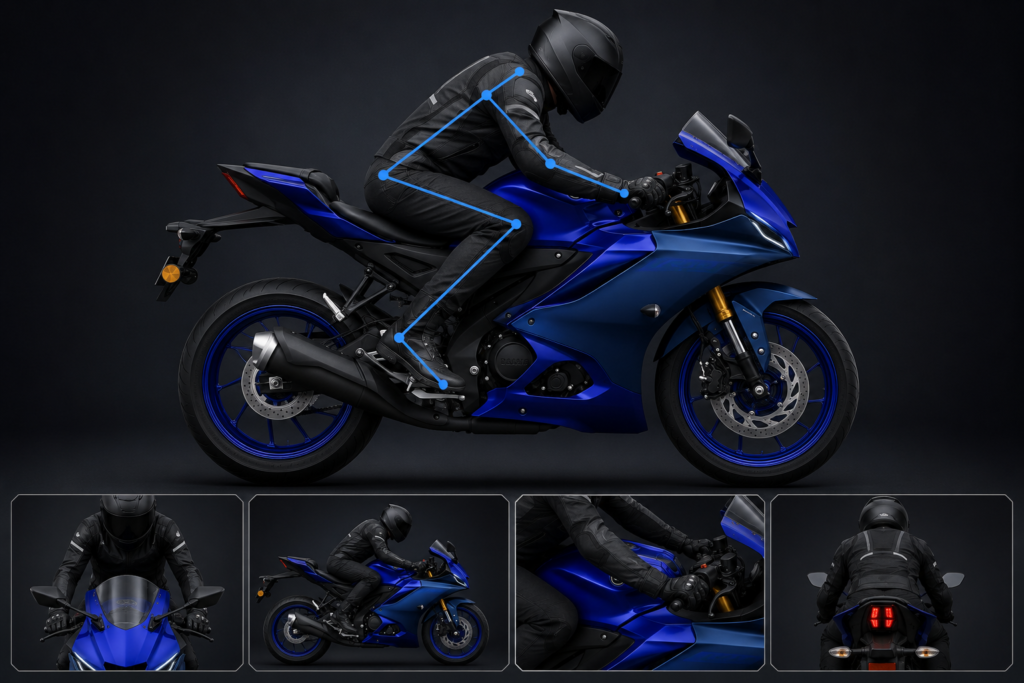
R15 V4 Ergonomics: What the Clip-Ons and Rear-Set Pegs Feel Like in Real Use
The R15 V4 has a committed riding position — clip-on handlebars below the top yoke, rear-set footpegs, and an 815mm seat height — that places the rider in a forward lean specific to sportbike riding. This posture is more aggressive than a naked bike or a cruiser, and some buyers who haven’t ridden a faired sportbike before find it requires a short adjustment period.
R15 V4 Comfort: What Owners Actually Experience After the First Month
After two to three weeks of regular riding, most R15 V4 owners report that the position becomes natural and, importantly, intuitive for the kind of riding the bike encourages. The committed position reduces wind fatigue at highway speeds by allowing the fairing to deflect airflow over the rider. It improves cornering confidence by keeping the rider’s weight forward and centred over the front wheel. And it simply makes the R15 V4 feel more alive, more engaged, and more purposeful than an upright equivalent would — which is the honest trade-off every sportbike buyer accepts and most genuinely appreciate.
Yamaha R15 V4 2025–26: Full Specifications at a Glance
| Parameter | R15 V4 Standard | R15 V4 M (With Quickshifter) |
|---|---|---|
| Price (Ex-showroom, Delhi) | ₹1.71 lakh | ₹1.87–1.97 lakh |
| Engine | 155cc, LC, SOHC, 4-valve | 155cc, LC, SOHC, 4-valve |
| Power | 18.4 PS @ 10,000 rpm | 18.4 PS @ 10,000 rpm |
| Torque | 14.2 Nm @ 7,500 rpm | 14.2 Nm @ 7,500 rpm |
| Special Engine Tech | VVA (Variable Valve Actuation) | VVA |
| Gearbox | 6-speed | 6-speed + upshift quickshifter |
| Clutch | Assist and slipper clutch | Assist and slipper clutch |
| Frame | Deltabox aluminium | Deltabox aluminium |
| Front Suspension | 37mm USD forks | 37mm USD forks |
| Rear Suspension | Linked-type monocross | Linked-type monocross |
| Brakes | 282mm front disc / 220mm rear disc | Same |
| ABS | Dual-channel | Dual-channel |
| Traction Control | Switchable | Switchable |
| Instrument Cluster | TFT digital with Y-Connect | TFT digital with Y-Connect |
| Seat Height | 815mm | 815mm |
| Kerb Weight | 141 kg | 141 kg |
| Fuel Tank | 11 litres | 11 litres |
| Real-World Mileage | 40–45 kmpl | 40–45 kmpl |
| Top Speed | ~145 km/h | ~145 km/h |
| Colours | 9 options incl. MotoGP Edition | Same |
R15 V4 vs KTM RC 200 vs Suzuki Gixxer SF 155 — Honest Comparison
The R15 V4 faces two credible alternatives in the Indian sportbike market: the KTM RC 200 and the Suzuki Gixxer SF 155. The RC 200 has a larger 199cc engine and a more aggressive track-focused tuning, but costs approximately ₹75,000–1 lakh more than the R15 V4 — a gap that significantly changes the value proposition. The Gixxer SF 155 is more comfortable in everyday riding and slightly friendlier for beginners, but its chassis and technology specification trail the R15 V4 on USD forks, traction control, VVA technology, and the quality of its TFT display.
The R15 V4 wins the segment on technology completeness, chassis quality-to-price ratio, VVA engine character, and the specific quality of what it teaches a rider. It is the motorcycle that best prepares a young Indian rider for larger, more powerful bikes — not just because it’s fast enough to thrill but because its feedback is honest enough to educate.
Final Verdict: The R15 V4 Is the Best ₹2 Lakh You Can Spend on a Sportbike in India
The R15 V4 has been available in India since 2022, and in mid-2026 it continues to be the benchmark that every competitor in the 150–200cc sportbike segment measures itself against. Its combination of VVA engine technology, Deltabox chassis, USD forks, dual-channel ABS, switchable traction control, TFT display with Y-Connect, assist-and-slipper clutch, and the optional quickshifter on the M variant represents a feature density that no competitor has matched at a comparable price.
For the Indian rider who wants a motorcycle that will make them faster, more skillful, and more confident over time — the R15 V4 is the most intelligent purchase in the segment. Not just because of what it is today, but because of what it will make you as a rider six months from now.
Frequently Asked Questions About the R15 V4
Q: What is the price of the R15 V4 in India in 2025–26?
The R15 V4 price in India starts at ₹1.71 lakh (ex-showroom, Delhi) for the standard variant and goes up to ₹1.97 lakh for the R15 V4 M with quickshifter. Prices were revised in May 2026 with a ₹4,900 increase across all variants.
Q: What is the mileage of the Yamaha R15 V4?
The R15 V4 returns approximately 40–45 kmpl in real-world mixed riding conditions. Most owners report an average around 42 kmpl, aided by the VVA system’s efficient low-cam profile during city and relaxed riding.
Q: What is VVA in the Yamaha R15 V4?
VVA stands for Variable Valve Actuation — a Yamaha technology that switches between two valve timing profiles at 7,400 rpm. Below that threshold, the engine is tuned for smooth, efficient city riding. Above it, the high-cam profile unlocks full performance potential, delivering a noticeable surge in power.
Q: Does the R15 V4 have traction control?
Yes. The Yamaha R15 V4 comes with a switchable traction control system as standard — a feature not available on most competitors at this price. It can be turned on for wet or slippery conditions and off for dry road riding.
Q: What is the difference between R15 V4 and R15 V4 M?
The R15 V4 M adds an upshift-only quickshifter to the standard V4’s feature set. Both variants share the same engine, chassis, TFT display, traction control, and dual-channel ABS. The M variant is available in Metallic Grey, MotoGP Edition, and Icon Performance colours.
Q: Is the Yamaha R15 V4 worth buying in 2026?
Yes. The R15 V4 offers a 155cc VVA liquid-cooled engine, USD forks, switchable traction control, dual-channel ABS, TFT display with Y-Connect Bluetooth, and optional quickshifter — all under ₹2 lakh. It is consistently rated as the best value sportbike under ₹2 lakh in India

 Sagar
Sagar