 Sagar
Sagar Introduction: Some Motorcycles Transport You. The Jawa Bobber 42 Transforms You.
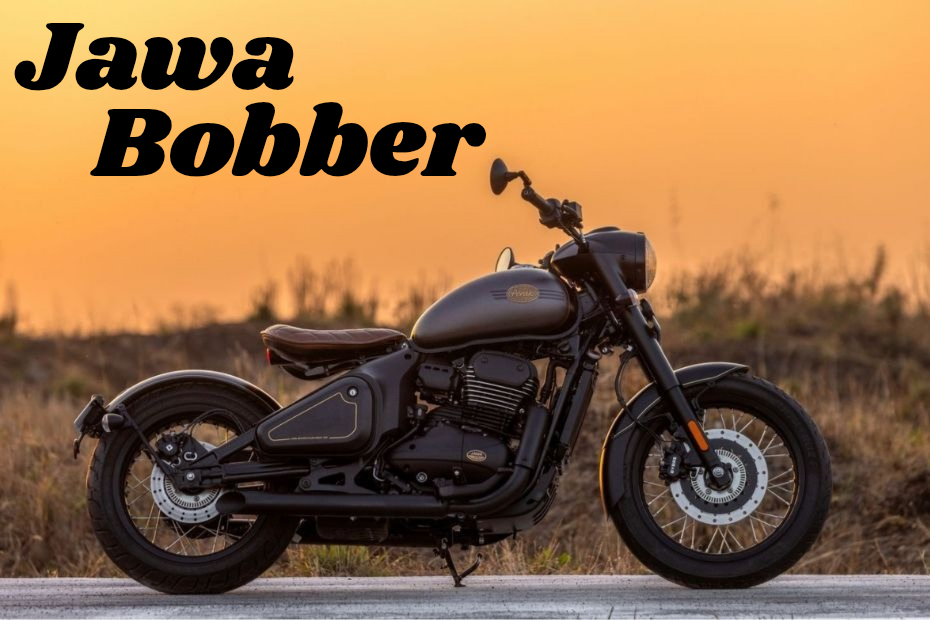
jawa bobber 42 There is a specific feeling jawa bobber 42 that a great motorcycle gives you the moment you sit on it — before you’ve even started the engine. The way the saddle holds you. The way the bars fall naturally into your hands. The way your feet find the forward pegs and your body settles into that low, unhurried, deeply satisfying cruiser posture. Very few motorcycles under ₹3 lakh in India deliver that feeling. The Jawa Bobber 42 is one of them.
The jawa bobber 42 as a motorcycle style has a history that goes back to post-war America, when riders would “bob” their fenders — cut them short, strip off unnecessary metal, and create low-slung, stripped-down bikes that looked as dangerous as they went fast. That spirit — minimal, purposeful, bold — is exactly what the Jawa 42 Bobber brings to Indian roads, wrapped in a 21st-century engineering package that makes it not just beautiful to look at, but genuinely enjoyable to ride.Since its launch in India, the Jawa 42 Bobber has carved out a distinctive identity in the neo-retro motorcycle segment. With a 334cc engine, pricing from ₹2.05 lakh, and over 20 user reviews consistently praising its character, the bike has found a loyal, passionate following among Indian riders who want something more than a motorcycle — they want a statement. And with the 2025 updates including reworked ECU mapping, revised ergonomics, new colour options, and improved BS6 Stage 2 compliance, the Jawa 42 Bobber has matured into the most complete version of itself yet.
In this article, we’ll walk you through 15 detailed, honest, research-backed reasons why the Jawa Bobber 42 deserves to be on every serious motorcycle buyer’s shortlist in India in 2025–26. Whether you’re buying your first motorcycle, upgrading from a commuter, or simply tired of seeing the same Royal Enfield at every traffic light — this guide is for you.
The Design Is Pure Bobber DNA — And Nothing Else in This Price Range Looks Like It
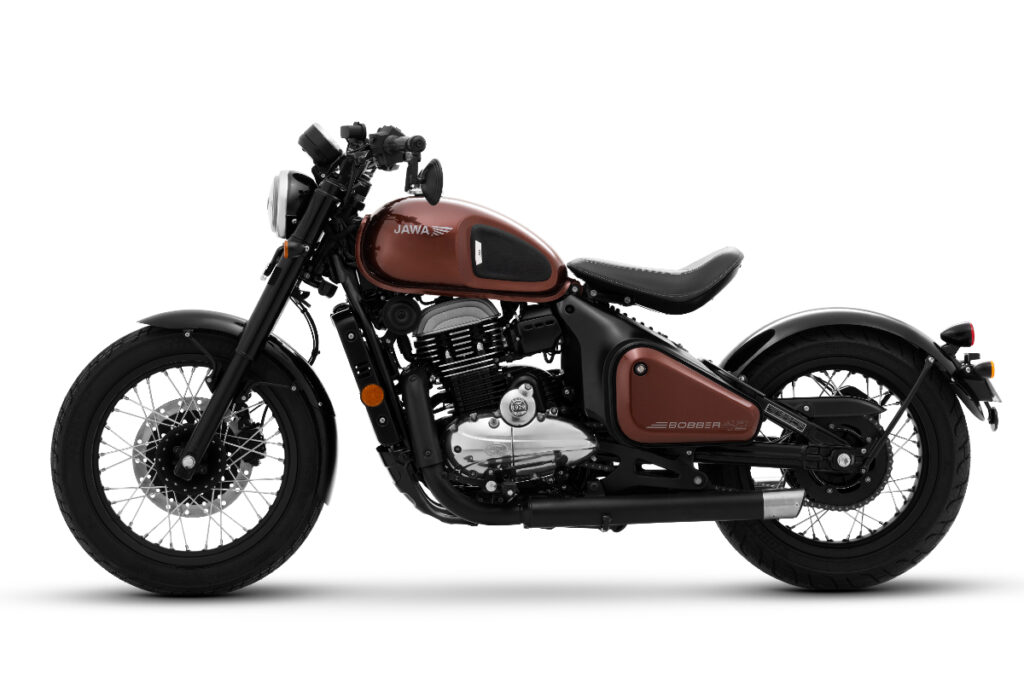
Let’s begin where every motorcycle conversation should begin — the design. Because the Jawa bobber 42 doesn’t just look different from its competitors. It looks different from almost every sub-₹3 lakh motorcycle on Indian roads, full stop.
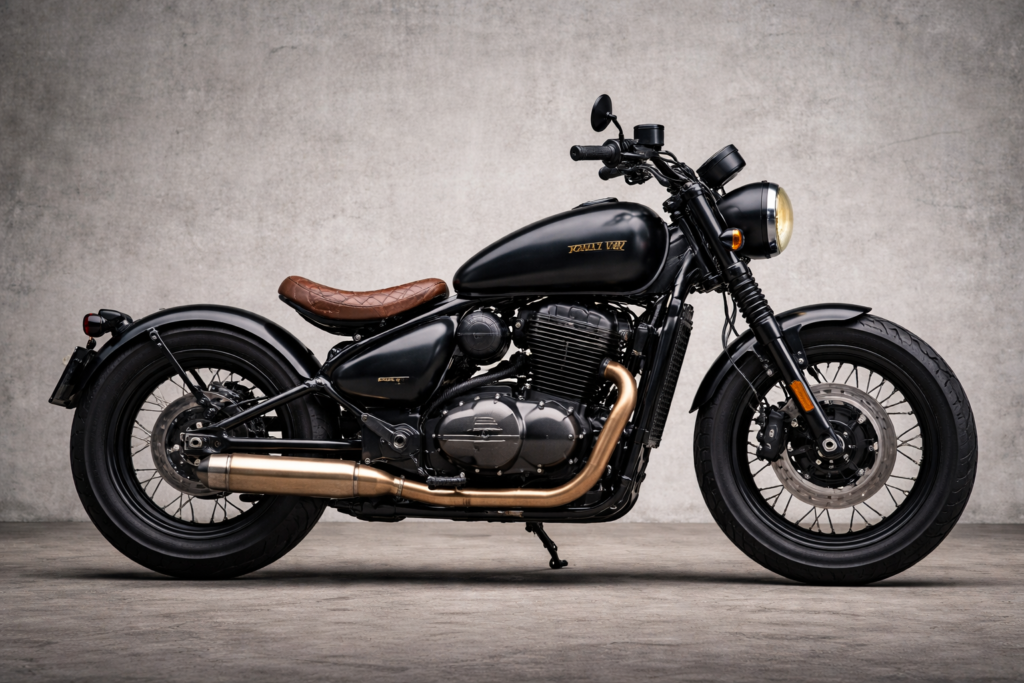
The bobber aesthetic is built on a philosophy of deliberate reduction. Where other motorcycles add chrome, fairing, and bodywork, the bobber takes it away. What’s left is a motorcycle reduced to its most essential, most honest form — and in that reduction, something genuinely beautiful emerges. The Jawa 42 Bobber features a low-slung stance, wide handlebars, chopped fenders, and a single floating seat that gives it a true custom-bike feel. The round LED headlamp, teardrop fuel tank, and fat rear tyre enhance its classic cruiser look while still feeling modern and premium on the road.That teardrop fuel tank is one of the Jawa 42 Bobber’s most recognisable design elements. It’s narrow where it meets the frame, widening gracefully at the bottom — a shape that references the hand-formed steel tanks of vintage customs while being entirely practical in terms of capacity. The chopped rear fender sits close to the tyre, giving the rear of the bike a tight, muscular profile that looks far more expensive than the price tag suggests.
The single floating seat deserves special mention because it’s not just a styling choice — it defines the motorcycle’s entire personality. Unlike traditional café racers or commuter bikes where the seat is integrated into the body, the 42 Bobber’s saddle appears to float above the rear wheel, supported by a spring mechanism that’s visible and deliberately showcased as a design feature. It’s the kind of detail that stops people on the street.Jawa has introduced design updates including Mystic Copper and Jasper Red dual-tone variants with diamond-cut alloy wheels, adding a layer of visual sophistication to the already striking colour palette. The available colours include Black Mirror, Mystic Copper, Moonstone White, and Jasper Red Dual Tone — a thoughtful selection that ranges from understated sophistication to bold, head-turning individuality.
No other motorcycle at this price point in India offers this specific combination of design courage. The Royal Enfield Classic 350 is charming. The Honda CB350 is clean. But the Jawa 42 Bobber is genuinely, unapologetically different — and for a certain kind of rider, that difference is the entire point.
The 334cc Liquid-Cooled Engine — More Power Than the Badge Suggests
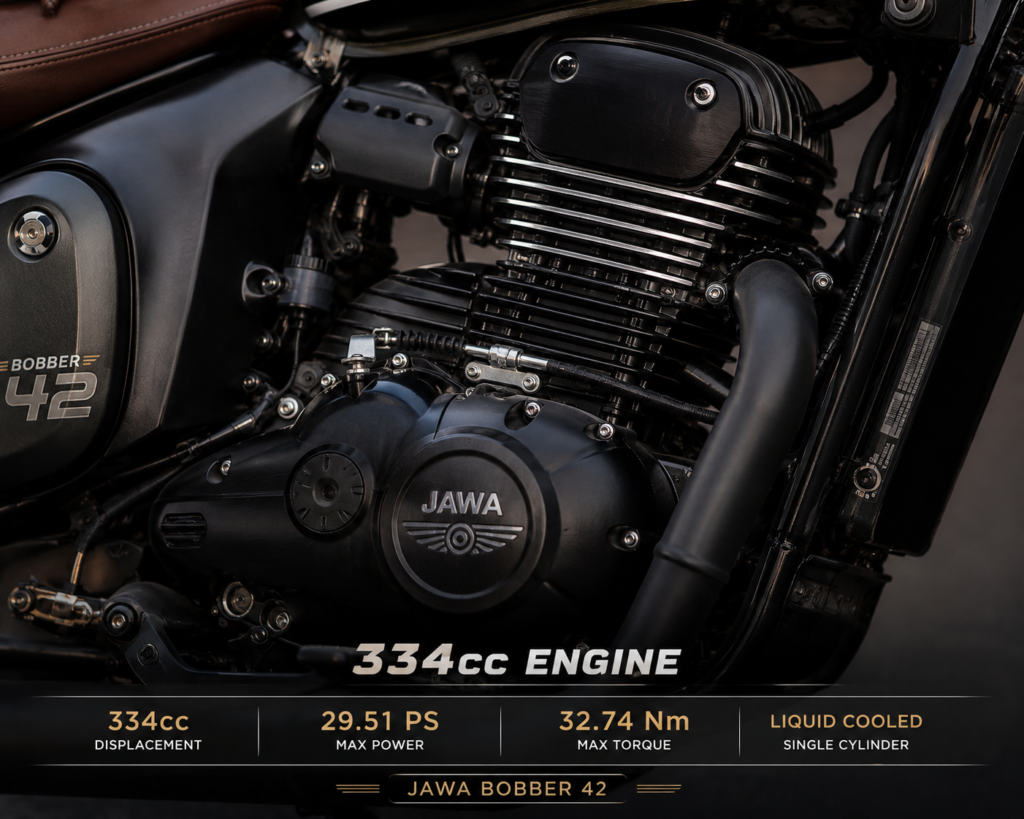
One of the most common misconceptions about the Jawa 42 Bobber among buyers who haven’t ridden one is that it’s a small, modest engine dressed up in dramatic styling. A brief stint in the saddle corrects that impression immediately.The bike is powered by a 334cc single-cylinder, liquid-cooled engine that delivers 29.9 PS of power and 32.74 Nm of torque, paired with a 6-speed gearbox and assist and slipper clutch. The engine’s torque curve makes cruising effortless, and the distinct exhaust note adds to the thrill of every ride.
That torque figure — 32.74 Nm — is the key number. For a cruiser motorcycle, torque is the currency that matters. It’s torque that gives you the confident, effortless pull when you roll on the throttle from a standstill, that makes overtaking on a highway feel unhurried and assured, and that defines the character of the motorcycle at the speeds most Indian riders actually use on a daily basis. At 32.74 Nm, the 42 Bobber has more torque than the Royal Enfield Classic 350’s 27 Nm — a fact that surprises most people who assume RE’s dominance in this space extends to every specification.The liquid-cooling system is another detail that deserves recognition. The advanced liquid-cooling system ensures consistent performance even during long highway journeys and summer commutes. In a country where summer temperatures in cities like Delhi, Hyderabad, and Pune regularly cross 40°C, this is not a small thing. Air-cooled engines in comparable motorcycles can heat-soak in severe traffic, delivering reduced performance and occasionally causing discomfort to the rider through heat radiating from the engine. The 42 Bobber’s liquid-cooled architecture keeps temperatures consistent, maintaining power delivery and rider comfort regardless of ambient conditions.
With a refined engine for 2025 offering smoother throttle response, the bike accelerates from 0–60 km/h in just 3.9 seconds and reaches a top speed of around 145 km/h. A sub-4-second 0–60 time in a motorcycle of this character and price is genuinely impressive and reflects the quality of the engine mapping work Jawa has done across successive updates.
The Assist and Slipper Clutch — A Feature That Changes How the Bike Feels Every Day
There are motorcycle features that exist on a spec sheet to impress during a showroom visit, and there are features that change how the motorcycle feels to ride every single day. The assist and slipper clutch in the Jawa 42 Bobber belongs firmly in the second category.The six-speed gearbox benefits from an assist and slipper clutch mechanism — a feature not available on the Perak — and this comes in handy in bumper-to-bumper traffic. The lever feels much softer than the unit on the Perak Bobber.
Let’s break down what this actually means. A standard clutch requires equal effort at all times — you squeeze it fully to pull away, and you squeeze it fully to change gears. An assist-and-slipper clutch has two functions. The “assist” function reduces the effort required to pull the lever, making clutch operation easier in traffic and reducing hand fatigue on long rides. The “slipper” function automatically reduces rear wheel lock-up risk when you downshift aggressively — when you suddenly close the throttle and downshift rapidly, a conventional clutch can cause the rear wheel to lock momentarily, which is unsettling and potentially dangerous. The slipper mechanism prevents this, giving the rider significantly more control in spirited riding situations.For the daily Mumbai or Delhi commuter who spends an hour in stop-start traffic every morning, the lighter clutch pull alone is a meaningful quality-of-life improvement. For the weekend rider who enjoys exploring hill roads and mountain passes, the slipper function adds a layer of confidence that makes the riding experience genuinely more enjoyable.
Slipper clutches are typically found on sports motorcycles priced significantly higher than the 42 Bobber. Having it in a neo-retro cruiser under ₹2.50 lakh is a statement about Jawa’s engineering priorities — and it’s a statement that benefits the rider directly.
A Fully Digital Instrument Cluster That Gives You Everything You Need
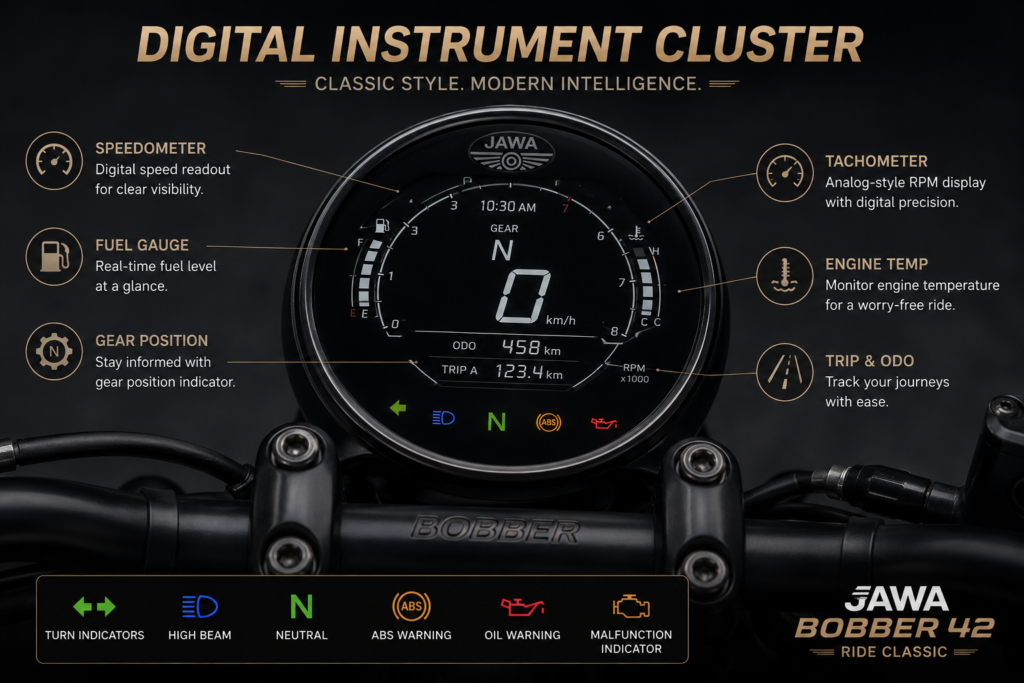
There’s an ongoing tension in the design of retro motorcycles between the desire for an authentic vintage aesthetic and the practical need for modern information. A circular analog speedometer might look perfectly period-correct, but it doesn’t tell you your fuel level, gear position, trip distance, or service reminder. The Jawa 42 Bobber has resolved this tension in a satisfying way.The digital instrument cluster displays speed, odometer, trip meter, fuel gauge, gear indicator, and time, with Type-A and Type-C USB chargers, hazard lights, and a side-stand engine cut-off sensor.
The fully digital display is sharp, readable in direct sunlight, and presents the information in a clean, uncluttered layout. The gear position indicator is particularly useful — knowing which gear you’re in at any given moment helps you make better riding decisions, particularly in city traffic where you’re constantly managing gear selection. The service reminder means you don’t need to manually track service intervals or keep a mileage log — the bike tells you when it needs attention.The headlight is among the best units tested in the recent past. The low beam has a good spread, while the high beam packs a commendable throw. Full-LED lighting all around means the 42 Bobber sees and is seen clearly in all conditions — a safety benefit that pays dividends every time you ride at dawn, dusk, or after dark.
The switchgear from the Yezdi motorcycles adds a touch of premium feel to the package while the USB charger enhances the utility value. Having USB Type-A and Type-C charging ports means your phone — which is increasingly your navigation device, music player, and communication hub on a long ride — stays charged throughout the journey. These are small practical touches, but they matter enormously in daily use.
Dual-Channel ABS — Safety Without Compromise, Standard Across All Variants
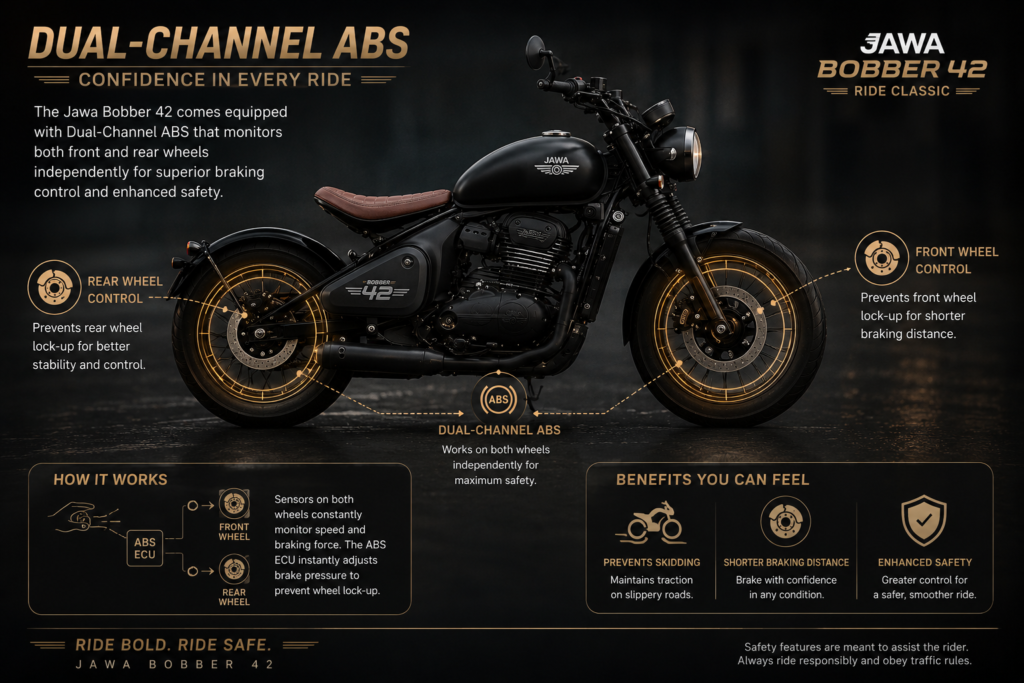
Safety technology on motorcycles is sometimes treated as a premium add-on — something you pay extra for in top-spec variants while base buyers make do with basic braking. The Jawa 42 Bobber takes a different approach: for safety, the bike is equipped with disc brakes at both front and rear along with dual-channel ABS. The braking setup offers strong stopping power and confidence, especially during sudden braking on highways.Dual-channel ABS — as opposed to single-channel ABS — monitors and prevents wheel lock-up independently at both the front and rear wheels. On a single-channel system, only the front wheel is protected; the rear wheel can still lock under hard braking, causing a skid. Dual-channel protection means that in any emergency braking scenario, regardless of whether you’re braking more with the front lever or the rear pedal, the system prevents both wheels from locking simultaneously.
On Indian roads, where road surfaces change quality without warning, where animals and pedestrians can step into traffic unexpectedly, and where sudden obstacles require rapid stops, dual-channel ABS is not a luxury feature — it’s a meaningful life-safety system. The fact that it’s standard across all variants of the 42 Bobber, not reserved for the most expensive trim, reflects Jawa’s commitment to accessible safety technology.The braking hardware uses ByBre-sourced callipers, which feel progressive. ByBre is a subsidiary of Brembo — the Italian brake specialist whose components are used in MotoGP and Superbike racing. Having Brembo-group calipers on an Indian motorcycle priced under ₹2.50 lakh is genuinely impressive and delivers braking feel and modulation that’s several grades above what budget motorcycle hardware typically offers.
The Ergonomics — A Riding Position That’s Both Stylish and Genuinely Comfortable
Motorcycle ergonomics is where style and function either coexist or conflict. On some cruisers, the low, dramatic stance looks spectacular in photographs but becomes genuinely uncomfortable after 30 minutes in the saddle. The Jawa 42 Bobber has been designed with enough thoughtfulness that the riding position feels natural rather than compromised.The low 740mm seat height suits riders of varying heights, while the forward-set footpegs and wide handlebars offer a relaxed riding posture. At 740mm, the seat height is accessible to a very wide range of Indian riders, including shorter riders who might struggle to flat-foot on taller adventure bikes. The low seat, combined with the forward-set footpegs, creates the classic bobber riding triangle — a position where your legs extend slightly forward, your upper body is upright, and your arms reach comfortably to the wide handlebars without stretching or cramping.
This posture has specific advantages for Indian riding conditions. In city traffic, the upright body position gives you better visibility over traffic ahead. At highway speeds, the forward peg position reduces wind fatigue by allowing your legs to absorb some of the wind pressure rather than your arms and core. On long rides, the relaxed posture means less tension in your shoulders and neck — which, for anyone who has spent six hours on a sportsbike hunched over clip-on bars, is an enormous quality-of-life benefit.The bike also features a 7-step adjustable monoshock at the rear and forward-set footpegs for improved comfort. The 7-step adjustability of the monoshock is a thoughtful engineering detail that allows the suspension preload to be tuned for different rider weights. A lighter rider can soften the preload for a more compliant ride; a heavier rider can stiffen it for better support. This adjustability is typically found on higher-priced motorcycles and reflects Jawa’s attention to making the bike genuinely usable for the diverse range of Indian riders.
The Exhaust Note — It Sounds as Good as It Looks
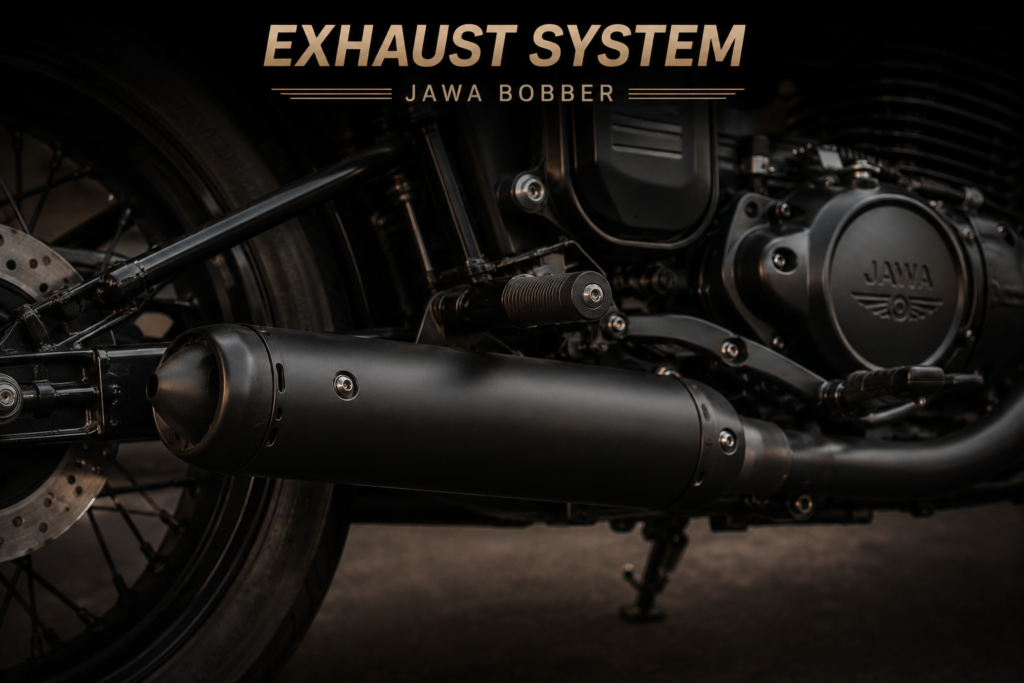
This might seem like a strange reason to include in a serious motorcycle buying guide, but anyone who has spent time around motorcycles will tell you: the exhaust note is not trivial. The way a motorcycle sounds defines a significant part of the riding experience. A great exhaust note creates an emotional connection with the machine that no specification sheet can quantify.The Jawa 42 Bobber has one of the most satisfying exhaust notes in its segment. The 334cc single-cylinder, liquid-cooled engine produces a deep, full-bodied thump at low revs that transitions to a crisp, punchy note as the revs rise. It’s not the artificial, over-amplified sound of some competitors. It’s the genuine voice of a well-engineered single-cylinder motor, and it’s the kind of sound that makes you look for excuses to accelerate.
The custom-style exhaust system — with its blacked-out headers and upswept can on certain variants — contributes both visually and acoustically to the motorcycle’s character. The positioning of the exhaust is deliberately designed to be visible from the right side of the bike, where it frames the engine and rear wheel in a composition that looks genuinely custom rather than factory-assembled.
Real owners consistently cite the exhaust note among the reasons they chose the 42 Bobber over rivals. One owner described it as a bike where “bold, unique, and full of character — the classic bobber design, deep exhaust sound, and relaxed riding make every ride special and enjoyable.” That emotional quality — that feeling of a machine with genuine personality — is what the 42 Bobber delivers that pure spec-sheet comparison misses entirely.
Pricing That Makes the Bobber Experience Accessible — ₹2.05 Lakh to ₹2.64 Lakh
The bobber motorcycle style, as it exists in the premium segment, typically requires a very large budget. Custom builders charge lakhs. Premium factory bobbers from international brands like Indian or Harley-Davidson cost ₹10 lakh and above. The Jawa 42 Bobber is one of the very few motorcycles in the world that delivers genuine bobber aesthetics and character at a price that Indian middle-class buyers can realistically access.The Jawa 42 Bobber price in India starts at ₹2.12 lakh (ex-showroom) and goes up to ₹2.64 lakh for the top variant. The on-road price varies across cities depending on taxes and registration.
Here’s how the variant ladder maps out for buyers:
Spoke Wheel Variant (Single-Channel ABS): The entry point into the 42 Bobber world. Gets the full design package, the 334cc engine, and the essential safety and feature suite. The spoke wheels on this variant are actually preferred by many buyers for their classic bobber authenticity — wire-spoke wheels are a trademark of genuine custom motorcycle culture and look far more period-correct than alloy wheels.
Spoke Wheel Variant (Dual-Channel ABS): The same spoke wheel aesthetic elevated with the dual-channel ABS system for enhanced safety. This is the recommended entry variant for most buyers who want the authentic bobber look with full braking safety.
Alloy Wheel Variant (Dual-Channel ABS): For buyers who want lower maintenance — alloy wheels don’t require spoke tensioning and are easier to keep clean — this variant offers the dual-ABS safety package with diamond-cut alloy wheels and the newer dual-tone colour options like Mystic Copper and Jasper Red.
Top Spec (Dual-Channel ABS, Premium Colours):The fully-loaded 42 Bobber experience with the complete colour palette, alloy wheels, and every available specification. At approximately ₹2.32–2.64 lakh, this remains significantly more affordable than any rival that delivers a comparable design experience.
Maintenance costs average ₹5,000–8,000 annually, supported by Jawa’s 200+ service centres. This cost of maintenance is comparable to Royal Enfield and significantly lower than premium international brands, making the total cost of ownership over 5 years genuinely reasonable for a motorcycle of this character.
The Liquid-Cooled Advantage — Why It Matters More Than You Think for Indian Summers
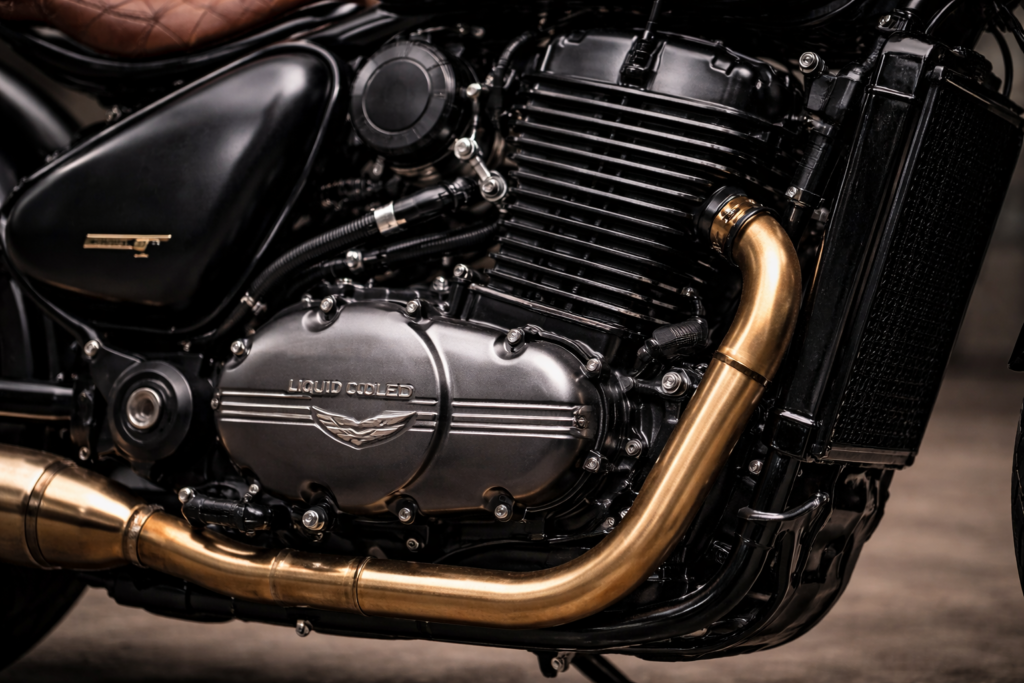
India’s climate is not kind to air-cooled engines. If you’ve ever sat on a Royal Enfield at a Delhi traffic signal in May, with the heat rising visibly off the engine fins and gradually warming your legs to an uncomfortable temperature, you’ll understand exactly what liquid-cooling solves.The advanced liquid-cooling system ensures consistent performance even during long highway journeys and summer commutes. The way liquid-cooling works is by circulating coolant fluid through channels within the engine block and cylinder head, absorbing heat and transferring it to a radiator where airflow dissipates it. This process maintains the engine at a consistent operating temperature regardless of ambient conditions, riding speed, or traffic density.
For the Indian rider, the practical benefits are multiple. First, the engine produces consistent power output regardless of heat — an air-cooled engine running hot will often lose power as the combustion chamber temperature exceeds optimal levels. Second, the heat radiation toward the rider is significantly reduced — a liquid-cooled engine runs cooler on the outside, making it far more comfortable in slow traffic on hot days. Third, the engine’s long-term reliability is improved because thermal stress on engine components is managed more consistently.
The liquid-cooling architecture also contributes to the 42 Bobber’s superior performance relative to its displacement. Squeezing nearly 30 bhp and 32.74 Nm from a 334cc single is partly possible because liquid-cooling allows tighter engine tolerances and more aggressive tuning than an air-cooled equivalent. This is why the 42 Bobber consistently outperforms larger-displacement air-cooled rivals in back-to-back performance tests.
30+ kmpl Mileage — Effortless Efficiency Without Sacrificing Character
A motorcycle with genuine performance and character can sometimes feel like it comes at the cost of efficiency. The Jawa 42 Bobber largely avoids that trade-off with a mileage figure that’s genuinely respectable for a performance-oriented cruiser.The motorcycle delivers an average mileage of 30–35 km/l, depending on riding conditions. In urban stop-start traffic, expect figures closer to 28–30 kmpl. On highways at a relaxed 80–90 km/h cruise, the mileage can improve to 33–35 kmpl. During road tests, a real-world city mileage figure of 30.56 kmpl was recorded — a number that’s honest and achievable for the typical Indian urban rider.
With mileage of 30–32 km/l, it balances performance and efficiency. The 13-litre fuel tank means a comfortable range of approximately 390–430 km on a full tank before you need to visit a pump — adequate for a long weekend road trip from Delhi to Jaipur, Bengaluru to Coorg, or Mumbai to Goa without excessive fuel stops.The efficiency is partly a product of the liquid-cooled architecture’s better thermal management, and partly a result of Jawa’s ECU mapping work across successive updates. Jawa engineers have reworked the ECU mapping for improved throttle response and efficiency, ensuring that riders experience the perfect mix of performance and practicality — a calibration that prioritises low and mid-range torque delivery while keeping fuel consumption in check.
The Jawa Heritage — Riding a Brand With 95 Years of Motorcycling History
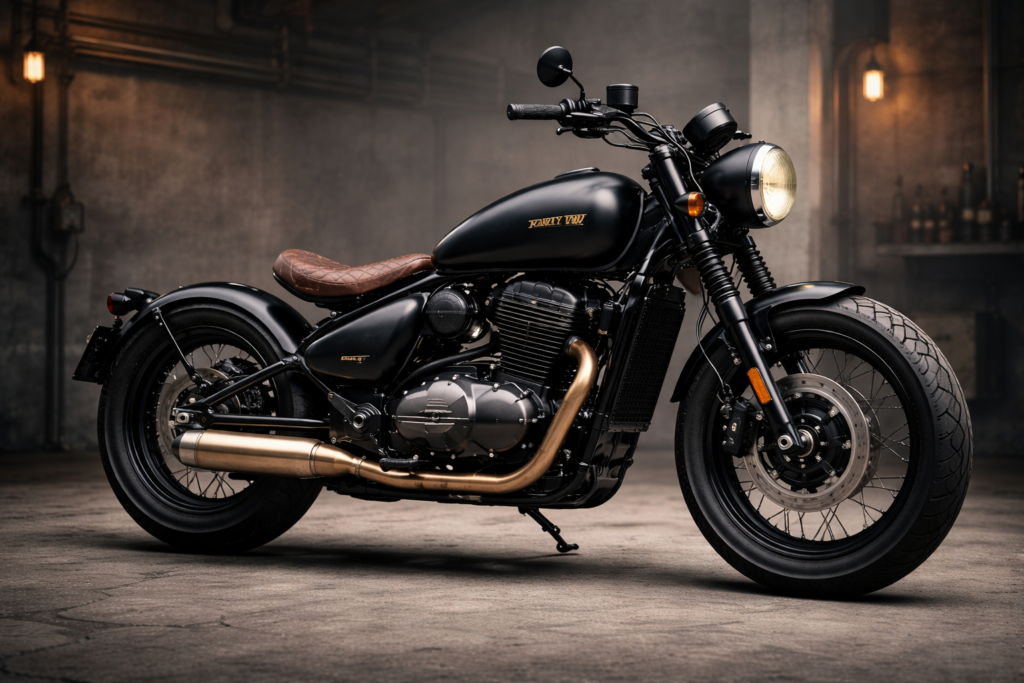
A motorcycle is not just a machine. For many riders, it’s a connection to something larger — a lineage, a culture, a community. And this is where the Jawa 42 Bobber offers something that most of its competitors simply cannot: a brand heritage that stretches back nearly a century and spans multiple continents.
The Jawa brand was founded in Czechoslovakia in 1929 by Frantisek Janeček. By the 1960s, Jawa motorcycles were among the most widely exported two-wheelers in the world, sold in over 120 countries. In India, Jawa motorcycles were assembled and sold from the 1960s through the 1990s, where they built a passionate following among riders who appreciated their engineering quality and distinctive character. When Jawa stopped production in India in the 1990s, the bikes didn’t disappear — they lived on in garages, in restoration projects, and in the memories of a generation of riders who still speak about their Jawas with a reverence that newer brands can’t quite manufacture.The revival of Jawa in India in 2018 — by Classic Legends, a joint venture involving Mahindra — was met with extraordinary enthusiasm precisely because the brand’s heritage was genuine. Today, Jawa motorcycles are made at Mahindra’s factory in Pithampur, Madhya Pradesh, where the plant handles final assembly, engine fitting, sub-assembly, and quality checks for all Jawa bikes sold in India. The Pithampur plant uses Mahindra’s strong supply chain and technology, which helps Jawa keep its build quality steady as production grows.
When you buy a Jawa 42 Bobber, you’re not buying the product of a newly-formed brand chasing market share. You’re buying a motorcycle from a name that has meant something to riders across seven decades and dozens of countries. That heritage doesn’t make the bike faster or more efficient — but it gives every ride a depth of meaning that a blank-slate brand simply cannot provide.
The Customisation Culture — Your Bobber Can Be Truly Yours
One of the most appealing aspects of the bobber motorcycle tradition is that it was never about buying and riding an off-the-shelf product. It was about buying a foundation and making it your own. The Jawa 42 Bobber lends itself to personalisation more naturally than almost any other Indian motorcycle in its price range, and this has spawned a thriving community of custom builders and enthusiastic owners who have taken the stock motorcycle as their canvas.
MS Dhoni received a customised Jawa 42 Bobber with a bespoke bottle-green paint scheme and golden pinstripes — a public example that showcases the motorcycle’s potential as a platform for individual expression at the highest level. When one of India’s most celebrated sportsmen chooses a motorcycle as a personalisation canvas, it sends a clear message about the bike’s character.The aftermarket ecosystem around the Jawa 42 Bobber includes custom seats ranging from diamond-stitched leather to bare-metal cafe saddles, aftermarket exhaust systems that alter the sound character, solo seat cowls for the pillion area, custom foot controls, bar-end mirrors, and a wide range of paint and wrap options that can transform the motorcycle’s personality entirely. Jawa’s own accessories catalogue offers genuine parts that maintain the bike’s warranty while personalising its appearance.
The design language of the 42 Bobber — with its relatively minimal bodywork and clean visual lines — is particularly well-suited to customisation. Unlike a motorcycle with extensive body panels, fairings, and integrated styling elements, the Bobber’s open frame and minimal fenders give customisers freedom to add, modify, and reimagine without fighting against an overcrowded design. The result is a motorcycle community that takes genuine pride in individual expression, and a used bike market where no two examples look exactly the same.
The Kerb Weight — Lighter Than It Looks, More Agile Than You Expect
One of the persistent myths about cruiser-style motorcycles is that they’re heavy, cumbersome machines suited only for open highways and not for urban riding. The Jawa 42 Bobber challenges this assumption directly with a kerb weight that makes it significantly more manageable than its visual presence suggests.
The Jawa 42 Bobber weighs 185 kg. Compare this to the Royal Enfield Classic 350 at 195 kg, the Meteor 350 at approximately 191 kg, or the Honda CB350 at around 181 kg. The 42 Bobber’s weight is entirely competitive within its segment, and critically, its weight distribution — with the low centre of gravity inherent in the bobber stance — makes it feel lighter and more nimble than the number suggests.The turning radius is relatively short, making it easy to filter through bumper-to-bumper traffic. For riders navigating the congested streets of Indian cities — the narrow lanes of Old Delhi, the constant lane-switching of Bengaluru’s Outer Ring Road, the perpetual gridlock of Mumbai’s Western Express Highway — a motorcycle’s maneuverability in slow-speed urban conditions is arguably more relevant than its highway cruising speed. The 42 Bobber’s combination of modest weight, low seat height, and short turning radius makes it a genuinely practical urban motorcycle dressed in weekend cruiser clothing.
The Jawa bike feels lighter to get off the side stand and to maneuver through tight city traffic compared to several rivals. When you’re parking on an incline or navigating a tight U-turn in a crowded parking area, that lighter, more responsive feel translates directly to confidence and ease.
The Jawa Community and Ownership Experience — You’re Buying Into a Brotherhood
The motorcycle community around the Jawa brand in India is one of the more passionate and genuinely enthusiastic in the country. Jawa Yezdi Club chapters exist in over 60 Indian cities, organising regular rides, meets, and events that give owners a social experience that extends well beyond the purchase transaction.
This matters because motorcycle ownership, particularly for a lifestyle-oriented machine like the 42 Bobber, is not a solitary experience. It’s something that connects you to other riders who share your sensibility — your appreciation for design, your preference for character over raw performance numbers, your attachment to heritage and individuality. Walking up to a group of Jawa riders at a weekend meet and having an immediate conversation about modifications, riding routes, and shared experiences is a qualitatively different ownership experience from buying a utility commuter.Jawa’s expansion of online sales via Flipkart and Amazon in 40+ Indian cities from 2024–2025 signals a push towards digital retail and wider accessibility. This wider accessibility means that riders in tier-2 and tier-3 cities — where premium motorcycle options have historically been limited — can now access the Jawa 42 Bobber more easily than ever before. Coupled with Jawa’s expanding service network, the ownership experience is becoming more supportive and less reliant on proximity to major city dealerships.
The brand has resurrected like a phoenix and kickstarted the cult it was always known for — and for buyers considering the 42 Bobber, joining that cult is part of the appeal. It’s a bike that gets conversations started at petrol stations, in parking lots, and on social media. Few motorcycles at this price generate the kind of genuine, unsolicited attention that the 42 Bobber consistently receives.
The Honest Comparison — Where the Jawa 42 Bobber Wins and Where to Manage Your Expectations
Any honest motorcycle review must address competition and limitations directly, and we’re not going to avoid that here. The Jawa 42 Bobber has genuine strengths over its rivals, and it also has areas where buyers should go in with clear eyes.
Where the Jawa 42 Bobber wins clearly:
The 42 Bobber features a decent number of features, fairly agile handling, better brakes, lighter kerb weight, and quicker acceleration — all of which make it a relatively more involving motorcycle to ride. These are not small advantages — they add up to a motorcycle that’s more engaging and more dynamic on a spirited ride than the Royal Enfield Classic 350. For riders who want their neo-retro motorcycle to have a sporting edge underneath its vintage clothing, the 42 Bobber delivers.
The Jawa Bobber 42 adds a digital speedometer and fuel gauge, which blends modernity with its retro look. Both bikes now offer dual-channel ABS and digital-analog instrumentation, but the Classic 350 features Tripper Navigation in select variants. The 42 Bobber’s fully-digital cluster is more information-rich than the Classic 350’s semi-digital setup, giving it a technology advantage in daily usability.
On design uniqueness, the 42 Bobber wins comfortably. No other motorcycle at this price in India offers a comparable bobber-specific design execution. The floating seat, chopped fenders, forward pegs, and teardrop tank collectively create an aesthetic that stands apart from every rival.
Where to manage expectations honestly:
The 42 Bobber’s prominent shortcomings include a fussy gearbox, crude engine character at high revs, and stiff ride quality. If these issues are ironed out, the desirability will definitely go several notches higher. The 2025 updates to the ECU and transmission have improved these issues, but buyers who are accustomed to the silky-smooth powertrains of Japanese motorcycles should expect a more characterful, less refined feel — which many Jawa owners consider part of the bike’s appeal rather than a defect.The single-seat setup makes it a pure solo motorcycle, with no standard pillion seat. This is a design choice, not an oversight — the bobber tradition demands a single seat. But buyers who regularly carry a pillion passenger should either look at the pillion accessory option or consider whether this is the right motorcycle for their use case.
The lack of advanced features like GPS, riding modes, or cruise control may disappoint tech-savvy riders. The Jawa 42 Bobber is, by design and intent, a motorcycle that prioritises the riding experience over digital sophistication. It’s not a connected, app-linked, mode-switching machine — it’s a raw, honest motorcycle that rewards the rider who wants to focus on the road, the engine, and the experience, rather than a screen full of riding telemetry.
Jawa 42 Bobber 2025–26: Full Specifications at a Glance
| Price Range | ₹2.05 lakh – ₹2.64 lakh (ex-showroom) |
| Engine | 334cc, single-cylinder, liquid-cooled, 4-stroke, DOHC |
| Power | 29.9 PS @ 7,500 rpm |
| Torque | 32.74 Nm @ 6,000 rpm |
| Gearbox | 6-speed with assist and slipper clutch |
| Mileage (Real-World) | 28–35 kmpl (city/highway) |
| Top Speed | 145 km/h |
| 0–60 km/h | 3.9 seconds |
| Fuel Tank | 13 litres |
| Seat Height | 740 mm |
| Kerb Weight | 185 kg |
| Front Suspension | Telescopic forks |
| Rear Suspension | 7-step adjustable monoshock |
| Front Brake | Disc, ByBre calliper |
| Rear Brake | Disc, ByBre calliper |
| ABS | Dual-channel (standard on most variants) |
| Instrument Cluster | Fully digital LCD |
| Lighting | Full LED (headlamp + tail lamp + DRLs) |
| Charging | USB Type-A and Type-C ports |
| Colours | Mystic Copper, Moonstone White, Jasper Red, Black Mirror, Red Sheen |
| Variants | 5 variants (spoke/alloy × single/dual ABS combinations) |
| Compliance | BS6 Phase 2 |
| Warranty | 2 years (extendable) |
Final Verdict: Some Motorcycles Move People. The Jawa Bobber 42 Moves Souls.
Buying a motorcycle is, at some level, always an emotional decision. Even the most rational spec-sheet analysis eventually comes down to how the machine makes you feel — whether it puts a smile on your face every time you walk toward it, whether it makes your morning commute feel less like a chore and more like an escape, whether it gives you a reason to take the long way home.
The Jawa 42 Bobber does all of these things. It does them with a 334cc liquid-cooled engine that has more torque than its segment leader. It does them with a design that stops strangers in their tracks. It does them with a heritage that gives the experience depth and meaning. And it does them at a price that most Indian motorcycle buyers can realistically achieve.Is it the most refined motorcycle in its class? No. Is it the most practical? Possibly not if you carry a pillion daily. Is it the most technologically advanced? Definitely not. But is it the most soul-stirring, character-rich, design-courageous motorcycle available in India under ₹3 lakh? Without question, yes.
The Jawa 42 Bobber isn’t just a motorcycle. It’s a point of view. And for riders who share that point of view, there is simply no better motorcycle at this price.
The8 Jawa Bobber 42 exemplifies a unique blend of character and heritage, distinguishing itself as a soulful motorcycle choice for enthusiasts in India during 2025-26. With its striking design and powerful performance, it resonates with riders seeking an authentic experience without exceeding a budget of ₹3 lakh.
 Sagar
Sagar