 Sagar
Sagar Introduction: The Legend Earns Its Third Act — And India Has Been Waiting
There are cars that sell. There are cars that impress. And then there are cars that become a part of how a generation of Indian drivers thinks about what an SUV should feel like. The Renault Duster belongs to that third, rarer category. When it first arrived in India in 2012, it didn’t just enter a market — it practically created the compact SUV segment as Indians know it today. It showed buyers that a sub-₹10 lakh vehicle could have genuine road presence, real off-road ability, and a quality of ride that made every Indian highway feel less like an obstacle course and more like a pleasure drive.
After exiting the Indian market in 2022, the Duster left a gap — both commercially and emotionally — that no rival entirely filled. Indian car enthusiasts have been tracking test mule sightings and industry rumours for years, waiting for the comeback. And on March 17, 2026, Renault India made it official. The third-generation Renault Duster was launched with prices starting at ₹10.49 lakh (ex-showroom), built on a brand-new platform, powered by new turbo-petrol engines (with a strong hybrid coming by Diwali 2026), loaded with 17 ADAS features, and rated 5 stars by Bharat NCAP. The comeback wasn’t just good. It was spectacular.
In this article, we give you 15 detailed, research-backed reasons why the new Renault Duster deserves your serious attention — whether you’re buying your first SUV, upgrading from a hatchback, switching from a rival, or simply want the most complete, character-filled SUV you can buy in India under ₹19 lakh in 2026.
1. Built on the All-New Renault Group Modular Platform — A Foundation That Changes Everything
The single most important thing to understand about the third-generation Renault Duster is not any individual feature or specification — it’s the platform the car is built on. Because the platform determines everything else: safety, ride quality, NVH levels, electrification potential, and the long-term adaptability of the product.
The new Duster is built on the Renault Group Modular Platform (RGMP) — a completely new architecture that replaces the older CMF-B platform used in the previous generation. This platform was developed with a clear purpose: to handle the extremes of global markets, from European motorways to Indian potholed state highways, without compromise. The RGMP uses advanced high-strength steel in its structural zones, which simultaneously improves crash protection and reduces overall body weight — a combination that is the holy grail of modern automotive engineering.
For Indian buyers, the implications of this platform are immediate and tangible. The structural rigidity of the new Duster is significantly higher than its predecessor, which translates directly into a cabin that feels more solid and less susceptible to the flexing and shaking that cheaper platforms exhibit when you hit a rough patch of road. The platform also delivers class-leading approach and departure angles — critical for the off-road and rough-road capability that has always defined the Duster’s character.
Perhaps most forward-looking is the RGMP’s electrification readiness. The same platform underpins Renault’s approach to strong hybrid powertrains, which is exactly why the E-Tech strong hybrid variant is a natural addition to the Duster lineup — arriving by Diwali 2026. The platform isn’t just meeting today’s requirements; it’s built for the next decade of Indian automotive evolution.
2. Three Powertrain Options — Including India’s Most Powerful Turbo in This Segment
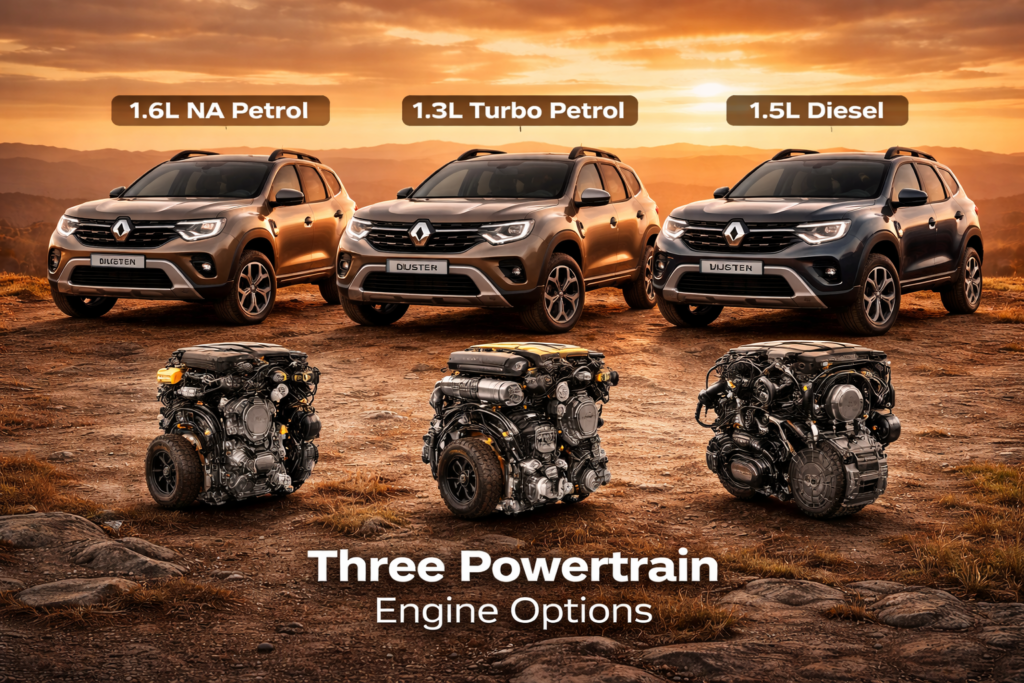
Renault hasn’t offered the new Duster with a one-size-fits-all engine philosophy. Instead, they’ve created a thoughtfully graduated powertrain ladder that has a genuine answer for every kind of Indian driver — from the city commuter who wants efficiency to the highway enthusiast who wants performance, and the urban hybrid buyer who wants both.
The 1.0-litre TCe 100 Turbo Petrol is the entry-level engine, producing 99bhp and 160Nm of torque, paired exclusively with a 6-speed manual gearbox. This is the engine for the buyer who wants the Duster nameplate and the Duster character on a managed budget. It’s smooth, relatively fuel-efficient, and entirely adequate for city and light highway use. Renault has tuned it for easy drivability — it’s not a rev-hungry engine, but a relaxed, torque-from-low-down unit that suits Indian stop-start traffic well.
The 1.3-litre TCe 160 Turbo Petrol is where the Duster truly comes alive. Producing 163bhp and a massive 280Nm of torque, this is officially the most powerful turbocharged engine in its segment in India. Paired with either a 6-speed manual or a 6-speed wet-clutch DCT automatic gearbox, the TCe 160 delivers performance that genuinely justifies the word. The DCT-equipped variant hit 0–100 km/h in 10.4 seconds during testing — a genuinely quick number for a mid-size SUV. The wet-clutch DCT, in particular, impresses with its torque-converter-like smoothness in city traffic, making it one of the most refined automatic SUV driving experiences in this price band.
The 1.8-litre E-Tech Strong Hybrid is the future — and it’s already generating extraordinary demand. Combining a 1.8-litre naturally aspirated petrol engine with a 49bhp traction motor, a 20bhp hybrid starter generator, and a 1.4kWh battery pack, the E-Tech produces a combined output of 160hp and 172Nm, mated to an 8-speed automatic transmission. Renault claims the car can operate in electric mode for a large proportion of city driving. In major Indian metro markets, nearly 40% of pre-booking customers chose the hybrid — and the entire 2026 production allocation sold out before the price was even officially announced. Deliveries are expected around Diwali 2026.
3. 5-Star Bharat NCAP Safety Rating — Certified, Not Just Claimed
In April 2026, just weeks after the Duster’s launch, Bharat NCAP awarded the new Renault Duster a 5-star safety rating — confirming what Renault had engineered toward from the beginning of the product’s development. This achievement carries real weight in a segment where safety credibility is increasingly being used as a decisive purchase criterion by informed Indian buyers.
The Bharat NCAP crash testing protocol involves frontal offset deformable barrier tests at 64 km/h, side movable deformable barrier tests at 50 km/h, and side pole impact tests at 29 km/h. The Duster’s performance across these tests reflects the structural strength of the RGMP platform, the calibration of its 6 standard airbags, and the effectiveness of its electronic safety systems in real-world crash scenarios.
What’s particularly notable is that this 5-star rating applies across the Duster’s variant range, meaning even buyers of the base Authentic trim are purchasing a car that has been tested and certified to the highest Indian safety standards. This isn’t a top-spec-only achievement — it’s a baseline commitment to occupant protection at every price point.
Standard safety features across all Duster variants include 6 airbags, ABS with EBD, Electronic Stability Control (ESC), Traction Control, ISOFIX child seat mounts, front and rear parking sensors, speed alert, 3-point seatbelts for all occupants, and a seat belt reminder system. Higher variants add the 360-degree camera, Level 2 ADAS (17 functions), electronic parking brake with auto hold, and tyre pressure monitoring. This is a comprehensive, layered safety ecosystem that rivals cars costing considerably more.
4. Level 2 ADAS With 17 Features — The Most Advanced Safety Tech in This Price Band
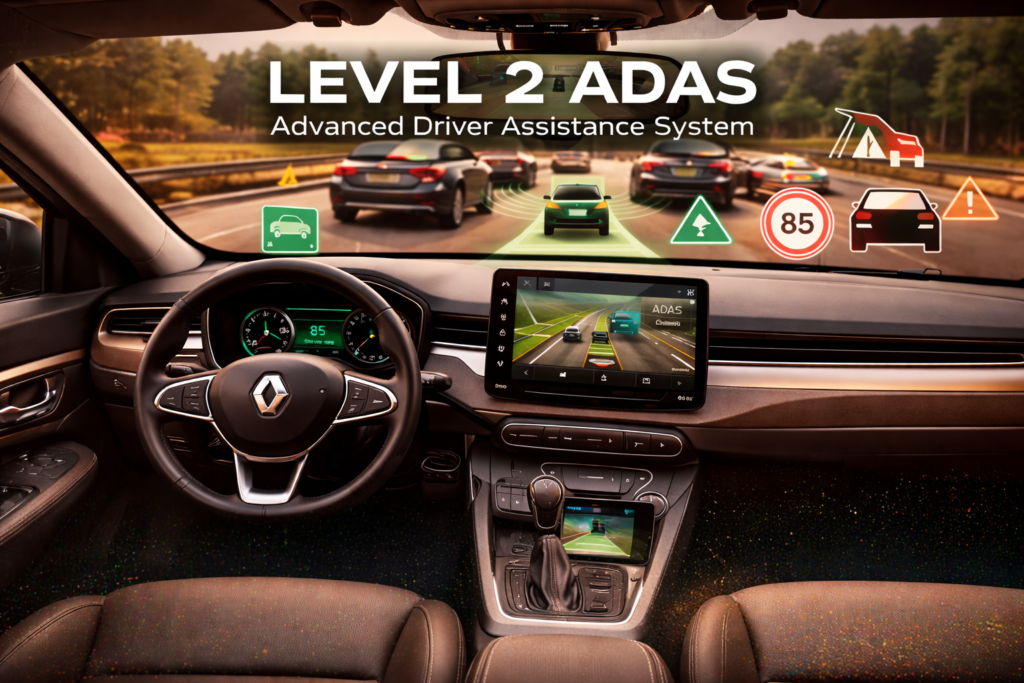
Renault calls its active safety philosophy the “Human First” programme — and it backs up that branding with a genuinely comprehensive suite of 17 ADAS features available on higher Duster variants. Level 2 ADAS means the car can simultaneously manage both steering and speed control in certain scenarios, reducing driver fatigue and actively preventing accidents.
The 17 ADAS functions are not token inclusions. They represent a thoughtful, practical set of systems calibrated for real Indian road conditions:
- Autonomous Emergency Braking (AEB):
- The system detects vehicles, pedestrians, and cyclists in the car’s path and can automatically apply brakes if the driver fails to respond in time. On chaotic urban roads and highways where sudden stops are common, this feature can genuinely prevent collisions.
- Adaptive Cruise Control (ACC):
- Unlike basic cruise control, ACC maintains a set speed and a safe gap to the vehicle ahead, automatically decelerating and accelerating in traffic. For long highway drives on the Mumbai–Pune Expressway or the Yamuna Expressway, this feature transforms the experience from exhausting to genuinely relaxed.
- Lane Departure Warning and Lane Keeping Assist (LKA):
- If the car drifts out of its lane without a turn signal, it warns the driver and gently steers back. On multi-lane highways where attention can lapse over long distances, LKA is a genuine life-safety feature.
- Blind Spot Monitoring:
- Sensors in the rear quarters detect vehicles in the driver’s blind spot and provide a visual warning in the door mirror. This is particularly valuable on Indian roads where motorcycles frequently occupy blind spot zones at unpredictable moments.
- Traffic Sign Recognition:
- The car reads road signs using a forward camera and displays speed limits and other information on the driver’s instrument cluster, helping the driver stay aware of changing road conditions.
The combination of passive safety (5-star BNCAP, 6 airbags, strong structure) and active safety (17 ADAS features) makes the new Duster one of the most comprehensively safe SUVs in the ₹10–19 lakh price range in India — full stop.
5. The Multimedia System With Google Built-In — Connectivity That Genuinely Impresses
If there’s a single interior technology that makes the new Duster feel like a product from a different era compared to the old model, it’s the OpenR Link multimedia system with Google built-in. This is not just a touchscreen with Android Auto and Apple CarPlay — it’s a fundamentally different approach to in-car connectivity.
The 10.1-inch OpenR Link infotainment display runs native Google services — meaning Google Maps, Google Assistant, and the Google Play Store are built directly into the car’s operating system, not just mirrored from your phone. This is a critical distinction. It means real-time traffic-adjusted navigation works even when your phone’s battery is dead or your mobile data is spotty. It means you can download apps directly to the car. It means Google Assistant can respond to voice commands for navigation, music, and phone calls without needing your phone to be connected at all.
Paired with this is a 10.25-inch TFT digital instrument cluster on higher variants (7-inch on lower), which can replicate navigation maps, ADAS status, trip information, and driver-customisable displays. The driver-facing digital screen means you get turn-by-turn navigation arrows directly in your line of sight, reducing the time your eyes leave the road.
The system also supports wireless Apple CarPlay and Android Auto, a wireless fast charger with magnetic grip in the centre console, and OTA (Over-the-Air) software updates — meaning the car’s software can be updated throughout its lifecycle without a service centre visit. For buyers who have lived with infotainment systems that became obsolete within two years of purchase, OTA capability is a meaningful long-term value-add.
The Duster becomes the first SUV in its category to offer the OpenR Link multimedia system with Google built-in — a segment-first distinction that sets a new standard for connected car technology at this price point.
6. 212mm Ground Clearance and Genuine Off-Road DNA — Because the Duster Was Always Built for Real Roads
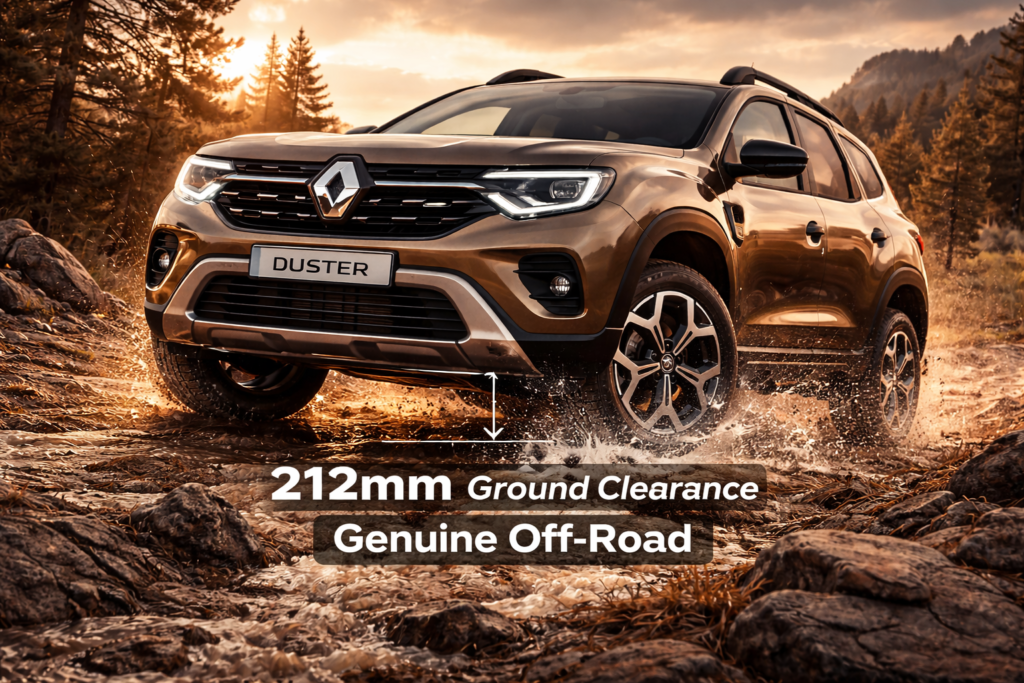
One of the defining characteristics of the original Renault Duster that made India fall in love with it was its willingness to go where other cars wouldn’t. That spirit is not just preserved in the third generation — it’s been elevated with properly engineered numbers that put the new Duster among the most capable daily-drive SUVs in its class.
The new Renault Duster offers 212mm of ground clearance — a figure that Renault describes as “best-in-segment” at its price point. For Indian buyers, this number translates directly into confidence: confidence when navigating the flooded streets of Mumbai’s monsoon season, confidence when turning off a highway into a village road that nobody has bothered to repave in a decade, confidence when a speed breaker appears without warning at 70 km/h, and confidence when a weekend adventure takes you onto an unpaved forest track in Coorg or Spiti.
The RGMP platform’s articulated suspension setup — MacPherson struts at the front and a twist beam with coil springs at the rear — is calibrated specifically for this combination of road-going comfort and off-pavement capability. Reviewers at Motors77 noted the suspension exhibits “European firmness at low speeds but translates to excellent high-speed stability,” with “sharp bumps and potholes filtered effectively with minimal cabin intrusion.” The 225/55 R18 tyres on the top variants provide an additional layer of cushioning and road-holding that contributes meaningfully to the ride quality.
The three Multi-Sense drive modes — Eco, Comfort, and Perso — allow the driver to adjust the car’s character based on the terrain and mood of the moment. In Eco mode, throttle response and fuel consumption are optimised for highway cruising. In Comfort mode, the suspension and steering responses are tuned for relaxed urban driving. In Perso mode, the driver can fully customise the combination of steering weight, throttle response, and even the ambient lighting colour — a feature that’s more personality than practicality but is genuinely enjoyable.
7. A Panoramic Sunroof Exclusive to the Indian Market — Renault Listened to What India Wanted
Here’s a detail that reveals just how specifically Renault has thought about the Indian market with this generation: the Duster’s panoramic sunroof is exclusive to the India-spec model and is not offered on the international versions of the same car. Renault’s product team clearly understood that the panoramic sunroof is not a luxury for Indian buyers — it’s a near-mandatory feature that influences purchase decisions at every price level above ₹12 lakh.
The panoramic sunroof on the Duster is genuinely large — it extends across a significant portion of the roof and can be controlled via the infotainment system. For rear passengers, it dramatically transforms the sense of space and airiness in the cabin. On evening drives, with the sunroof tilted and a clear sky above, the Duster cabin feels more like a lounge than a car interior.
Adding the panoramic sunroof specifically for India while keeping it off the global spec is a meaningful gesture — it says that Renault isn’t treating India as a market that gets a slightly trimmed version of what Europe receives. Instead, India gets something that Europe doesn’t. That’s a statement of market respect, and it reflects in the product’s overall positioning.
8. 518-Litre Boot Space — The Most Generous in Its Segment
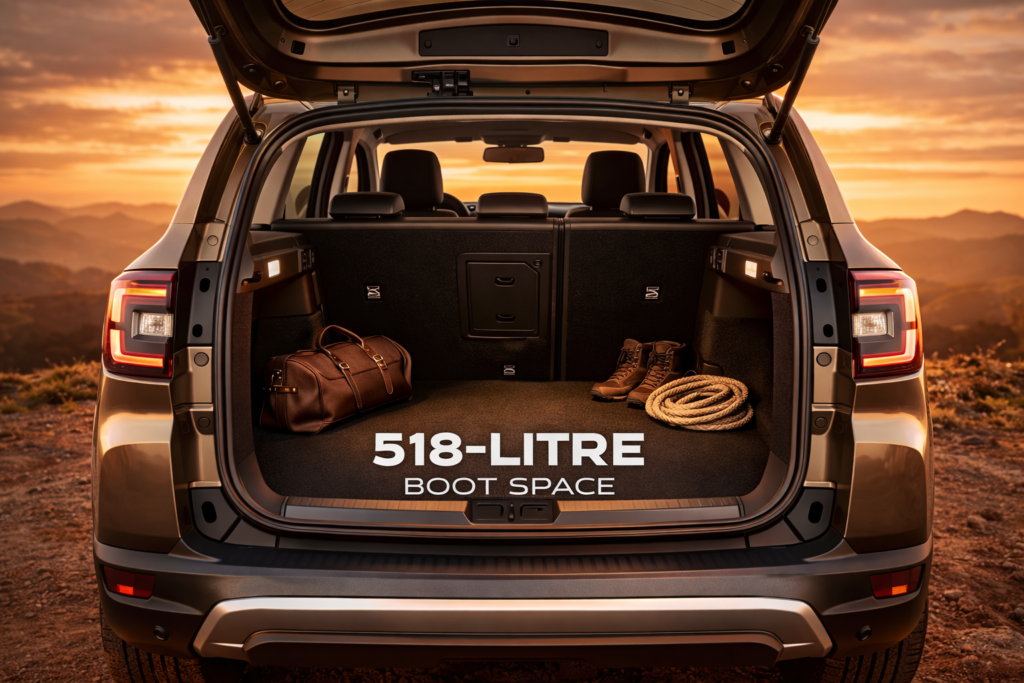
Space matters. Especially when you’re buying a family SUV that needs to handle airport runs, weekend road trips, grocery hauls, and school bag piles simultaneously. And the new Renault Duster delivers space in its boot that genuinely sets a benchmark: 518 litres measured to the parcel shelf, expandable to 700 litres when loaded to the roofline with the rear seats in use, and further extendable with the 60:40 split-folding rear seats folded flat.
To put 518 litres in context: many rivals in this segment offer 400–450 litres of boot space. The Duster’s extra 70–100 litres is not a cosmetic number — it’s the difference between fitting two large suitcases and three, or between a comfortable grocery run and a stressful Tetris game with shopping bags.
The electric-powered tailgate on higher variants adds a quality-of-life detail that families will genuinely appreciate. If you’re returning from a shopping trip with hands full, or unloading luggage at an airport, being able to open the boot with a foot swipe or a key fob button is a small convenience that, used daily, becomes a feature you’d rather not live without.
The interior also benefits from thoughtful packaging elsewhere: the elevated centre console houses the e-shifter (on DCT variants), a cooled storage compartment, and the wireless charging pad. Door pockets are sized practically. The rear seat passengers get a rear armrest with cup holders and good knee clearance. The overall sense is of a car that’s been packaged by people who actually thought about how families use SUVs in real life.
9. 48-Colour Ambient Lighting and Electric Front Seats — Premiumness You Can See and Feel
Luxury features used to be the exclusive domain of cars that cost ₹30 lakh and above. The new Renault Duster is changing that equation systematically — and two features in particular stand out for the way they elevate the daily driving and sitting experience.
The 48-colour ambient lighting system is one of those details that sounds like a minor marketing talking point until you’ve experienced it in person. Available as part of the Multi-Sense personalisation system, the ambient lighting can be adjusted through 48 distinct colour combinations across the dashboard, door panels, and footwells. In Perso drive mode, you can create your own specific ambience — warm amber for a relaxed evening drive, cool blue for a focused highway stint, or vibrant red when you want the car to match your mood. The lighting integrates with the drive mode selection, so when you switch modes, the cabin’s visual character shifts with it.
The 6-way electrically adjustable front seats with manual lumbar support are another genuine upgrade over most competitors at this price. Six-way electric adjustment allows the seat to move forward/backward, height up/down, and seatback recline forward/backward — all via a button, not a manual lever. For drivers who share the car with family members of different heights and seating preferences, this is a meaningfully more convenient experience. The seats are also ventilated on higher variants, which in the context of Indian summers — where cabin temperatures can exceed 50°C when parked in the sun — is not a luxury but a genuine comfort necessity.
10. Pricing That Challenges the Entire Segment — ₹10.49 Lakh to ₹18.69 Lakh
Renault has priced the new Duster with evident aggression, establishing a range that challenges established rivals from the entry level all the way to the fully-loaded top spec. The lineup spans ₹10.49 lakh to ₹18.69 lakh (ex-showroom) across five main variants — Authentic, Evolution, Techno, Techno Plus, and Iconic — with an Iconic Launch Edition available as a special introductory trim.
Here’s how the value proposition maps across the variant ladder:
- Authentic (₹10.49 lakh, 1.0T MT): The entry point. Standard 6 airbags, full LED lighting, 7-inch TFT driver display, rear AC vents, power windows with auto up/down function, remote keyless entry, and 35 standard safety features. On 17-inch steel wheels — functional and honest at this price point.
- Evolution (approx. ₹12–13 lakh): Steps up with 17-inch alloy wheels, the 10.1-inch OpenR Link infotainment system with wireless Apple CarPlay and Android Auto, a wireless charger, roof rails, and additional comfort features. This is the minimum variant most family buyers should seriously consider.
- Techno (approx. ₹14–15.5 lakh): The sweet spot. Adds the panoramic sunroof, 360-degree camera, dual-zone climate control, 6-way electric front seats, ventilated front seats, and higher-quality audio. This is where the Duster’s character as a premium SUV truly comes alive.
- Techno Plus (approx. ₹16–17 lakh): Adds the 10.25-inch digital cluster, electric tailgate, additional ADAS features, and premium interior details. A significant step up in technology and daily convenience.
- Iconic (approx. ₹17.5–18.69 lakh): The flagship. All 17 ADAS features, the full ambient lighting system, 48-colour customisation, top-spec audio system, and the complete connected car experience. The Iconic Launch Edition adds exclusive yellow decals and adventure black alloy wheels.
The Duster also came with an R-Pass pre-booking programme that offered an introductory price of ₹10.29 lakh until March 31, 2026 — a ₹20,000 saving on the already competitive base price. Renault has also announced a 7-year/1,50,000 km warranty through its Renault Forever programme — one of the most comprehensive manufacturer warranties in the Indian market.
11. A Design That’s Rugged, Road-Dominating, and Unmistakably Duster
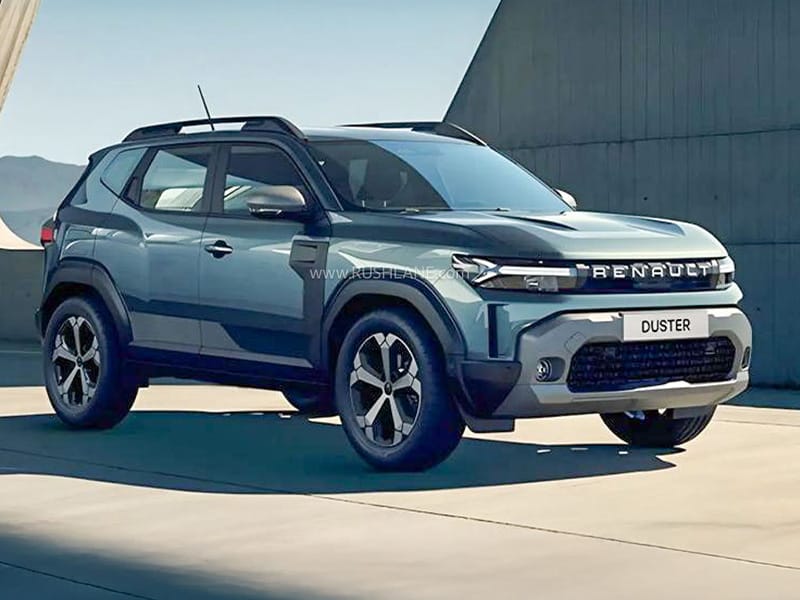
Design is always personal. But the new Renault Duster’s exterior manages to walk a rare line — it references the heritage that made the original beloved while presenting a modern, assertive face that stands out in a segment full of cars trying hard to look similar to each other.
The front end features full LED headlights with distinctive eyebrow-shaped DRLs — a signature element that’s recognizable from a distance and gives the Duster a focused, intentional expression. The wide front bumper with integrated skid plates (matching at the rear) reinforces the off-road narrative without looking theatrical. The bold ‘DUSTER’ lettering on the front grille is a design choice borrowed from Renault’s retro-modern playbook and gives the car an unapologetic, confident identity.
The side profile features pronounced fender flares, generous body cladding, roof rails, and C-pillar-mounted rear door handles — a clever design detail that gives the profile a smooth, coupe-like flow while keeping the door functionality intuitive. On higher variants, 18-inch diamond-cut alloy wheels fill the arches properly, giving the car the planted, purposeful stance that SUV buyers want to see.
At the rear, triangular LED tail lamps connected by a thin LED light bar create a horizontal visual signature that reads as modern and cohesive. The dual-ridge roof spoiler and the sculpted rear bumper with silver surrounds complete a design that looks confident from every angle.
Colour options include Moonlight Silver, Stealth Black, Pearl White, Mountain Jade Green, Sunset Red, and River Blue as monotones, plus four dual-tone combinations pairing the body colours with a Stealth Black roof — a palette that caters to adventurous personalities as much as classic sensibilities.
12. The Interior — A Driver-Centric Cockpit With Premium Materials and Smart Storage
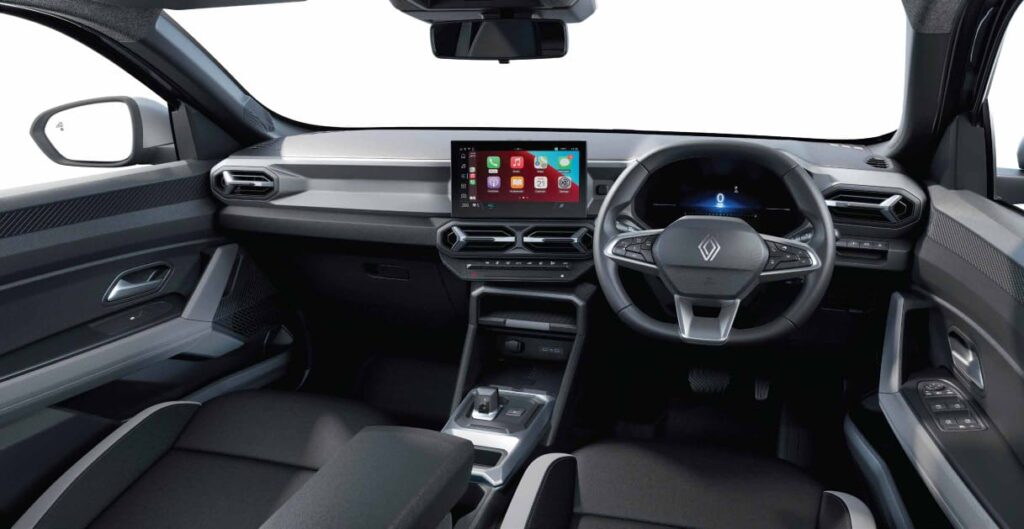
Step inside the new Duster and the cabin immediately communicates a deliberate philosophy: this is a driver’s car that doesn’t forget its passengers. The dashboard is horizontal in its primary layout, anchored by the large 10.1-inch OpenR Link screen on the centre stack and framed by angular, chunky AC vents arranged vertically at the outer edges and horizontally near the centre — a design detail that looks like it belongs in a European sports utility.
The materials throughout the cabin are a meaningful step up from what the previous Duster offered. Textured surfaces on the dashboard and door panels give the interior tactility and visual interest. Soft-touch materials appear where your hands and arms naturally rest. The all-black interior theme is sporty and hides wear well — a practical choice for a car that’s likely to see adventure, muddy boots, and active family use.
The elevated centre console creates a sense of a driver’s cockpit rather than a flat, generic dashboard. It houses the e-shifter (on DCT variants), the wireless charging pad, a cooled storage compartment underneath, and cup holders that are sized and positioned for real use. The driver’s seat, with its 6-way electric adjustment and lumbar support, frames you well in relation to the steering wheel and the digital display — giving the feeling of a car engineered for driving rather than just transportation.
Rear passengers are well-served with genuine knee clearance, a rear central armrest with cup holders, rear AC vents, and the benefit of the panoramic sunroof above creating the sense of a much larger cabin. The 60:40 folding rear seat and the 518-litre boot together offer a versatility that makes the Duster genuinely usable for families rather than just aspirational for them.
13. Mileage That Justifies the Turbo — Efficient Without Sacrificing Performance
There’s a common assumption that turbocharged petrol engines trade efficiency for performance — that you pay at the pump for the fun at the throttle. The new Renault Duster’s powertrain team has challenged that assumption with ARAI-certified figures that are competitive for the class.
The 1.3-litre TCe 160 turbo petrol manual returns 17.75kmpl under ARAI testing, while the DCT automatic version delivers 18.45kmpl — an unusual result where the automatic is marginally more efficient than the manual, reflecting the DCT’s ability to select optimal gear ratios more precisely than a human driver in varied conditions.
In real-world Indian driving — a mix of city traffic and occasional highway runs — expect figures of approximately 13–15kmpl in city conditions and 17–20kmpl on highways, depending on driving style and traffic conditions. For a car producing 163bhp, these are genuinely respectable numbers.
The E-Tech strong hybrid, when it arrives by Diwali 2026, is expected to push efficiency significantly further — particularly in urban driving where the electric mode does a larger proportion of the work. Renault’s global E-Tech hybrids have demonstrated city efficiency that approaches CNG levels in real-world testing, and the Indian version is positioned as the efficiency flagship of the Duster range.
For buyers doing 1,000–1,500 km per month, the DCT’s 18.45kmpl figure over a 5-year ownership period translates to significant cumulative savings compared to less efficient turbocharged rivals in the same class.
14. Demand That Tells the Real Story — Hybrid Sold Out Before It Was Even Priced
Sometimes the most compelling evidence for a product’s appeal isn’t the specification sheet or the expert review — it’s what the market collectively decides before the rational analysis is even complete. And the market’s verdict on the new Renault Duster has been emphatic.
The hybrid variant sold out its entire 2026 production allocation before Renault even officially announced the price — an extraordinary commercial signal that reflects genuine, informed enthusiasm rather than impulse purchasing. In major Indian metro markets, nearly 40% of pre-booking customers chose the hybrid during the R-Pass phase, at a time when the exact price hadn’t been confirmed. Bookings for the hybrid are set to reopen ahead of Diwali deliveries.
The TCe 160 turbo petrol variant has accounted for over 90% of petrol bookings since launch — which tells you that buyers, when given the choice between the entry 1.0L and the more powerful 1.3L at a modest premium, are overwhelmingly choosing performance and refinement over minimum cost.
The renault Duster’s launch on March 17, 2026 was followed by the start of deliveries in April — a quick turnaround that reflects Renault’s production readiness and the efficiency of their supply chain. Dealerships across India reported strong footfall in the weeks following launch, with the Techno and Iconic variants particularly in demand among urban buyers willing to spend ₹15–18 lakh for the fully-featured experience.
15. Against the Competition — Where the Duster Wins and Why It Matters
The mid-size SUV segment in India in 2026 is perhaps the most fiercely competitive it has ever been. The Renault Duster’s primary rivals include the Hyundai Creta, Kia Seltos, Maruti Grand Vitara, Toyota Hyryder, Skoda Kushaq, Volkswagen Taigun, and the Honda Elevate. Each of these is a credible, capable product with its own strengths. So where does the Duster win?
The Duster leads on performance: At 163bhp and 280Nm, the TCe 160 is the most powerful turbocharged engine in this segment. No direct rival offers that combination of power and torque at the Duster’s price point. For buyers who want performance as a genuine purchase criterion, the Duster is the only answer.
The Duster leads on technology uniqueness: The OpenR Link system with Google built-in is a segment-first. The Multi-Sense drive modes with 48-colour ambient lighting are a segment-first. These aren’t incremental features over rivals — they represent a genuinely different approach to in-car technology that competitors haven’t yet matched at this price.
The Duster leads on off-road capability: 212mm of ground clearance, combined with the RGMP platform’s approach and departure angles, makes the Duster genuinely capable beyond tarmac in a way that crossovers styled as SUVs simply aren’t. For buyers in tier-2 cities, hilly regions, or those who actually want to use their SUV’s potential, this matters.
The Duster leads on boot space: 518 litres to the parcel shelf is larger than most rivals offer. For families that actually use their car’s boot, this is an immediate, practical advantage.
The Duster leads on warranty: The Renault Forever programme’s 7-year/1,50,000 km warranty is longer than what most rivals offer, reducing the ownership cost anxiety that comes with buying a premium-priced vehicle.
Where rivals have their own strengths: The Creta and Seltos have a more established dealer network and historically stronger resale values. The Maruti Grand Vitara and Toyota Hyryder offer hybrid powertrains already available today (the Duster’s hybrid comes later). The Skoda Kushaq and VW Taigun share the MQB-A0 platform’s precise European handling characteristics that some enthusiasts prefer. These are honest distinctions that buyers should weigh based on their own priorities.
The Duster doesn’t win every individual comparison. But it wins the aggregate — the combination of performance, technology, safety, space, off-road credentials, and value — more convincingly than any single rival can claim.
Renault Duster 2026: Full Specifications at a Glance
| Parameter | Detail |
|---|---|
| Price Range | ₹10.49 lakh – ₹18.69 lakh (ex-showroom) |
| Launch Date | March 17, 2026 |
| Platform | Renault Group Modular Platform (RGMP) |
| Length / Width / Height | 4,346mm / 1,815mm / 1,710mm |
| Wheelbase | 2,657mm |
| Ground Clearance | 212mm |
| Engine Options | 1.0L TCe 100 / 1.3L TCe 160 / 1.8L E-Tech Hybrid |
| Power Outputs | 99bhp / 163bhp / 160hp |
| Torque | 160Nm / 280Nm / 172Nm |
| Transmissions | 6MT / 6MT + 6DCT / 8-speed AT (Hybrid) |
| Mileage (ARAI) | 17.75kmpl (1.3T MT) / 18.45kmpl (1.3T DCT) |
| Boot Space | 518L (to parcel shelf) / 700L (to roof) |
| Airbags | 6 (standard across all variants) |
| Safety Rating | 5-star Bharat NCAP |
| ADAS | Level 2 (17 features) |
| Infotainment | 10.1-inch OpenR Link with Google built-in |
| Driver Display | 10.25-inch TFT digital (7-inch on base) |
| Sunroof | Panoramic (India-exclusive spec) |
| Ambient Lighting | 48-colour customisable |
| Drive Modes | Eco / Comfort / Perso (Multi-Sense) |
| Variants | Authentic, Evolution, Techno, Techno+, Iconic, Iconic Launch Edition |
| Warranty | 7 years / 1,50,000 km (Renault Forever) |
| Colours | 6 monotone + 4 dual-tone (10 options total) |
Who Should Buy the New Renault Duster?
The Duster’s appeal is simultaneously broad and specific, which is exactly what makes it such a compelling product.
You should seriously consider the Duster if you’re an adventure-oriented buyer who genuinely uses the weekend for long drives, mountain trips, or off-road exploration. The 212mm ground clearance, the rugged platform, and the powerful TCe 160 engine make it the most capable option in this segment for buyers who want more than a lifestyle SUV.
You should consider the Duster if you’re a technology enthusiast who wants the most advanced connected car experience available in India under ₹19 lakh. The OpenR Link with Google built-in, the 48-colour ambient lighting, the 17 ADAS features, and OTA updates make the Duster the tech leader in its segment — by a clear margin.
You should consider the Duster if you’re a family buyer who prioritises safety and space above all else. The 5-star Bharat NCAP rating, 6 standard airbags, 17 ADAS functions, 518-litre boot, and panoramic sunroof create a package that genuinely serves a family’s diverse daily and weekend needs.
You should consider the Duster if you’re a performance buyer who is tired of tepid, adequate-but-uninspiring turbocharged crossovers. The TCe 160’s 163bhp and 280Nm, combined with the wet-clutch DCT’s smooth delivery, makes this the most enjoyable SUV to drive enthusiastically in the ₹13–18 lakh range.
Variant Buying Guide: Which Duster Should You Buy?
For the budget-conscious buyer: The Authentic at ₹10.49 lakh is genuinely equipped — full LED lighting, rear AC vents, 6 airbags, and all the safety basics. It’s the Duster character at the most accessible price. However, note that it comes with the 1.0L engine and steel wheels.
For the value-seeking family buyer: The Evolution or Techno variant with the 1.3L TCe 160 MT is the sweet spot. You get the powerful engine, the panoramic sunroof (Techno), alloy wheels, and OpenR Link infotainment — everything a family actually uses daily. Budget ₹14–15.5 lakh.
For the daily-commute automatic buyer: The Techno or Techno Plus with the 1.3L TCe 160 DCT offers the DCT’s smooth automatic experience with the more powerful engine. This is the ideal choice for urban buyers who want performance without the manual clutch in heavy traffic. Budget ₹15.5–17 lakh.
For the everything buyer: The Iconic is the fully-realised Duster — 17 ADAS, 48-colour lighting, 10.25-inch cluster, electric tailgate, and every premium feature the car offers. At ₹18.49–18.69 lakh, it competes with cars in a higher segment on features. Budget accordingly.
For the efficiency-first buyer: Wait for the E-Tech hybrid — deliveries expected around Diwali 2026. The 80% electric mode in city driving will dramatically reduce running costs, and the demand signal from 40% of pre-bookings choosing the hybrid confirms you’re not alone in this priority.
Final Verdict: The Duster Didn’t Just Come Back — It Came Back to Lead
Four years after leaving India, the Renault Duster has returned with a clarity of purpose that’s genuinely refreshing. Renault hasn’t tried to make the Duster into something it isn’t. It’s still rugged. It’s still capable. It still has that unmistakable Duster confidence. But now it has the safety ratings, the technology ecosystem, the powertrain sophistication, and the interior quality to compete at the very front of its segment — not merely participate in it.
The 5-star Bharat NCAP rating, the segment-first OpenR Link multimedia with Google built-in, the most powerful turbo in its class, 212mm ground clearance, a panoramic sunroof exclusive to India, 518 litres of boot space, and a 7-year warranty — these aren’t features assembled to win a comparison chart. They’re a statement of intent from a brand that knows exactly who its buyers are and what they deserve.
The Renault Duster is back. And it’s brought everything with it.
Frequently Asked Questions (FAQ)
Q: What is the price of the new Renault Duster in India in 2026?
The Renault Duster 2026 starts at ₹10.49 lakh (ex-showroom) for the Authentic 1.0T MT variant and goes up to ₹18.69 lakh for the Iconic 1.3T DCT Launch Edition. The R-Pass introductory price was ₹10.29 lakh until March 31, 2026.
Q: When was the new Renault Duster launched in India?
The third-generation Renault Duster was officially launched in India on March 17, 2026. Deliveries for turbo-petrol variants commenced from April 2026.
Q: What are the engine options in the Renault Duster 2026?
The Duster offers three powertrains: a 1.0-litre TCe 100 (99bhp, 160Nm) with 6-speed manual; a 1.3-litre TCe 160 (163bhp, 280Nm) with 6-speed manual or 6-speed wet-clutch DCT; and a 1.8-litre E-Tech strong hybrid (160hp, 172Nm) with 8-speed automatic, arriving by Diwali 2026.
Q: Does the Renault Duster have ADAS?
Yes. Higher variants of the new Renault Duster feature Level 2 ADAS with 17 functions, including Autonomous Emergency Braking, Adaptive Cruise Control, Lane Keeping Assist, Blind Spot Monitoring, and Traffic Sign Recognition.
Q: What is the ground clearance of the Renault Duster 2026?
The Renault Duster 2026 offers 212mm of ground clearance — one of the highest in its segment.
Q: Has the Renault Duster received a safety rating?
Yes. The Renault Duster 2026 received a 5-star Bharat NCAP safety rating in April 2026, confirming its structural strength and occupant protection across all variants.
Q: What is the boot space of the new Renault Duster?
The new Renault Duster offers 518 litres of boot space to the parcel shelf, expandable to 700 litres when loaded to the roofline, with 60:40 split-folding rear seats.
Q: What is the mileage of the Renault Duster 2026?
The 1.3-litre turbo-petrol manual returns 17.75kmpl, and the DCT automatic returns 18.45kmpl (ARAI certified figures).
Q: What makes the Renault Duster different from other SUVs in its segment?
The Duster’s key differentiators include: segment-first OpenR Link multimedia with Google built-in; the most powerful turbocharged engine in its class (163bhp/280Nm); India-exclusive panoramic sunroof; 17 ADAS features; 212mm ground clearance; 518-litre boot; 48-colour ambient lighting; 7-year warranty; and 5-star Bharat NCAP rating.
Q: Is the Renault Duster hybrid available in India?
The E-Tech strong hybrid variant was fully booked for 2026 before its official launch. Deliveries are expected around Diwali 2026, with prices to be announced closer to that date.
All prices mentioned are ex-showroom and subject to revision. On-road prices vary by city, state taxes, registration charges, and insurance. Confirm current pricing and availability at your nearest Renault India dealership.
Last updated: June 2026

 Sagar
Sagar