 Sagar
Sagar Introduction: Eighteen Years, Millions of Hearts, and Still Going Strong
Some cars sell well. A few cars become icons. And then there’s the Swift Dzire — a car that has, over the past eighteen years, quietly and consistently embedded itself into the daily lives of millions of Indian families, cab drivers, government employees, newlyweds, and retirees alike. It is the kind of car that doesn’t need an aggressive marketing campaign because the sheer number of Dzire owners on every Indian road does the selling for it.
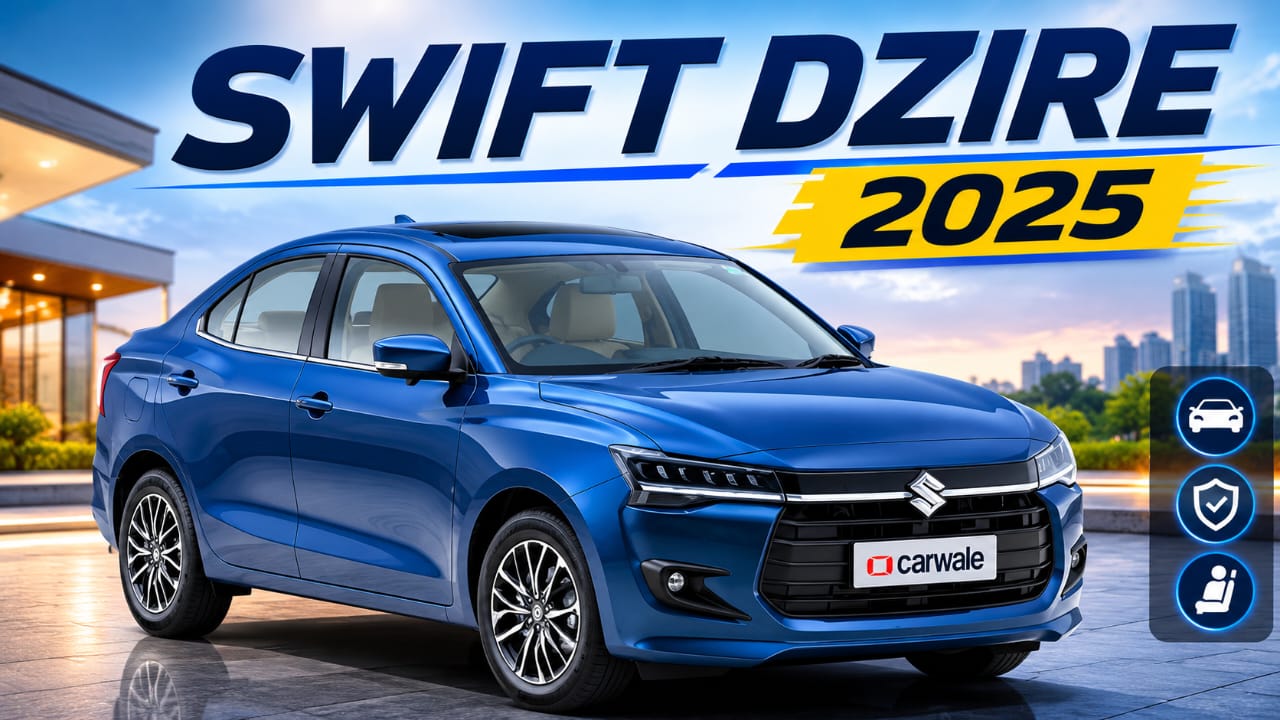
The original Swift Dzire was launched in 2008 as what many dismissed as “just a Swift with a boot.” Over four generations, that dismissive framing couldn’t have aged worse. The Dzire shed the ‘Swift’ from its name in 2017, evolved its own distinct visual identity, built its own loyal customer base, and in November 2024 launched its most ambitious iteration yet — a fourth-generation model that does something Maruti had never managed before: earned a 5-star Global NCAP safety rating. The first time in the company’s history.
In October 2025, the Dzire became the bestselling Maruti model with 20,791 units sold in a single month. Not the bestselling sedan. The bestselling Maruti — beating even the Swift and WagonR. That’s not a marketing number. That’s a market verdict.
And in September 2025, Maruti made it even more compelling with a GST-related price revision that slashed up to ₹87,700 off the ex-showroom price, bringing the starting price down to ₹6.26 lakh. A car with a sunroof, 360-degree camera, and 5-star safety, starting under ₹6.30 lakh — that’s genuinely hard to beat.
In this article, we’ll walk you through 15 detailed, research-backed reasons why the Swift Dzire continues to be one of the smartest car purchases you can make in India in 2025–26. Whether you’re a first-time buyer, a family looking for a second car, or a cab fleet owner evaluating your next batch of vehicles — this guide is for you.
1. It Earned India’s Most Celebrated Safety Achievement: The First 5-Star Maruti
Let’s begin with what matters most and what the Indian car market had waited a very long time to hear: the new Maruti Suzuki Dzire is the first Maruti car in history to receive a 5-star Global NCAP safety rating. This achievement, announced in November 2024, was historic not just for Maruti Suzuki, but for the Indian automotive industry as a whole.
In Global NCAP testing, the Dzire scored an impressive rating for adult occupant protection and demonstrated strong performance across frontal offset, side impact, and side pole impact tests. But Maruti didn’t stop there. In June 2025, Bharat NCAP also awarded the Dzire a 5-star rating, where it scored 29.46 out of 32 for Adult Occupant Protection (AOP) and 41.57 out of 49 for Child Occupant Protection (COP). To put those numbers in perspective: to qualify for a 5-star Bharat NCAP rating, a car needs at minimum 27 points in AOP and 41 points in COP. The Dzire cleared both thresholds convincingly.
What does this mean in practical terms? It means that in a frontal collision at 64 km/h, the Dzire’s body structure and airbag system protect the driver and front passenger with “good” ratings across the head, neck, and chest. In a side impact at 50 km/h, the side airbag and curtain airbag system performed strongly. For child occupants, the ISOFIX child seat mounts and the restraint system worked effectively in both frontal and side impact scenarios.
For a country where road accident fatalities remain unacceptably high, buying a car with a verified 5-star safety rating from both domestic and global crash testing agencies is one of the most meaningful decisions a family can make. And the Dzire offers this at a starting price under ₹7 lakh. That combination of affordability and verified safety is extraordinarily rare and genuinely worth celebrating.
2. The New Z-Series Engine — Smooth, Efficient, and Built for Indian Roads
Underneath the Dzire’s sharper hood lies an all-new Z12E 1.2-litre, 3-cylinder petrol engine — a complete departure from the older K-series unit. This new Z-series engine represents Maruti’s most advanced petrol powertrain for mass-market vehicles, and it shows in every aspect of the driving experience.
The engine produces 90PS of power and 113Nm of torque on petrol — figures that are entirely adequate for a car of the Dzire’s weight class. But what makes the Z-series engine special isn’t the power numbers. It’s the character. Three-cylinder engines have historically been associated with vibration, a coarse note at idle, and a slightly agricultural feel at low revs. Maruti has worked hard on NVH (noise, vibration, harshness) engineering, and the Z12E is notably smooth — the kind of engine you can sit at a long traffic signal without feeling like your fillings are being rattled loose.
The engine is paired with either a 5-speed manual gearbox or a 5-speed AMT (Automated Manual Transmission). The AMT in the Dzire deserves specific praise. Maruti’s Auto Gear Shift (AGS) technology has been refined over multiple generations, and in the new Dzire, it feels more confident and less “jerky” than earlier iterations. For Mumbai or Bengaluru traffic where you’re constantly stopping and starting, being able to drive in automatic mode is a quality-of-life upgrade that many first-time car owners genuinely appreciate.
What truly distinguishes the Z-series engine, though, is its fuel efficiency. The petrol manual returns 24.79kmpl under ARAI testing, and the AMT claims an even more impressive 25.71kmpl. These are not real-world figures — in city driving, expect 17–20kmpl — but they reflect how thermally efficient this engine architecture is. Compared to the Honda Amaze’s 18.65kmpl, the Dzire’s Z12E has a significant efficiency advantage that will translate to meaningful savings over the ownership period.
3. The CNG Option — 33.73 km/kg Is Genuinely Extraordinary
For a large and growing segment of Indian car buyers — particularly cab aggregator drivers, government employees doing high monthly mileage, and cost-conscious daily commuters in CNG-available cities — the fuel cost equation is the single most important buying criterion. And here, the Swift Dzire’s S-CNG variant does something almost breathtaking.
The Dzire S-CNG claims an ARAI-certified mileage of 33.73 km/kg. That number is not a typo. Thirty-three point seventy-three kilometres per kilogram of CNG. To put that in context, CNG at most Indian pumps costs approximately ₹75–90 per kg (varies by city), meaning you’re covering over 33 km for roughly ₹80. That’s less than ₹2.50 per kilometre for a comfortable, air-conditioned, 4-door sedan. No other car in the compact sedan segment comes remotely close to this figure.
The Hyundai Aura CNG manages around 28 km/kg. The Dzire bests it by nearly 6 km/kg — a difference that adds up to thousands of rupees in monthly savings for high-mileage users.
On CNG, the Z12E engine produces 77PS and 98.5Nm of torque — reduced from the petrol output but perfectly functional for city driving. The manual-only gearbox in the CNG variant means you don’t get an AMT option here, but for the kind of driving a CNG car typically does — urban routes with frequent stops — the manual works just fine.
One important detail: Maruti’s S-CNG system is factory-fitted, not an aftermarket kit. This matters significantly because factory-fitted CNG systems are calibrated specifically for the vehicle’s engine, come with proper warranties, and don’t void the manufacturer’s warranty. If you’re considering a Dzire primarily for running economics, the S-CNG variant should be your first, second, and third choice.
4. A Sunroof in a Sub-₹10 Lakh Sedan — A Genuine Segment First
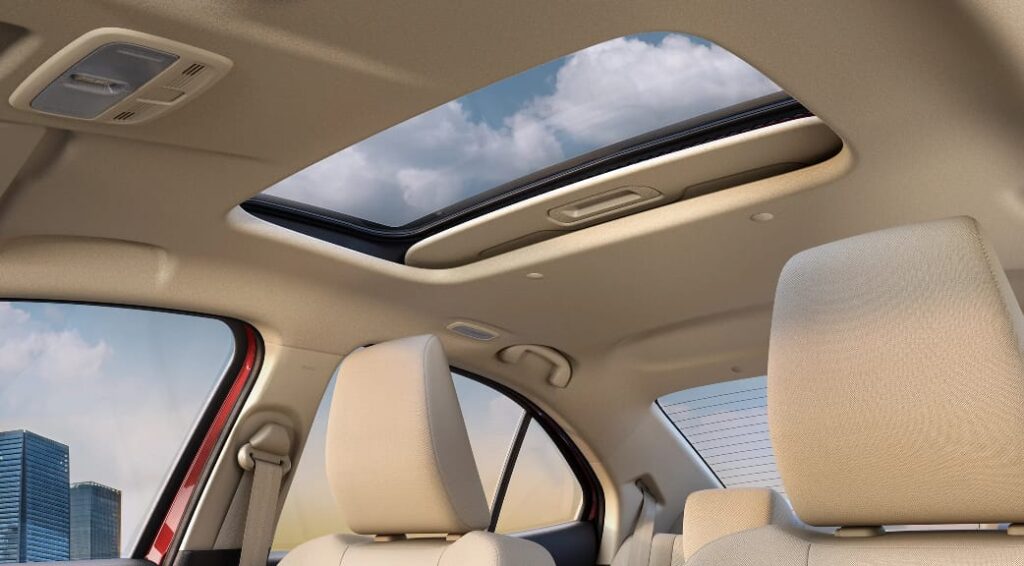
When Maruti Suzuki added a single-pane electric sunroof to the Dzire ZXI Plus variant, they did something that nobody in the compact sedan segment had done before. The Dzire became the first sedan in its class to offer a sunroof — a feature that Indian car buyers have overwhelmingly voted with their wallets as near-essential in the modern market.
Why does a sunroof matter so much to the Indian buyer? It’s partly aspirational — it signals that you’re driving something premium, something above the ordinary. It’s partly practical — it dramatically improves ventilation in a car that might be stuck in traffic for an hour every day. And it’s partly experiential — the feeling of cruising on the Delhi-Jaipur highway or Mumbai’s Bandra-Worli sea link with the moonroof open and the Arkamys audio system playing is genuinely lovely, regardless of how the word “segment-first” sounds in a press release.
What’s particularly elegant about Maruti’s implementation is that the sunroof can be controlled via the infotainment touchscreen — a detail that makes it feel like a thoughtful feature rather than an afterthought. The opening is generous for the class, and at highway speeds, there’s minimal wind noise intrusion into the cabin.
Competitors haven’t yet responded meaningfully. The Honda Amaze doesn’t offer a sunroof. The Hyundai Aura doesn’t either. For the Indian buyer who wants a proper sedan with that prized sunroof experience without stepping up to a full-sized car, the Dzire ZXI Plus is the only answer in the segment — and it starts at a price that doesn’t require you to compromise on other life goals.
5. The 360-Degree Camera — Parking in Indian Cities Has Never Been This Stress-Free
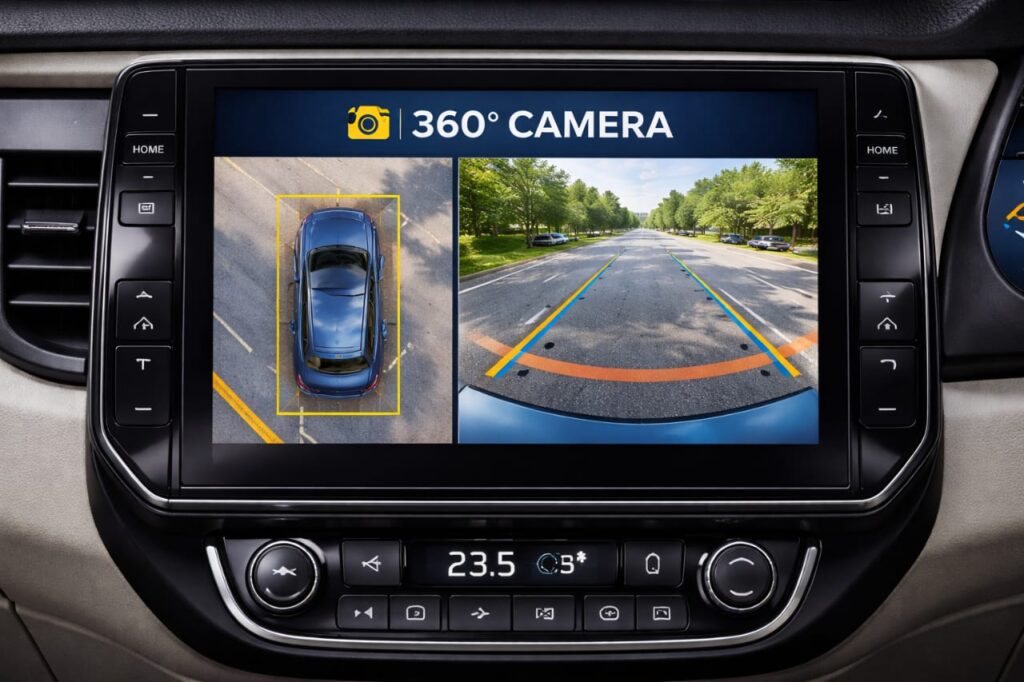
The second segment-first feature that Maruti has brought to the Dzire is a 360-degree surround view camera system — again, unprecedented in this price and segment category at the time of launch.
Parking in any Indian city of moderate size is an exercise in courage, spatial judgment, and tolerance for chaos. Whether it’s squeezing into a spot on a crowded Lajpat Nagar lane in Delhi, navigating the narrow roads of a Pune residential colony, or finding space near a busy South Mumbai market, the task requires you to be aware of exactly where all four corners of your car are at all times. The 360-degree camera makes this dramatically easier.
Using four cameras mounted at the front, rear, and sides of the car, the system stitches together a real-time bird’s-eye overhead view of the vehicle and its immediate surroundings. You can see parked cars, motorcycles, stray animals, and kerbs from an angle that no single camera could provide. It removes much of the guesswork from parallel parking, reverse parking, and tight maneuvers.
This feature is available on the ZXI Plus variant and comes paired with a reverse parking camera for lower trims. Given that the ZXI Plus is the top-spec Dzire, you get the full camera experience as part of a comprehensive premium package rather than paying extra for it as a stand-alone option.
For first-time car owners who may not yet be fully confident with spatial awareness behind the wheel, this feature can genuinely be the difference between a relaxed ownership experience and one filled with minor scrapes and dented bumpers.
6. The Design — Finally, a Dzire That Doesn’t Look Like a Swift With a Boot
For many years, the criticism of the Dzire was that it was merely the Swift hatchback with a boot tacked on — a comment that was more charming than it was accurate, but not entirely unfair for the older generations. The fourth-generation Dzire has comprehensively put that criticism to rest with a design that gives the car its own distinct, mature visual identity.
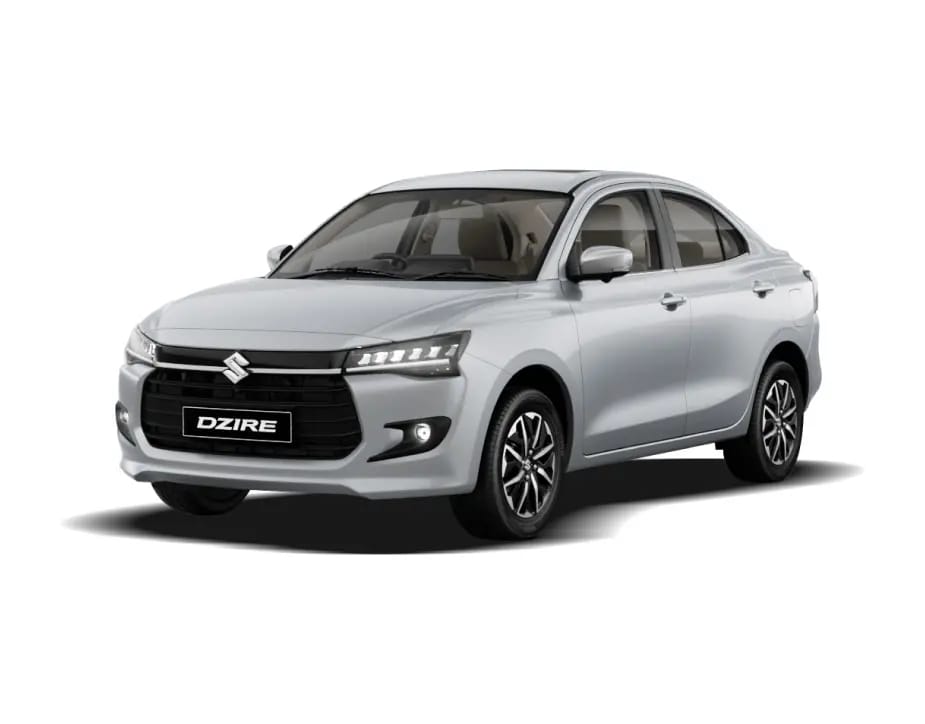
The front end features a wider, bolder grille with sleek LED headlamps that give the car a presence on the road that feels contemporary and self-assured. The lower air dam is well-proportioned and adds visual width, making the front view feel more planted. The side profile is where the Dzire truly establishes its own character — flowing lines that create a proper three-box sedan silhouette, finished with 15-inch diamond-cut alloy wheels on the ZXI and ZXI Plus variants. These wheels add a sparkle to the design that’s particularly striking in direct sunlight.
At the rear, the LED tail lamps are a new standard from the base LXI variant — a decision that signals Maruti’s commitment to the car feeling premium at every price point, not just at the top. The bootlip spoiler and shark fin antenna complete the rear design and give the Dzire a slightly sporty finish that’s a welcome evolution from the more conservative previous generation.
The dual-tone colour options — including Alluring Blue, Gallant Red, and Nutmeg Grey — give buyers genuine choices that allow them to express personality through the car. Gone are the days when a compact sedan meant a white or silver box. The new Dzire on Indian roads has an energy and confidence about it that earlier generations simply didn’t have.
7. The Interior — Premium Materials, Smart Ergonomics, and Space That Surprises
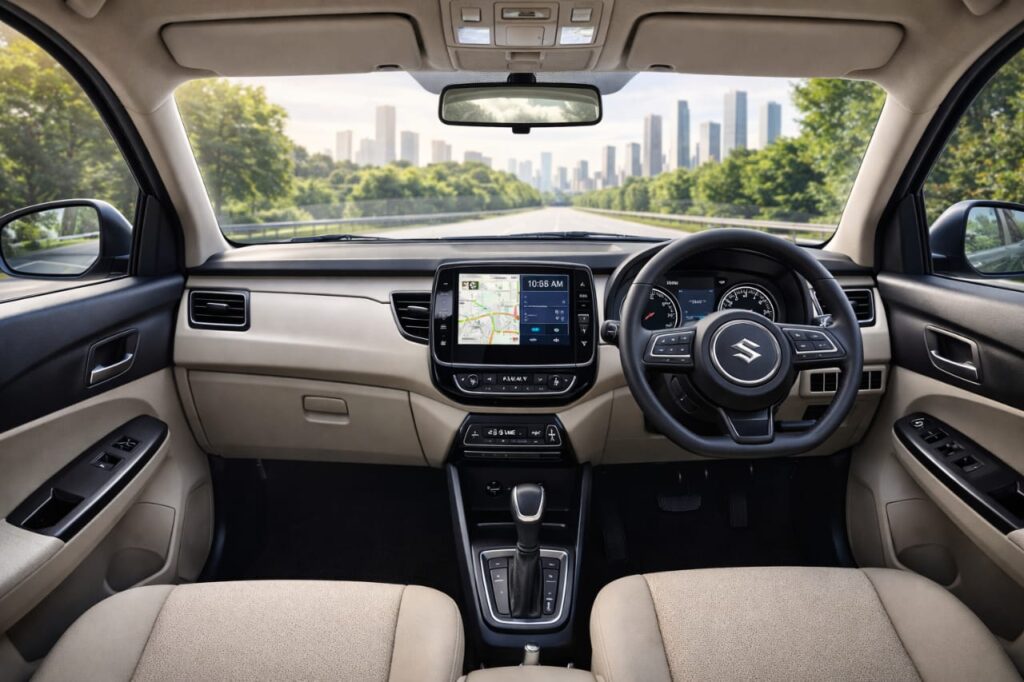
Step inside the new Dzire and the first thing that strikes you is how much more considered the cabin feels compared to the previous generation. The dual-tone black and beige interior theme creates an airy, open feel, especially appreciated in a sub-4-metre sedan where the fear of claustrophobia is always lurking. The Fox Wood Accent finish on the dashboard adds a genuinely premium detail that you’d expect in a car costing significantly more.
The 9-inch touchscreen infotainment system sits at the centre of the dashboard and is genuinely one of the best implementations in the segment. It’s sharp, responsive, and supports wireless Android Auto and Apple CarPlay — meaning your phone connects without a cable the moment you sit down, and your maps, music, and contacts are right there on the screen. Maruti has also added a wireless charging pad in higher variants, so your phone is always topped up without hunting for a cable.
Rear passengers — historically the forgotten constituency in compact sedan design — have been given meaningful attention in the new Dzire. The rear seat offers good legroom for a sub-4-metre car, with a recline angle and backrest design that supports the lower back better than many rivals. Rear AC vents ensure that passengers in the back aren’t baking in Indian summer heat. The rear central armrest and adjustable rear headrests on higher variants add comfort elements that make long family drives substantially more pleasant.
All four door pockets are designed to hold 1-litre bottles — a small but very practical detail that parents with children and road-trippers will appreciate immediately. The rear seats also offer decent thigh support. A height-adjustable driver’s seat means drivers of varying heights can find a comfortable position easily.
Boot space is 378 litres — respectable for the class, with a shape that’s square enough to actually be useful. You can fit a pair of large suitcases for a family airport trip, or load up for a weekend getaway without playing Tetris with the luggage.
8. Six Airbags as Standard — Safety Without Compromise From the Base Variant
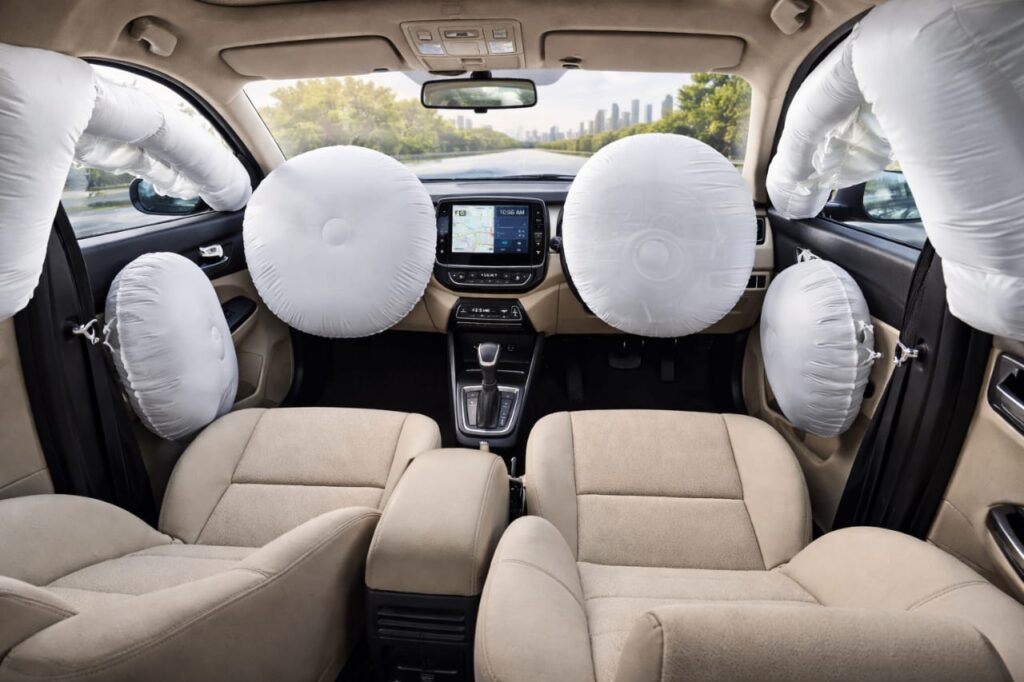
In a world where some car manufacturers still offer base variants with only two airbags and list six airbags as a premium feature, Maruti Suzuki has taken a genuinely refreshing stance: six airbags are standard across all Dzire variants, from the base LXI upwards.
This includes dual front airbags, dual side airbags, and dual curtain airbags — a configuration that provides meaningful protection in frontal, side, and rollover scenarios. For the driver who buys the entry-level LXI to keep costs manageable, this is a meaningful safety net that many rivals don’t provide at equivalent price points.
The standard safety suite across all variants also includes ABS with EBD (Anti-lock Braking System with Electronic Brakeforce Distribution), Electronic Stability Programme (ESP), Hill Hold Assist, ISOFIX child seat mounts, rear parking sensors, and a 3-point seatbelt for all occupants with seatbelt reminder lamps and buzzers. Speed-sensitive auto door locking means the car locks itself once it’s moving, reducing the risk of doors being opened accidentally in traffic.
Higher variants add TPMS (Tyre Pressure Monitoring System), a reverse parking camera, a 360-degree camera, and an anti-theft security system with a shock sensor. The cumulative effect of this safety package is a car that scored 29.46/32 in Bharat NCAP’s adult protection test — not because of expensive technology borrowed from luxury cars, but because of thoughtful, comprehensive engineering applied consistently across the entire range.
9. A Price Point That Defies Everything It Offers — ₹6.26 Lakh to ₹9.31 Lakh
Pricing a car is as much an art as it is a science. And with the September 2025 GST revision, Maruti has priced the Dzire in a way that’s genuinely aggressive for what’s on offer. The range now spans ₹6.26 lakh (LXI) to ₹9.31 lakh (ZXI Plus AMT), all ex-showroom.
Here’s how the value proposition breaks down across the variant ladder:
- LXI (₹6.26 lakh): The entry point. Gets LED tail lamps, 14-inch steel wheels, 6 airbags, ABS with EBD, ESP, Hill Hold Assist, rear parking sensors, and all the safety basics. Manual AC, power windows, and central locking. More than a bare-bones car — this is genuinely equipped for the needs of the daily commuter on a tight budget.
- VXI (approx. ₹7.0–7.6 lakh): Steps up with wheel covers, chrome inserts, body-coloured door handles and mirrors, a 7-inch touchscreen with wireless Android Auto and Apple CarPlay, 4 speakers, rear AC vents, electric outside mirrors, driver seat height adjustment, and a rear central armrest. This is where the car starts to feel genuinely civilized.
- ZXI (approx. ₹8.0–8.6 lakh): The sweet spot for most buyers. Adds 15-inch diamond-cut alloy wheels, auto climate control, a 9-inch touchscreen infotainment system, a wireless charger, cruise control, leather-wrapped steering wheel, and an analogue driver’s display. This is the variant where the Dzire starts to feel premium.
- ZXI Plus (approx. ₹8.9–9.31 lakh): The flagship. Adds the electric sunroof, 360-degree camera, premium leatherette seats, auto-dimming IRVM, and TPMS. This is the Dzire at its most fully-realised — and at ₹9.31 lakh AMT, it competes with cars that cost ₹12–14 lakh on features alone.
All variants are available in petrol manual. The VXI, ZXI, and ZXI Plus also get an AMT option. The VXI and ZXI are available in S-CNG variants. This breadth of choice means there’s a Dzire for almost every buyer profile and budget.
10. Ride Quality That Genuinely Absorbs Indian Road Realities
One of the most frequently praised aspects of the new-generation Dzire in owner reviews and expert evaluations is its ride quality. The suspension has been specifically tuned to deliver an absorbent, comfortable ride — which, in the context of Indian roads with their broken patches, speed breakers, and occasional crater-sized potholes, is not a trivial engineering achievement.
The swift Dzire’s suspension setup is a MacPherson strut at the front and a torsion beam at the rear — a tried-and-tested configuration that Maruti has refined extensively over multiple generations. The key is in the damper calibration and spring rates, which strike a balance between soaking up sharp road imperfections and maintaining sufficient body control at higher speeds. On well-maintained highways, the car feels stable and planted. On the broken urban roads of tier-2 cities, it cushions the occupants without bottoming out.
This suspension tuning is also a deliberate departure from what some of the Dzire’s competitors offer. CarWale specifically notes that “the suspension setup is tuned to deliver an absorbent and smooth ride” — and owner reviews consistently cite the Dzire’s ride quality as one of the primary reasons they chose it over alternatives.
For families doing long-distance road trips — say, the Bengaluru to Coorg run, or the Delhi to Mussoorie drive — the Dzire’s ability to maintain comfort over varied road surfaces makes a genuinely tangible difference to how fatiguing the journey feels. The well-cushioned, supportive seats compound this advantage by preventing the lower back discomfort that long drives in cheaper, more spartan cars often produce.
11. The Arkamys Sound System — Because Your Daily Commute Deserves Better Audio
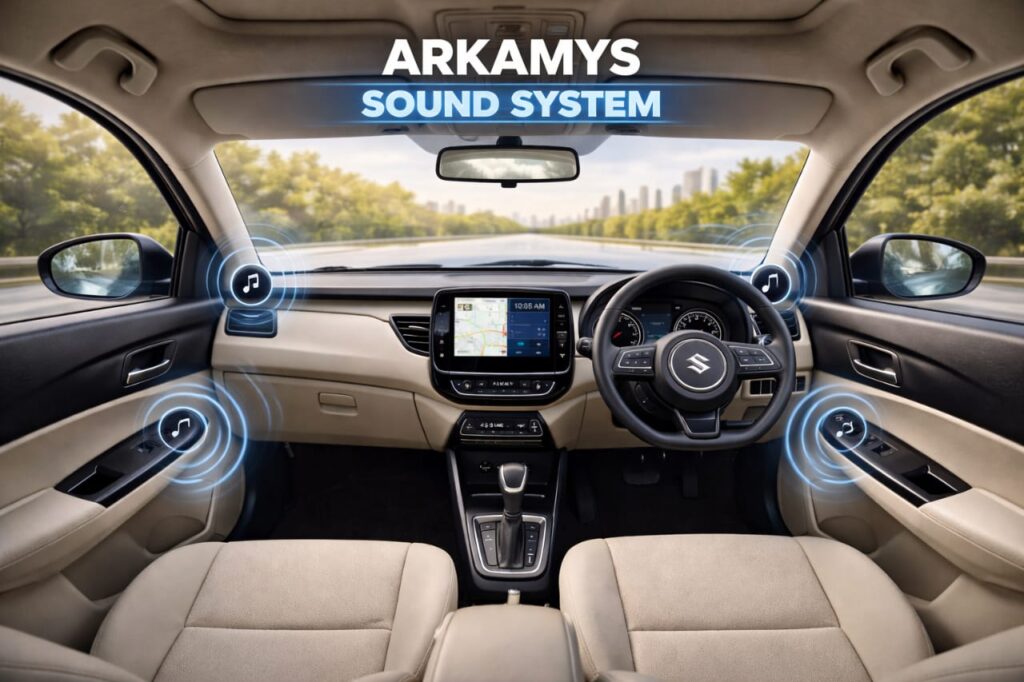
Audio quality in cars is, oddly, one of the most underappreciated aspects of the ownership experience — until you’ve spent 45 minutes in Delhi traffic with tinny speakers buzzing at you, and then you understand exactly why it matters.
The higher variants of the new Dzire feature an Arkamys-tuned audio system paired with the 9-inch infotainment display. Arkamys is a French audio engineering company that specialises in optimising sound reproduction for the specific acoustic characteristics of car interiors — they don’t just add speakers, they calibrate the entire system for the vehicle’s dimensions, materials, and typical listening position.
The result is noticeably more balanced, richer audio than you’d expect from a car at this price point. Bass is controlled without being boomy. Mid-range vocals — crucial for the Bollywood and Punjabi pop that makes up the majority of Indian in-car listening — are clear and present. The system is paired with wireless Apple CarPlay and Spotify integration, so your playlists are accessible without any fuss.
For a car that many buyers will spend 1–2 hours in every single day, the quality of the audio system is a legitimate contributor to daily quality of life. And the Dzire delivers it at a price where most rivals are still offering basic 4-speaker setups with no particular audio tuning.
12. The Maruti Service Network — 4,000+ Service Centres Across India
No discussion of the Swift Dzire’s value proposition is complete without talking about what happens after the purchase — the ownership experience, the service costs, and the resale value. And here, Maruti Suzuki’s structural advantage over every rival is almost embarrassingly large.
Maruti Suzuki’s service network in India is the most extensive of any car manufacturer, with over 4,000 service centres spread across more than 1,900 cities and towns. This includes remote tier-3 towns and district headquarters where rival manufacturers simply don’t have authorised service presence. For the Indian buyer who might be based in a smaller city or who travels frequently to smaller towns, the peace of mind of knowing a Maruti service centre is within reasonable reach is genuinely valuable.
Service costs for the swift Dzire are also among the most affordable in the segment. The Z-series engine uses common, easily available parts that have been in production in various forms for years. Routine maintenance — oil changes, air filter replacement, tyre rotation — costs a fraction of what equivalent servicing on a Honda Amaze or any imported variant would cost. Maruti’s True Value network also means that when the time comes to sell, you have a guaranteed, organised channel for getting a competitive resale price.
On the topic of resale value — Maruti cars consistently command the best resale premiums in the Indian used car market. A CarWale owner review from a previous-generation Dzire owner perfectly captures this: after 7 years and nearly the car’s full lifecycle of daily use, they reportedly recovered 65% of their buying price as resale value. For a depreciating asset, that retention rate is exceptional and reflects the market’s deep trust in the Maruti brand.
13. Mileage That Beats the Segment — Consistently, Across Every Variant
We’ve already covered the CNG efficiency. But the petrol variants deserve their own dedicated attention, because the Dzire’s mileage superiority over competitors is consistent and significant across every powertrain comparison.
The ARAI-certified petrol manual mileage of 24.79kmpl and AMT mileage of 25.71kmpl are both higher than any direct competitor. The Honda Amaze petrol manual returns 18.65kmpl — a gap of over 6kmpl versus the Dzire manual. The Hyundai Aura petrol returns 20.5kmpl — still 4+ kmpl below the Dzire.
In real-world Indian driving — the mix of city stop-start and occasional highway runs that most owners actually experience — the Dzire typically returns 17–22kmpl on petrol depending on driving conditions and style. Comparable real-world figures for the Amaze tend to be 14–18kmpl, and the Aura runs at 15–19kmpl. Over a car’s typical 10-year lifespan, covering perhaps 15,000 km per year, this mileage difference translates to savings of ₹40,000–₹80,000 or more in fuel costs alone.
This efficiency is a product of the Z-series engine’s architecture — the three-cylinder design inherently has less friction than a four-cylinder, and its combustion efficiency has been optimised specifically for the kind of light-load, moderate-speed driving that characterises most Indian usage. The lightweight body of the Dzire (920–968 kg) further aids efficiency by reducing the energy needed to accelerate from standstill.
14. Sales Numbers That Tell the Real Story — India’s Verdict in Black and White
At some point, the most compelling evidence for why the Dzire is the right choice is simply what millions of Indian buyers have already decided. And the numbers are unambiguous.
The Maruti Suzuki Dzire crossed the 3 million unit sales milestone in March 2025 — a figure that very few cars in any segment globally can claim. In October 2025, the Dzire became the bestselling Maruti model with 20,791 units delivered in a single month — not the bestselling sedan, not the bestselling Maruti sedan, but the outright bestselling Maruti vehicle across all segments.
In June 2025, the Dzire led compact sedan sales with 15,484 units. In May 2025, it posted 18,084 units. Month after month, consistently, the Dzire is at the top of the compact sedan segment — and increasingly challenging hatchbacks in overall monthly rankings.
These numbers matter because they reflect the collective judgment of hundreds of thousands of Indian buyers who have done their research, visited dealerships, driven alternatives, and concluded that the Dzire offers the best combination of value, reliability, features, and ownership economics in the compact sedan segment. No amount of advertising can sustain those numbers — only a genuinely excellent product can.
The breadth of the Dzire’s buyer base is also telling. It’s bought by urban professionals as a primary family car, by cab aggregator drivers as a commercial vehicle, by government employees for daily commuting, by parents as a gift for their children starting their first jobs, and by retirees as a comfortable, easy-to-drive car that doesn’t intimidate. A car that works across that many different use cases and buyer profiles is doing something fundamentally right.
15. The Competition Is Capable, But the Dzire Leads Where India Votes
The compact sedan segment in India is well-served by capable competitors. The Honda Amaze, Hyundai Aura, and Tata Tigor are all credible choices that deserve consideration depending on a buyer’s priorities. An honest look at the Dzire must acknowledge both where it leads and where rivals have their own strengths.
Where the Dzire leads comprehensively:
- Safety credibility: 5-star ratings from both Global NCAP and Bharat NCAP. This is a binary distinction — either you have them or you don’t. The Dzire does. The Amaze, Aura, and Tigor don’t share this distinction at equivalent levels.
- Fuel efficiency: At 24.79kmpl petrol and 33.73 km/kg CNG, the Dzire is the clear segment leader. The Aura is the nearest competitor on CNG at 28 km/kg, and the Amaze trails significantly on petrol efficiency.
- Segment-first features: The sunroof and 360-degree camera remain exclusive in this class. No rival offers both in a sub-₹10 lakh sedan.
- Service network and ownership costs: Maruti’s 4,000+ service centres and affordable spare parts represent an ownership advantage that Honda and Hyundai cannot match in smaller cities.
- Resale value: Maruti’s used car premiums are consistently the highest in the segment, making the Dzire a better long-term financial proposition.
Where rivals have their own merits:
- The Honda Amaze offers a more powerful engine (88.76bhp) and a proper CVT automatic — which is smoother and more refined than the Dzire’s AMT. For buyers who prioritise automatic transmission refinement and brand loyalty to Honda, the Amaze is a serious consideration.
- The Hyundai Aura starts slightly lower in price, making it appealing for the most budget-constrained buyer. Its 4-cylinder engine has a slightly different character than the Dzire’s 3-cylinder, and some buyers prefer that feel.
- The Tata Tigor offers the lowest starting price in the segment at ₹5.49 lakh, which makes it relevant for buyers who need a sedan body style on the tightest possible budget, though it doesn’t match the Dzire’s features or safety credentials.
The key insight is this: the Dzire wins on almost every parameter that the widest cross-section of Indian buyers actually prioritises — safety, mileage, features, service network, and resale. It doesn’t win every single comparison in every single specification, but it wins the overall equation more convincingly than any rival, which is exactly why India buys it in such extraordinary numbers.
Swift Dzire 2025–26: Complete Specifications at a Glance
| Parameter | Detail |
|---|---|
| Price Range | ₹6.26 lakh – ₹9.31 lakh (ex-showroom) |
| Body Style | Sub-4-metre compact sedan |
| Length | 3,995mm |
| Engine | 1.2-litre Z12E 3-cylinder petrol |
| Power | 90PS (petrol) / 77PS (CNG) |
| Torque | 113Nm (petrol) / 98.5Nm (CNG) |
| Transmissions | 5-speed manual / 5-speed AMT |
| Petrol Mileage (ARAI) | 24.79kmpl (manual) / 25.71kmpl (AMT) |
| CNG Mileage (ARAI) | 33.73 km/kg |
| Boot Space | 378 litres |
| Airbags | 6 (standard across all variants) |
| Safety Rating | 5-star GNCAP + 5-star BNCAP |
| BNCAP Score | 29.46/32 AOP, 41.57/49 COP |
| Infotainment | 9-inch touchscreen (ZXI/ZXI+) / 7-inch (VXI) |
| Connectivity | Wireless Apple CarPlay + Android Auto |
| Camera | 360-degree surround view (ZXI+) |
| Special Features | Segment-first sunroof + 360-degree camera |
| Audio | Arkamys-tuned system |
| Variants | LXI, VXI, VXI AMT, ZXI, VXI CNG, ZXI AMT, ZXI+, ZXI CNG, ZXI+ AMT |
| Colours | Alluring Blue, Nutmeg Grey, Splendid Silver, Gallant Red, Arctic White, Phoenix Red, Sherwood Brown |
| Warranty | 2 years / unlimited km (extendable) |
Who Should Buy the Swift Dzire?
The beauty of the Dzire’s proposition is how many different buyer profiles it fits — which is partly why it sells so consistently across so many Indian markets and demographics.
If you are a first-time car buyer stepping up from a two-wheeler or public transport, the Dzire’s ease of driving, light controls, and AMT option make it one of the most accessible cars to learn on. The 5-star safety rating means your family has meaningful protection even when you’re still building your driving confidence.
If you are a family of four looking for a primary car, the Dzire’s spacious rear seat, good boot space, rear AC vents, and comfortable ride make it an excellent all-rounder. The sunroof on the ZXI Plus adds a sense of occasion to weekend outings. The 360-degree camera reduces parking stress in family-heavy residential areas.
If you are a cab aggregator driver — whether on Ola, Uber, or running a private taxi operation — the CNG variant is nearly unbeatable in its ownership economics. At 33.73 km/kg, covering 200+ km per day in CNG costs less than any alternative in the market. Combined with Maruti’s service network ensuring minimum downtime, the Dzire CNG is one of the most commercially rational vehicle choices in India.
If you are a government employee or someone who needs a reliable, low-maintenance car for daily commuting with occasional long-distance travel, the Dzire’s combination of dependability, service network ubiquity, and fuel efficiency represents the kind of sensible value proposition that genuinely stands up over 8–10 years of ownership.
Variant Buying Guide: Which Dzire Should You Actually Choose?
This is the question every prospective Dzire buyer Googles before their dealership visit. Here’s a clear, honest recommendation based on buyer type:
For the budget-first buyer: The VXI is the minimum recommended variant. The base LXI is fine on safety but too sparse on comfort and convenience features for most buyers. The VXI adds the touchscreen, rear AC vents, and electric mirrors for a modest premium over the LXI — and that addition dramatically improves the daily experience.
For the value-seeker: The ZXI is the sweet spot of the entire Dzire range. You get the 9-inch screen, auto climate control, cruise control, alloy wheels, wireless charger, and all the daily-use features you’ll actually appreciate. At approximately ₹8–8.6 lakh, it offers exceptional value.
For the everything buyer: The ZXI Plus is for those who want the best Dzire experience — sunroof, 360-degree camera, leather seats, and top-spec features. The ₹9.31 lakh price point for the AMT variant is competitive with nothing else in the segment that offers a comparable feature set.
For high-mileage or CNG buyers: Choose the VXI CNG or ZXI CNG. The CNG variants don’t get an AMT option, but they offer running costs that will genuinely transform your monthly expenditure. Budget ₹7.5–8.5 lakh for the CNG variants.
Final Verdict: Some Cars Are Good. The Dzire Is Right.
There’s a difference between a car being good and a car being right — right for the market it serves, right for the buyers who need it, right for the roads it drives on, right for the wallets it has to fit. The Swift Dzire has always been more right than it has been exciting, and that’s exactly what has made it India’s favourite compact sedan for eighteen years.
The fourth-generation model adds something the Dzire never had before: genuine safety credibility backed by the highest crash test scores Maruti has ever achieved. Combined with a fuel efficiency that no rival can match, segment-first features that buyers genuinely want, a service network that gives ownership confidence nationwide, and a price that Maruti has now made even more competitive — the 2025 Dzire is the most complete version of a car that was already the right choice for millions of Indians.
If you’re in the market for a sub-4-metre sedan in India in 2025–26, the Swift Dzire is your benchmark. Everything else defines itself in relation to it.
Frequently Asked Questions (FAQ)
Q: What is the current starting price of the Maruti Swift Dzire in India?
The Maruti Suzuki Dzire starts at ₹6.26 lakh (ex-showroom) following the September 2025 GST revision. The top ZXI Plus AMT variant is priced at ₹9.31 lakh ex-showroom.
Q: What is the mileage of the Maruti Dzire 2025?
The ARAI-certified mileage is 24.79kmpl for the petrol manual, 25.71kmpl for the petrol AMT, and 33.73 km/kg for the CNG variant.
Q: Does the Maruti Dzire have a sunroof?
Yes. The Maruti Dzire ZXI Plus variant features a single-pane electric sunroof — a segment-first feature in the compact sedan class, not available in rivals like the Honda Amaze or Hyundai Aura.
Q: What safety rating has the Dzire received?
The Maruti Suzuki Dzire has received a 5-star rating from both Global NCAP (November 2024) and Bharat NCAP (June 2025). It scored 29.46 out of 32 for adult occupant protection and 41.57 out of 49 for child occupant protection in Bharat NCAP testing.
Q: Is the Swift Dzire available in CNG?
Yes. The Dzire S-CNG variants (VXI CNG and ZXI CNG) are available with a factory-fitted CNG system, offering a segment-leading ARAI mileage of 33.73 km/kg.
Q: How many airbags does the Dzire have?
The Maruti Suzuki Dzire comes with 6 airbags as standard across all variants, including the base LXI.
Q: Which Dzire variant is the best buy?
The ZXI is the sweet spot for most buyers, offering the 9-inch touchscreen, auto climate control, alloy wheels, and cruise control. For the best overall package, the ZXI Plus adds the sunroof and 360-degree camera.
Q: Is the Dzire better than the Honda Amaze?
Both are excellent. The Dzire leads on safety rating (5-star GNCAP and BNCAP vs Amaze’s lesser scores), mileage (24.79 vs 18.65kmpl petrol), features (sunroof, 360-degree camera), and ownership costs. The Amaze leads on engine power (88.76bhp vs 90PS) and offers a smoother CVT automatic. For most Indian buyers, the Dzire’s overall proposition is stronger.
Q: What is the boot space of the Maruti Dzire?
The Maruti Suzuki Dzire offers 378 litres of boot space.
Q: How many units has the Dzire sold in India?
The Maruti Suzuki Dzire crossed 3 million (30 lakh) units in March 2025 and became the bestselling Maruti model in October 2025 with 20,791 monthly units.

 Sagar
Sagar
[…] Brezza Swift Dzire […]