 Sagar
Sagar Introduction: Why the Range Rover Conversation Never Gets Old
There are cars, and then there are icons. The Range Rover belongs firmly in the second category — and after more than five decades on the road, it shows absolutely no signs of stepping down from its throne.
Since its debut in 1970, the Range Rover has done something that very few vehicles in automotive history have managed to pull off: it invented its own category, dominated it for generations, and then kept reinventing itself fast enough to stay at the top. Launched by British Leyland, it was the first vehicle to successfully combine rugged off-road capability with on-road comfort and luxury — and its cultural impact was so significant that it became the first car ever displayed at the Louvre. Let that sink in. A car. In the Louvre. Not as a quirky exhibit, but as a legitimate object of industrial design.
For American buyers in 2026, the Range Rover proposition is stronger than ever. Whether you’re looking at the full-size flagship, the sportier Range Rover Sport, or keeping an eye on the all-electric model now entering the market, there’s a version of this vehicle built for your lifestyle. But with prices starting at $113,300 and top models that can go for twice as much or more, this is a serious investment that demands serious research.
That’s exactly what this article is here for. We’ve gone deep on the 2026 lineup, its history, its technology, its real-world capabilities, and its competitors — so by the time you finish reading, you’ll know whether a Range Rover belongs in your driveway and, if so, which one.
1. A Legacy That Actually Earns the Hype
Before we get into specs and price tags, it’s worth understanding why the Range Rover carries the cultural weight it does — because that history isn’t just marketing fluff. It’s genuinely earned.
Born from the vision of Charles Spencer “Spen” King, Range Rover redefined what a capable and comfortable vehicle could be. What began as a two-door 4×4 with a lightweight V8 and shooting brake silhouette would go on to become the blueprint for generations of luxury SUVs — long before the rest of the industry caught on. Think about that for a moment. Every luxury SUV you see on American roads today — the Cadillac Escalade, the Mercedes GLS, the BMW X7 — all of them exist because the Range Rover proved the concept first.
Range Rover quickly proved it was more than just luxury SUV engineering. It crossed the length of the Americas in 1972, tackled the Sahara Desert in 1974, and won the first-ever Paris-Dakar Rally in 1979. This wasn’t a soft-handed luxury toy trucked around on flat California highways. This was a machine that went where other vehicles simply couldn’t — and looked extraordinary doing it.
The Range Rover is one of the most influential cars ever made. It redefined the SUV as a luxury vehicle, and its luxury iconic status is why four of Land Rover’s seven vehicles per sale carry “Range Rover” branding. That’s the kind of brand equity money can’t buy — it has to be built over decades of consistent excellence.
2. The 2026 Lineup: More Options Than Ever Before
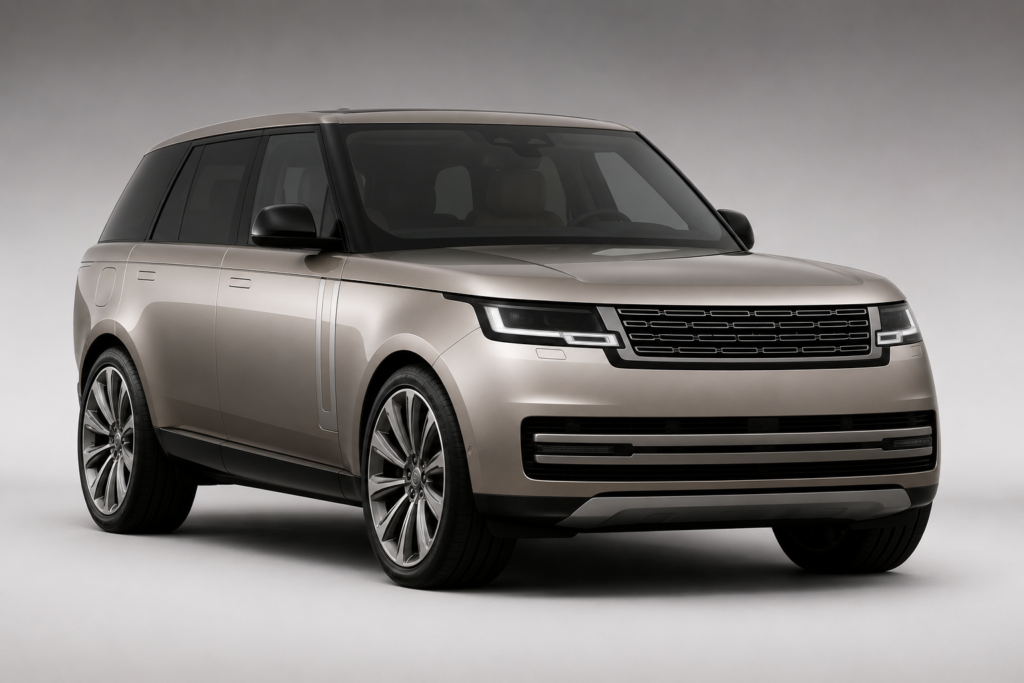
One of the smartest things Land Rover has done in recent years is expand the Range Rover family into a genuine portfolio of vehicles rather than a single flagship. In 2026, American buyers have more entry points into the Range Rover world than at any point in the brand’s history.
The Full-Size Range Rover remains the crown jewel. It’s offered in two basic configurations: standard wheelbase (SWB) and long wheelbase (LWB). Seating for five is standard in both, but the LWB gives you a choice between outrageous stretch-out space in the second row or a third row and seating for seven. For families or executives who frequently travel with passengers, this flexibility is genuinely valuable.
The Range Rover Sport slots into the lineup as the performance-minded sibling. The 2026 Range Rover Sport is a luxury midsize SUV that slots below the full-size Range Rover and above the smaller Velar and Evoque SUVs in the brand’s lineup. But from behind the wheel, the Sport feels every bit as grand as its bigger brother. Its cabin is spacious, whisper-quiet and bathed in rich leather.
The New SV Black is the biggest story of the 2026 model year for both models. For 2026, the legendary Range Rover gains an all-new model that sits at the very top of the model range. Known as the SV Black, this menacing new model features plenty of darkened and blacked-out exterior accents for a more aggressive look. SV Black models also boast Body-and-Soul Seats and Sensory Floor technologies for a truly remarkable in-vehicle experience.
And then there’s the all-electric Range Rover, which is now entering the market and generating significant buzz. The 2026 Range Rover EV is designed to combine luxury, power, and efficiency — built for both city roads and off-road adventures, with pricing estimated between $120,000 (SE) and $160,000 (Autobiography).
3. Engine Options That Cover Every Personality
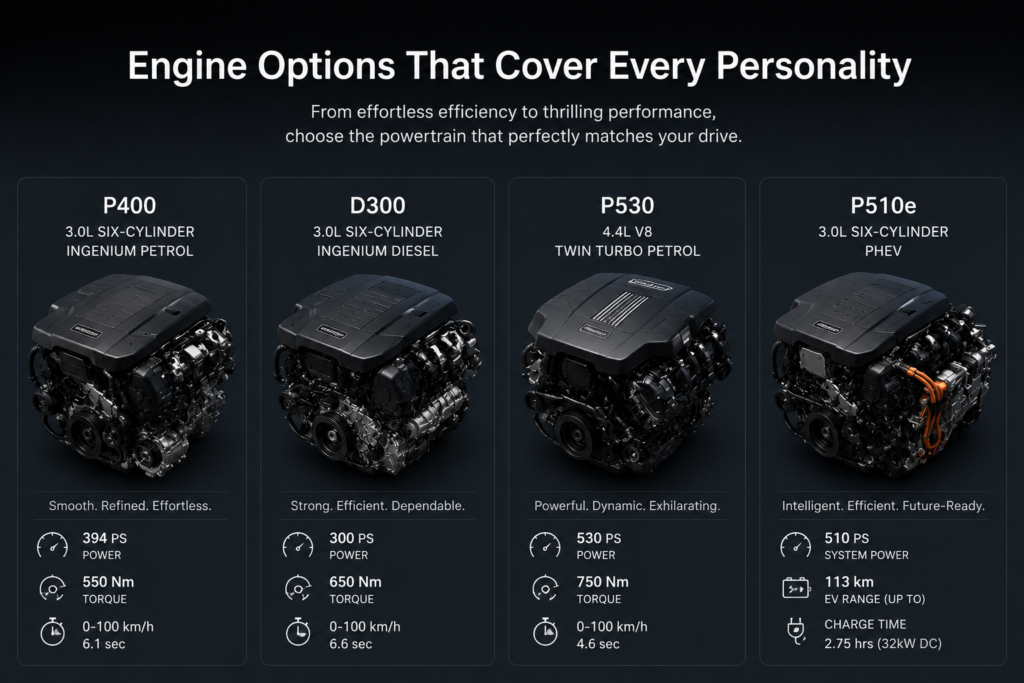
The Range Rover has never been a one-size-fits-all vehicle, and the 2026 powertrain lineup reflects that beautifully. Whether you want efficiency, balanced performance, hybrid practicality, or outright V8 muscle, there’s an engine in this family with your name on it.
- Turbocharged 3.0-liter inline-six:
- The base engine produces 355 horsepower, with output rising to 395 in Dynamic SE models. Despite being the entry-level option, it delivers instantaneous throttle response and brawny acceleration that has been compared to the sensation of a jet taking off. For most everyday drivers in the US, this engine will feel more than adequate — it’s genuinely quick, refined, and delivers respectable fuel economy for a full-size luxury SUV.
- Plug-in hybrid (PHEV) versions:
- The PHEV version houses an electric motor in the transmission and boosts output to 454 or 543 horsepower, depending on trim. For American buyers in urban environments, the PHEV option is particularly compelling. All-electric range is 50 miles with a fully charged battery in full EV mode, per EPA estimates. That means most daily commutes could be handled entirely on electricity, while longer highway drives tap the combustion engine seamlessly.
- Twin-turbocharged 4.4-liter V8:
- This engine churns out 523 horsepower, rising all the way to 626 horsepower in SV models. This is the engine for buyers who want not just performance, but a statement. The V8 transforms the Range Rover from a refined luxury cruiser into something genuinely thrilling — while somehow remaining composed and quiet at highway speeds.
All powertrains come mated to an eight-speed automatic transmission, and all-wheel drive is standard across the board, with four-wheel drive available on select trims.
4. An Interior That Rivals Private Aviation
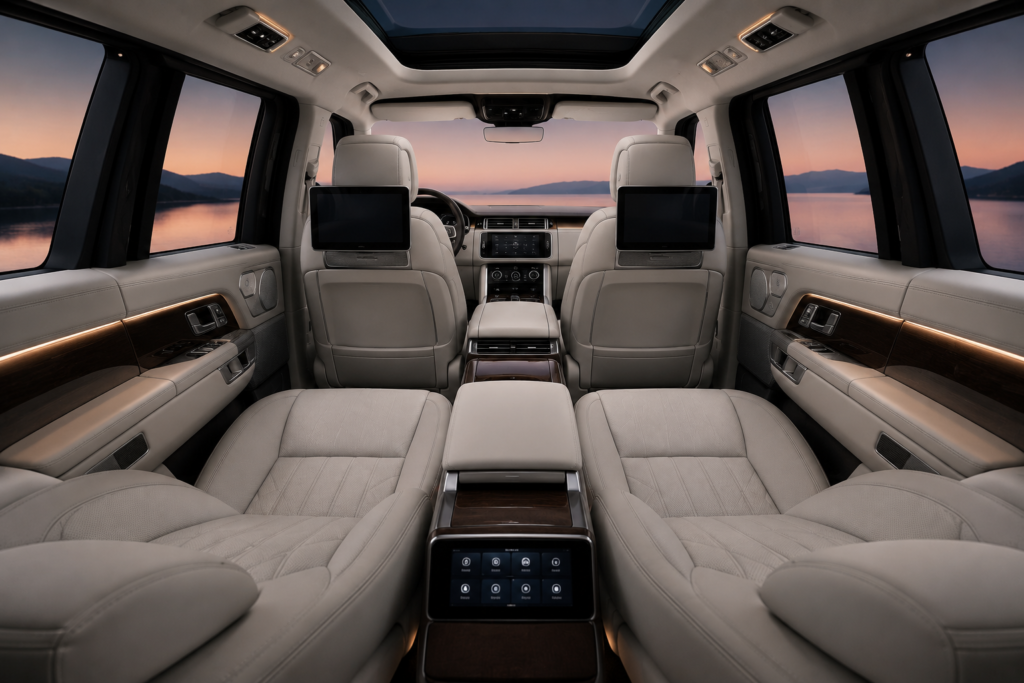
If there’s one area where the Range Rover consistently leaves its competitors speechless, it’s the interior. And in 2026, Land Rover has pushed that standard even further.
The Range Rover is a rolling monument to excess: excess capability, excess space in the available long-wheelbase model, and excess luxury — from the available massaging front and rear seats to the 22-speaker Meridian sound system with in-floor transducers so you feel the music. That last detail is worth pausing on. In-floor transducers mean you don’t just hear music through speakers — you feel it as low-frequency vibration through the floor of the vehicle. It’s an audiophile experience on wheels.
From heated center and door armrests to “hot stone” Range Rover massage seats, every aspect adds a touch of comforting elegance. Executive Class Rear Seating includes an 8-inch touchscreen controller within the electrically deployable center armrest to manage rear entertainment and comfort features. With Semi-Aniline heated leather seats in all three rows, the long wheelbase seven-seat model offers an unrivaled travel experience for up to seven adults, no matter where they sit.
The SV and SV Black trims go even further. Interior of SV Black models features Near-Aniline Ebony leather with unique perforations and SV Black-specific stitching — the kind of detail that separates a luxury vehicle from an ultra-luxury one.
And for those willing to go all the way to SV Bespoke on the Sport? SV Bespoke offers nearly limitless personalization with 230 exterior colors and over 1,500 interior combinations — a first for the Range Rover Sport. That’s not customization. That’s couture.
5. Technology That Actually Makes Sense
Luxury vehicles today often over-engineer their technology to the point where it becomes a distraction rather than an enhancement. The Range Rover takes a different philosophy: technology should work invisibly, making the driving experience smoother without demanding your constant attention.
As Land Rover’s flagship vehicle, the 2026 Range Rover includes a full complement of safety technologies as standard equipment: forward collision warning with pedestrian and bicyclist detection, automatic emergency braking, adaptive cruise control, lane-centering assist, blind spot intervention, rear cross-traffic alert, road-sign recognition, automated parking, a 360-degree camera system, and front and rear parking sensors. Every single one of those features comes standard — not as a paid package, not as an add-on, but as part of the base vehicle. That’s the kind of commitment to safety and technology that American buyers increasingly expect from premium brands.
The infotainment system centers around a floating 13.1-inch touchscreen running Land Rover’s Pivi Pro software. Apple CarPlay, Android Auto, and built-in navigation all come standard. Amazon Alexa integration means you can control smart home devices, get answers, and manage your schedule without taking your hands off the wheel.
For the suspension, Land Rover has integrated what they call a predictive system — an intelligent suspension system that continuously optimizes damper settings using navigation data to adjust for the road ahead, delivering a supremely smooth driving experience. The vehicle is, in effect, reading the road before you reach it.
6. Off-Road Capability That Would Embarrass a Dedicated Trail Rig
Here’s where many people are genuinely surprised. They assume the Range Rover is a soft-roader — a luxury costume draped over a city-car chassis. They’re wrong.
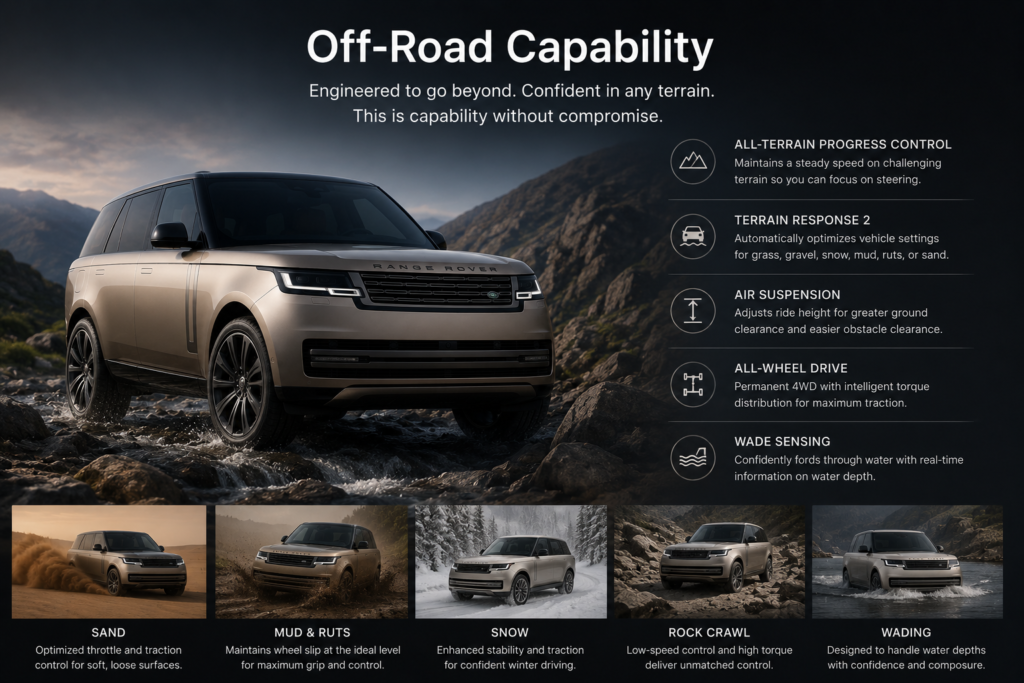
Should you attempt to take your Range Rover off-road, it’s hard to beat this SUV’s capabilities thanks to two locking differentials, standout maximum ground clearance of over 11 inches, and five terrain driving modes, including the Wade one for traversing rivers. Eleven-plus inches of ground clearance and a dedicated water-wading mode. This is a vehicle built to cross rivers, scale rocky inclines, and navigate deep snow — while its passengers sit in massage seats listening to a 22-speaker sound system.
Much of the Range Rover Sport lineup comes standard with all-wheel drive, but you can upgrade to four-wheel drive with a two-speed transfer case for just $350 on select trims. That low-range gearing is a boon for tackling steeper climbs and slippery surfaces. A locking rear differential and four-wheel steering are also helpful off-road options.
All models benefit from Land Rover’s Terrain Response 2 system. This system automatically selects the best traction control parameters based on the road or off-road surface. You don’t need to be a technical expert to get the most out of this vehicle off-road — the Range Rover figures it out for you and adjusts accordingly.
The towing capability is equally impressive. The Range Rover can tow a competitive 8,200 pounds — making it a legitimate choice for boat owners, horse trailer haulers, and outdoor enthusiasts across America.
7. The 2026 Range Rover Sport SV: Performance Redefined
For buyers who want the Range Rover experience with a sharper, more athletic edge, the 2026 Range Rover Sport SV family deserves special attention. This is where luxury and performance genuinely converge.
The 2026 Range Rover Sport lineup introduces new distinct models that redefine luxury performance. The new Range Rover Sport SV Black, SV Carbon, and SV Bespoke each bring something different to the table — but all SV models are powered by a 626HP Twin Turbo V8 engine and special features like 6D Dynamics Suspension and Body and Soul seats, creating a truly immersive experience.
The SV Carbon model deserves specific attention for design enthusiasts. Range Rover Sport SV Carbon introduces exclusive ultra-lightweight detailing. The model is available in a choice of four optional paint colors, as well as curated colors from the SV Premium Palette, with a Forged Carbon exterior pack and Twill Exposed Carbon hood enhancing the airflow-honed design. SV Carbon features a cockpit-like cabin, with Forged Carbon Fiber-backed performance seats featuring integrated headrests, sculpted bolsters, and illuminated SV logos.
This isn’t a performance package bolted onto a luxury vehicle as an afterthought. The SV Carbon is engineered from the ground up to feel like a hypercar when you want it to, and a grand tourer when you don’t.
8. How It Compares to Rivals in the American Market
American luxury SUV buyers have no shortage of excellent options in 2026, so it’s worth being honest about where the Range Rover stands relative to its competition.
The Range Rover is currently tied with the Mercedes-Benz GLS for the second spot in luxury large SUV rankings, slotting behind the Cadillac Escalade but ahead of the BMW X7, Jeep Grand Wagoneer, and Infiniti QX80. The Range Rover’s interior quality feels a cut or two above all of its rivals, but its price tag is much higher, starting $20,000 to $30,000 more than those models and rising steeply from there. The Range Rover’s ride is silkier than most, and its handling is more athletic, while still being able to tow a competitive amount and venture off-road. However, rivals such as the Escalade and Wagoneer offer considerably more in the way of third-row seating space and cargo room.
At its upper price points, the competitive set changes entirely. In its pricier trims, the Range Rover goes toe-to-toe with the Mercedes-Maybach GLS and Bentley Bentayga. That’s extraordinary company for what started as a utilitarian 4×4 more than half a century ago.
The honest summary: if you prioritize maximum cargo space and third-row room on a budget, the Escalade or Wagoneer makes more practical sense. If you prioritize ride quality, interior refinement, genuine off-road capability, and design prestige, the Range Rover has no true equal.
9. The Plug-In Hybrid: The Smartest Range Rover to Buy Right Now
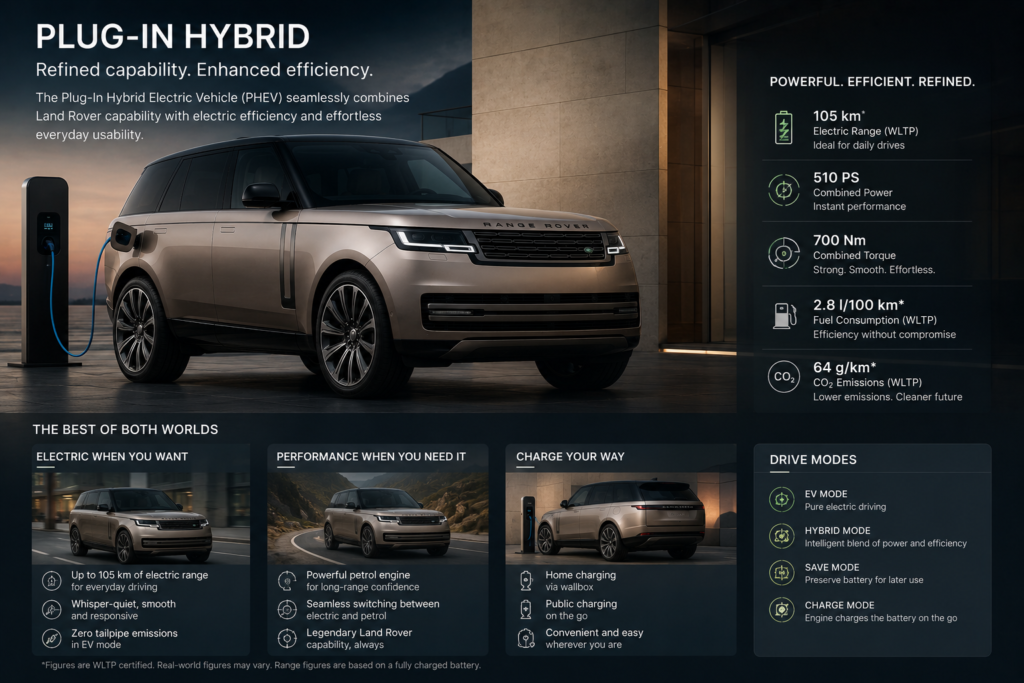
For American buyers who want the full Range Rover experience while keeping one eye on fuel costs and environmental impact, the PHEV version is arguably the most compelling vehicle in the entire lineup.
There’s a plug-in hybrid with 21 miles of electric range — and 543 horsepower. Prudence and excess, in one unmistakable package. The most popular PHEV trim is the P550e SE, priced at $125,900 MSRP for the standard wheelbase.
For a typical American commuter averaging 30–40 miles per day, this configuration means the vast majority of daily driving happens in near-silent electric mode — with zero fuel consumption and zero emissions. Long-distance drives are handled by the petrol engine without range anxiety. It’s genuinely the best of both worlds, and the 543 horsepower ensures no one will accuse you of making a compromise.
The PHEV also comes with a practical caveat worth noting: towing capacity is slightly reduced compared to the purely combustion models, so if hauling heavy loads is a priority, the P530 or P615 V8 variants are the better choice.
10. Pricing Breakdown: What You Actually Pay in 2026
Let’s talk numbers honestly, because Range Rover pricing can feel like an entirely separate universe from the rest of the auto market — and it basically is.
The 2026 Land Rover Range Rover starts at $115,450 (including the $2,150 destination charge) and is on sale now. Here’s how the key price points break down across the lineup:
- Entry-level SE (Standard Wheelbase):
- Starting around $115,450 — this gets you a fully-loaded luxury SUV by any objective standard, with the entire suite of driver assistance technology, premium leather, and the refined inline-six engine.
- P550e PHEV SE (Standard Wheelbase):
- Priced at $125,900 MSRP — the most popular configuration in the US market, combining the electric efficiency story with the Range Rover luxury experience.
- P550e Autobiography (Standard Wheelbase):
- Priced at $159,200 MSRP — for buyers who want the absolute highest expression of Range Rover luxury in the plug-in hybrid format.
- SV Black (new for 2026):
- Positioned above the Autobiography, the SV Black commands a significant premium for its exclusive darkened trim, Near-Aniline leather, and V8 powertrain.
For context, the entry-level SE is priced similarly to the Lexus LX and higher-end Cadillac Escalade, but it’s vastly more luxurious than either. Once you move up to the Autobiography and SV tiers, you’re in Bentley Bentayga territory in terms of what’s on offer.
Land Rover covers the 2026 Range Rover with a four-year/50,000-mile limited warranty.
11. The All-Electric Range Rover: The Future Is Almost Here
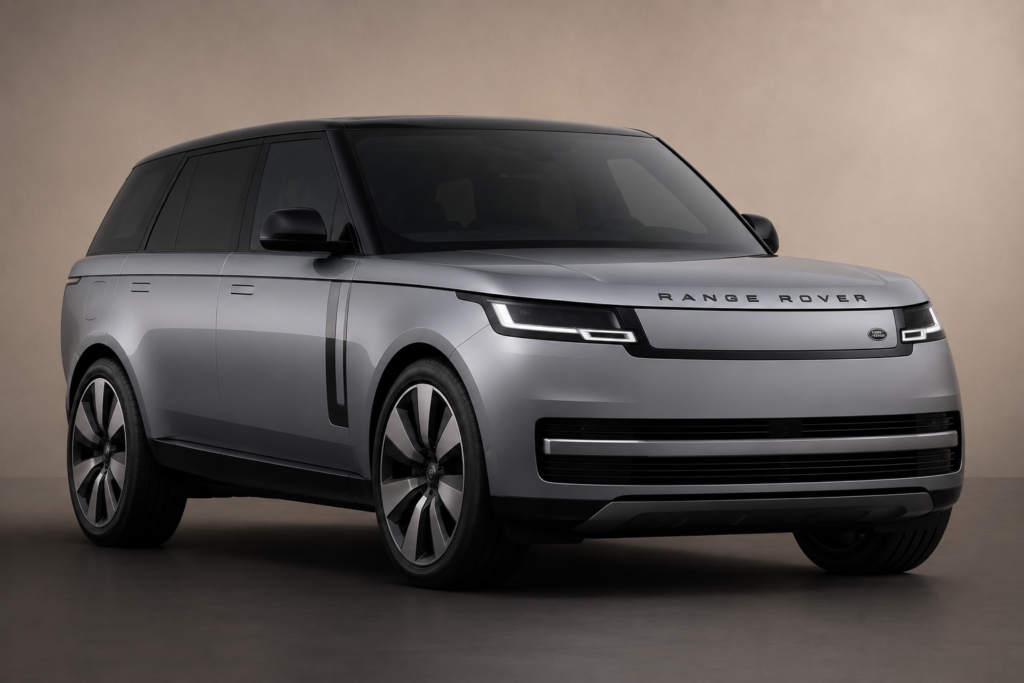
Perhaps the most anticipated vehicle in the Land Rover lineup isn’t even fully in showrooms yet — the all-electric Range Rover has been generating enormous buzz, and for good reason.
Land Rover is committed to a fully electric future, and the 2026 model year showcases the brand’s next big steps. The all-electric Range Rover is expected to debut by 2026, combining zero-emission driving with ultra-luxury refinement. Expansion of Plug-In Hybrid (PHEV) models is also expected across more trim levels in the Range Rover, Range Rover Sport, and Velar lines.
Available EV Range Rover trims — SE, HSE, and Autobiography — offer tailored features for every driver. The combination of electric power, advanced suspension, and responsive traction systems means the 2026 Range Rover EV stands out as a capable and luxurious SUV. It retains the classic Range Rover feel while pushing electric performance to a new level.
For American buyers in eco-conscious states like California, Colorado, and the Northeast, the electric Range Rover will be particularly compelling. Range Rover has already opened a waiting list, and given the brand’s loyal following, early allocation is expected to be highly competitive. If you’re interested, the time to register is now.
12. Design: Why the Range Rover Still Stops Traffic
In an era of increasingly anonymous-looking luxury SUVs, the Range Rover’s exterior design remains one of its greatest selling points. It’s instantly recognizable, even from a distance — and that’s something that no facelift, no redesign, and no amount of marketing has been able to manufacture for its competitors.
It combines athleticism, grace, and confidence with its signature short front overhang complemented by a boat tail rear featuring a split tailgate. Available in both short and long wheelbases, the Range Rover boasts eye-catching LED lighting signatures that provide both visibility and a distinctive design cue. The same three defining character lines that can be traced back to the original Range Rover have been elegantly integrated into the current model, preserving the sophisticated look that’s made this one of the world’s most recognizable luxury vehicles.
That continuity of design language is deliberate. Land Rover understands that Range Rover owners are buying into an aesthetic legacy as much as a vehicle. The subtle evolution of those three character lines from the 1970 original to the 2026 SV Black is one of the most elegant examples of long-term brand consistency in the entire automotive industry.
The new SV Black and SV Carbon trims add aggressive blacked-out and carbon fiber elements for buyers who want that design heritage delivered with a more confrontational edge. They’re striking in a way that manages to feel cohesive rather than bolt-on.
13. Real-World Ownership: What American Buyers Actually Experience
Specs and features tell part of the story. But what’s it actually like to live with a Range Rover day-to-day in the United States?
Owner feedback from American buyers consistently highlights several themes. The ride quality is universally praised — even on the deteriorating highway surfaces common in states like Michigan, New York, and Illinois, the air suspension absorbs imperfections with a serenity that feels almost surreal. Passengers frequently comment that it rides better than their home furniture.
The technology integration gets high marks too. The Pivi Pro infotainment system is one of the more intuitive large-screen systems in the luxury segment, with a layout that doesn’t require diving into sub-menus to perform basic tasks. Apple CarPlay and Android Auto both work seamlessly over wireless connections.
Off-road performance continues to surprise owners who bought the vehicle primarily as a road car. The Terrain Response 2 system makes confident off-road driving accessible to drivers with zero trail experience — select a terrain mode and the vehicle handles the technical calibration automatically.
The one area that draws consistent criticism is reliability. Land Rover’s dependability scores in long-term surveys, including those from J.D. Power, have historically trailed German and Japanese competitors. The brand has made measurable improvements over the past several years, but prospective buyers should factor in the cost of an extended warranty or CPO coverage, particularly on higher-mileage used examples.
14. The Range Rover in American Culture
Part of what makes the Range Rover conversation so interesting in the United States is the vehicle’s unique cultural positioning. It occupies a space that no American-made luxury vehicle has ever convincingly claimed: genuine aspiration across every demographic.
Range Rover’s popularity has transcended borders and social classes. It’s loved by royalty, celebrities, adventurers, and families alike, becoming a symbol of luxury, performance, and prestige. Its enduring appeal lies in its ability to deliver luxury without compromising on performance or functionality.
In American cities, the Range Rover is a fixture outside high-end restaurants, school drop-offs, and business meetings. In rural states, the same vehicle earns its keep pulling horse trailers, navigating unpaved ranch roads, and handling harsh winters that would strand lesser luxury vehicles. Very few products — automotive or otherwise — manage to carry genuine credibility across such a wide range of contexts.
Today, Range Rover continues to lead — not just in design or performance, but in relevance. With a commitment to electric vehicle innovation, eco-minded craftsmanship, and an enhanced connected user experience, it remains as forward-looking as ever. And yet, it never forgets where it came from. Because Range Rover is not just a vehicle. It is a moving sculpture; a design object; a legacy in motion.
15. Should You Buy a Range Rover in 2026?
After everything we’ve covered — the history, the technology, the performance, the pricing, and the real-world ownership experience — here’s the honest, bottom-line answer.
Buy a Range Rover if:
- You want the most refined, beautiful interior in the large luxury SUV segment, period. No competitor comes close to the craftsmanship, material quality, and sensory experience of the Autobiography or SV tiers.
- You genuinely use your SUV across varied conditions. The Range Rover is one of the very few vehicles in this price range that is equally at home in a Manhattan parking garage, on a Colorado ski mountain, and towing a boat down a Florida highway.
- You value design heritage and brand identity. The Range Rover’s visual language is 55 years in the making — it carries a weight of history that no recently-minted luxury SUV can manufacture.
- You’re interested in the PHEV efficiency story without sacrificing performance. The P550e delivers 543 horsepower and 50 miles of electric range — a combination that makes enormous practical sense for American daily drivers.
Think carefully if:
- Third-row practicality is a primary concern. The Escalade and Wagoneer genuinely offer more usable third-row space.
- Reliability is non-negotiable and you’re unwilling to pay for extended coverage. Budget for a comprehensive warranty.
- Your budget is genuinely entry-level in this segment. At $115,000+, the Range Rover demands a serious financial commitment, and there are excellent alternatives from Lexus, Cadillac, and Genesis at lower price points.
Final Thoughts: The Range Rover Earns Every Dollar
In a market crowded with excellent luxury SUVs, the Range Rover earns its premium in ways that are both rational and deeply emotional. Rationally, it delivers genuine off-road capability, best-in-class interior quality, a comprehensive technology suite, and a proven 55-year track record of continuous improvement. Emotionally, it delivers something harder to quantify — the feeling that you’re driving a vehicle with a genuine story, a real legacy, and an identity that hasn’t been engineered by a focus group.
While many luxury vehicles sacrifice capability for comfort, the Range Rover has always sought to balance both. Modern iterations come equipped with high-output engines capable of propelling this sizable SUV to 60 mph in under five seconds. Yet it’s never just about raw speed. These engines are tuned for quiet strength, and paired with adaptive dynamics, they deliver a ride that’s remarkably composed regardless of terrain.
The 2026 lineup — with its expanded SV family, its PHEV options, its incoming electric model, and its continued commitment to interior excellence — represents the Range Rover at perhaps its most complete and capable point in history. If you’re in the market for a large luxury SUV and you haven’t yet sat in one, do yourself a favor and book a test drive. It has a way of making the decision for you.
Questions About the Range Rover
What is the starting price of the 2026 Range Rover in the USA? The 2026 Range Rover starts at approximately $115,450 including destination charges for the base SE trim.
Does the 2026 Range Rover come in an electric version? Yes. The all-electric Range Rover is now entering the market in 2026, with an estimated price range of $120,000–$160,000 depending on trim level.
How much can a 2026 Range Rover tow? The 2026 Range Rover can tow up to 8,200 pounds when properly equipped. PHEV models have a slightly reduced tow capacity of approximately 6,614 pounds.
Is the Range Rover actually capable off-road? Yes — despite its luxury positioning, the Range Rover features over 11 inches of ground clearance, multiple terrain driving modes including a dedicated river-wading setting, two locking differentials, and Land Rover’s Terrain Response 2 system. It is genuinely capable on challenging terrain.
How does the 2026 Range Rover compare to the Cadillac Escalade? The Range Rover offers superior interior quality, ride refinement, and off-road capability. The Escalade offers more cargo and third-row space at a lower starting price. Both are exceptional vehicles serving slightly different buyer priorities.

 Sagar
Sagar