
 Sagar
Sagar Introduction: The Compact SUV That Grew Up Without Growing Out
There’s a reason the Hyundai Venue has been one of the best-selling cars in India since its debut in 2019. It didn’t just fill a gap in the market — it created an entirely new conversation about what a sub-4-metre SUV could actually offer. And now, with the all-new second-generation model launched in November 2025, Hyundai has done something rare in the automotive world: it has taken something that was already working, and made it genuinely better in almost every measurable way.
The 2025 Hyundai Venue is not a facelift. It’s not a refresh. It’s a proper second-generation product built on an all-new global K1 platform, powered by NVIDIA computing technology, loaded with Level 2 ADAS, and dressed in design that draws from Hyundai’s premium DNA. And yet, it still starts at a price that won’t make your heart skip — ₹8.00 lakh ex-showroom.
If you’re in the market for a compact SUV right now and you’re wondering whether the Venue deserves a place on your shortlist, the answer is a confident yes. But we’re not just going to tell you that. We’re going to walk you through 15 specific, detailed, research-backed reasons why the 2025 Hyundai Venue continues to be one of the smartest car purchases you can make in India today.
Let’s dig in.
1. It’s Built on a Brand-New, Stiffer Global K1 Platform — And That Changes Everything
Most people look at a new car and notice the design, the features, the price. What they often miss is the foundation — the platform underneath — which is arguably the most important thing of all. And this is exactly where the second-generation Hyundai Venue makes its single biggest leap forward.
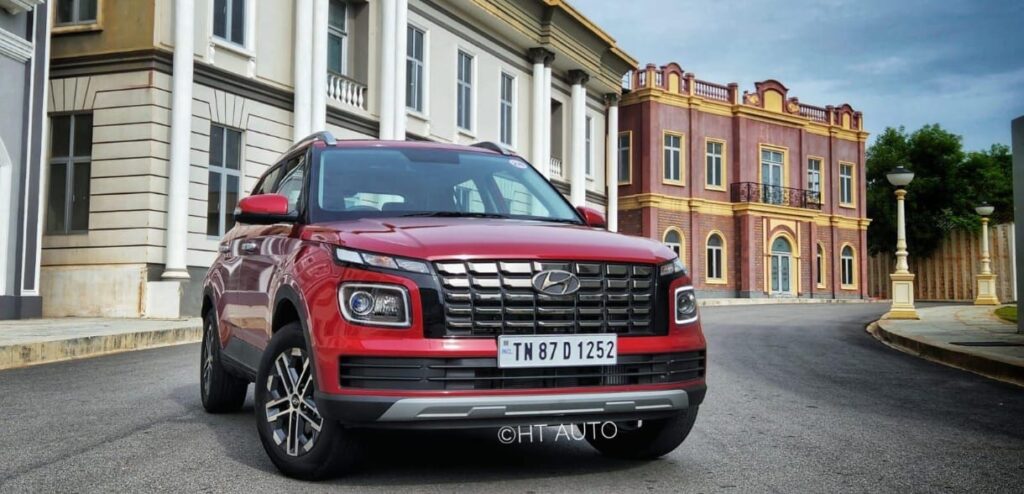
The new Venue is built on Hyundai’s global K1 platform, which replaces the older K2 architecture used in the first-generation car. This might sound like engineering jargon, but the real-world implications are enormous. The K1 platform uses ultra high-strength steel in critical structural areas, making the car’s body significantly more rigid than before. More rigidity means better crash protection, reduced cabin noise, improved handling, and a more premium feel when you drive over bumpy Indian roads.
What’s even more exciting is that this same platform underpins the Kia Syros, which scored an outstanding 30.21 out of 32 for adult occupant protection and 44.42 out of 49 for child occupant protection in Bharat NCAP testing — earning it a 5-star safety rating. Hyundai has already stated they expect the Venue to achieve a similar 5-star Bharat NCAP rating, and based on what we know about the platform, that expectation is well-founded.
The K1 platform also brings dimensional improvements that you’ll notice immediately. The new Venue is 30mm wider, 48mm taller, and has a 20mm longer wheelbase than the outgoing model — all while staying within the sub-4-metre bracket that keeps tax costs lower. This means more headroom, more shoulder room, and better knee space for rear passengers, all without the car feeling bulkier or harder to maneuver in city traffic.
Perhaps most futuristically, the K1 platform makes the Venue a software-defined vehicle (SDV) — one that can receive over-the-air (OTA) updates throughout its lifecycle. This means Hyundai can push new features, fix bugs, and improve the car’s software without you ever having to visit a service center. It’s the same approach that made Tesla famous, and it’s now available in a sub-4-metre Indian car under ₹16 lakh.
2. The Design Is Bold, Contemporary, and Unmistakably Hyundai
Let’s be honest — car design is subjective. But there’s a difference between a car that tries to look aggressive and a car that actually has the visual vocabulary to back it up. The 2025 Hyundai Venue belongs firmly in the second category.
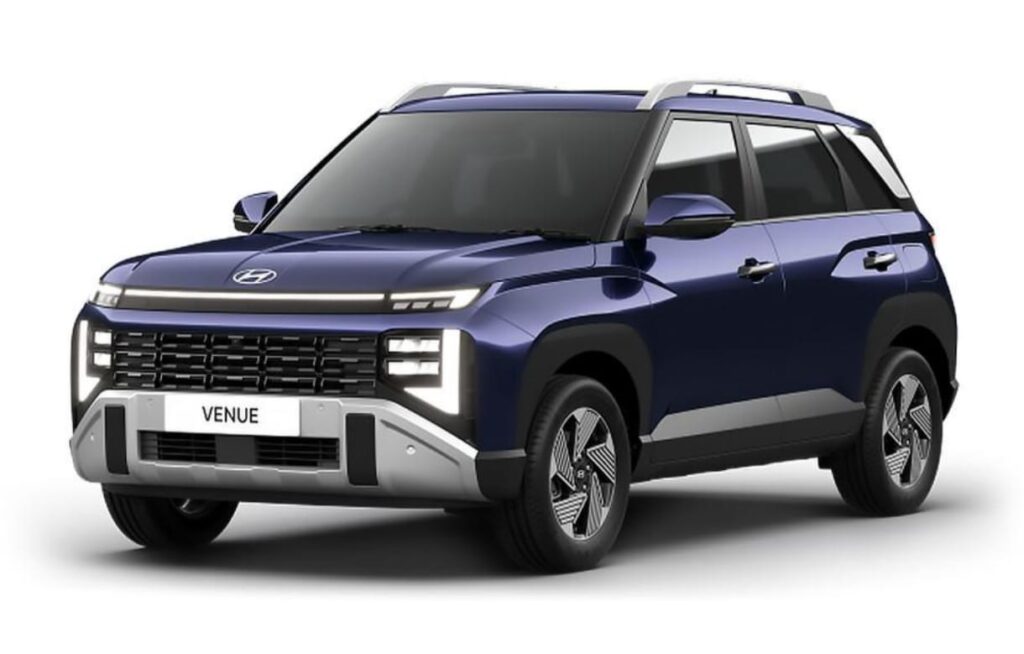
The front end draws clearly from Hyundai’s premium lineup — echoing cues from the Creta, the Exter, and even the flagship Palisade. The sharp parametric grille, the connected LED DRL signature, and the wide stance give the car a presence on the road that feels several segments above its price point. The side profile features sharp creases, flared fenders, and a new C-pillar quarter glass that adds a dash of sportiness and improves the driver’s peripheral vision.
At the rear, the connected LED tail lamp design wraps the car neatly, giving it a modern, cohesive look that photographs well and looks even better in person. The standard Venue rides on 16-inch alloy wheels that Hyundai has carefully proportioned to avoid the “undertyred” look that plagues some rivals. The result is a car that looks confident and planted rather than nervous or too compact.
For those who want something spicier, the Venue N Line takes the design further with 17-inch wheels featuring striking red brake calipers, an all-black exterior theme with red contrast stitching, and a sporty bodykit. It’s the kind of car that gets noticed in traffic without trying too hard.
Available colours include Atlas White, Abyss Black Pearl, Starry Night, Ranger Khaki, Fiery Red, and Atlas White with Black Roof (dual-tone) — a palette that caters equally to those who want subtle sophistication and those who want to stand out.
3. The Dual 12.3-Inch Curved Display Is Bigger Than Even the Creta’s
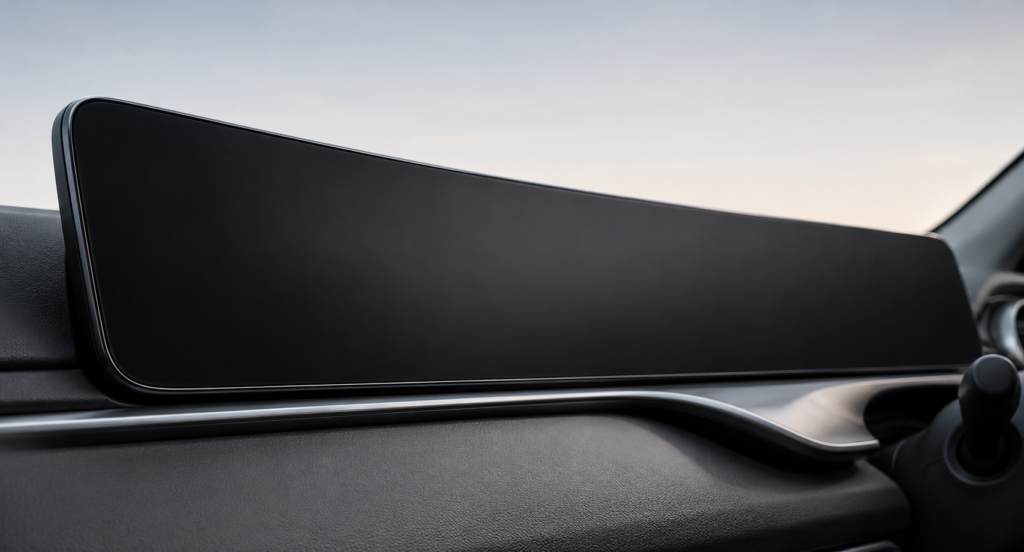
Let’s talk about what you see every single day when you sit inside the car — the dashboard technology. Because the 2025 Hyundai Venue has done something remarkable here: its dual 12.3-inch curved display setup is actually larger than what’s found in the Creta, which is Hyundai’s own SUV positioned a full segment above.
The infotainment screen and the digital instrument cluster are presented as a single, continuous curved panel. This isn’t a cosmetic gimmick — it’s powered by NVIDIA computing technology, which means the system is genuinely fast, responsive, and visually crisp. Anyone who has suffered through a laggy touchscreen in a car will understand what a difference this makes in daily use. The 360-degree camera feed, in particular, renders in superb resolution that makes parking in tight Mumbai or Delhi lanes significantly less stressful.
The system supports wireless Apple CarPlay and Android Auto — no cables, no fiddling, just pick up your phone and it connects. Multiple USB-C ports throughout the cabin ensure that everyone stays charged, whether you’re on a long road trip or a short daily commute.
Hyundai’s BlueLink connected car technology is also built in, giving you remote start, lock/unlock, live vehicle tracking, and a host of other functions via your smartphone. It also allows Hyundai to push OTA updates, diagnose issues remotely, and alert you to service reminders. In a world where your phone gets software updates automatically, it only makes sense your car should too.
4. Level 2 ADAS — A First in This Price Segment, and It Actually Works
Safety technology in cars is often a topic that doesn’t get the attention it deserves in India. People focus on airbags and star ratings, which are important — but the ability of a car to actively prevent an accident in the first place is arguably even more valuable. The 2025 Hyundai Venue is the only car in its segment to offer Level 2 ADAS, and it offers a total of 16 safety-assist features.
Level 2 ADAS means the car can simultaneously control both steering and braking/acceleration in certain scenarios, without requiring the driver to take over immediately. This is a significant step up from the Level 1 ADAS found in the previous Venue and in several rivals even today.
Here’s what 16 ADAS features look like in practice:
- Forward Collision Avoidance Assist (FCA): The system detects vehicles, pedestrians, and cyclists ahead and can automatically apply brakes if the driver doesn’t respond in time. On Delhi’s chaotic ring roads or Bengaluru’s stop-start traffic, this alone can prevent minor fender-benders.
- Lane Following Assist (LFA): When you’re on a highway and the car detects lane markings on both sides, it will gently steer the car to stay centered in the lane. This is particularly useful on NH-44 or expressways where long, straight stretches can lead to attention fatigue.
- Smart Cruise Control with Stop-and-Go: Set your cruising speed, and the car will automatically maintain a safe gap from the vehicle ahead — accelerating, decelerating, and even coming to a complete stop in traffic jams, then resuming when traffic moves. This feature alone transforms highway driving.
- Driver Attention Warning: The system monitors your driving patterns and alerts you if it detects signs of fatigue or inattention. For those long Diwali road trips, this could genuinely save lives.
- Lane Departure Warning & Prevention: If you drift out of your lane without signaling, the car warns you and gently steers you back. Highway driving in India, where lane discipline can be inconsistent, makes this feature genuinely useful.
The Venue N Line goes even further with five additional ADAS features, including Rear Cross Traffic Avoidance Assist and Blind Spot Avoidance Assist. Used responsibly, this suite of technology represents a meaningful step forward in Indian road safety.
5. Three Engine Options, All Refined and Purpose-Built for Indian Conditions
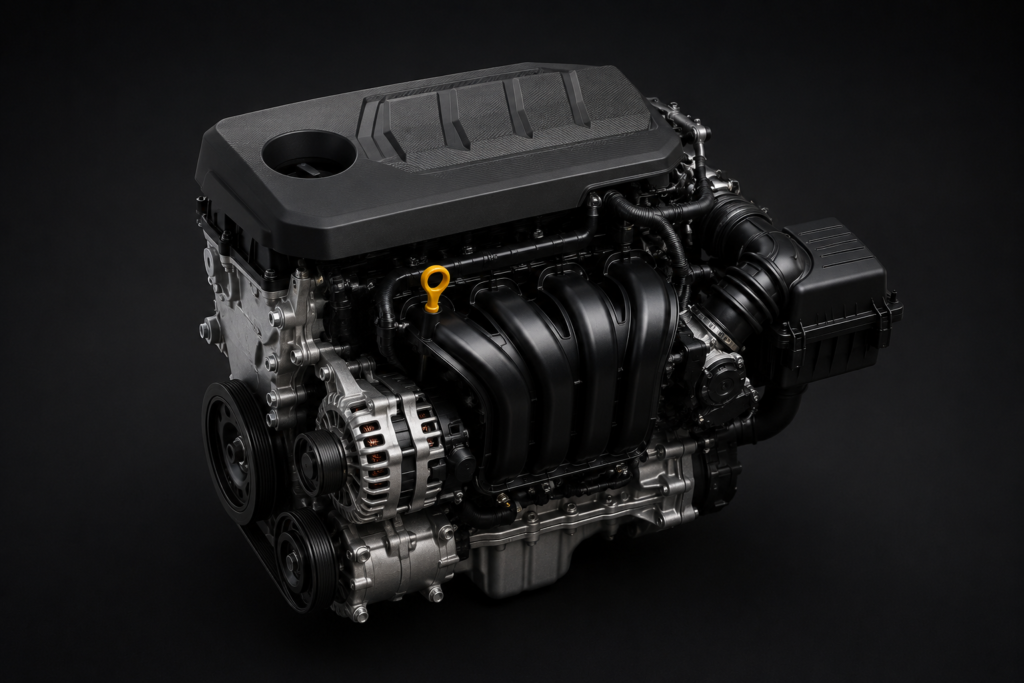
One of the most thoughtful things about the Hyundai Venue lineup is that Hyundai hasn’t offered a one-size-fits-all engine solution. Instead, they’ve given buyers three distinct powertrain options, each designed for a specific kind of Indian driver.
The 1.2-litre Naturally Aspirated Petrol
produces 82bhp and 114.7Nm of torque, paired with a 5-speed manual transmission. This is the engine for the budget-conscious urban commuter who wants reliability, ease of maintenance, and the lowest running costs. It’s smooth, predictable, and perfectly sized for city driving where you’re rarely pushing above 60 km/h. ARAI-claimed mileage is 18.5kmpl. This engine is available in the lower HX2 and HX4 variants, keeping entry costs down.
The 1.0-litre Turbo Petrol
is where things get exciting. Producing 118bhp and 172Nm of torque, this engine offers a noticeably punchier driving experience. The seven-speed DCT (Dual Clutch Transmission) option makes it feel genuinely fun — gears snap through crisply, and the power is available in a responsive, satisfying way. ARAI-claimed mileage is 18.74kmpl for the manual and an impressive 20kmpl for the DCT. This is the engine that most urban buyers who enjoy driving will gravitate toward, and it’s the sweet spot of the Venue range.
The 1.5-litre Turbo Diesel
is Hyundai’s answer to the long-distance traveler and the mileage-conscious buyer. It produces 114bhp and an impressive 250Nm of torque — that big torque figure means it feels effortlessly strong at highway speeds, making overtaking on state highways feel safe and unhurried. It’s available with a new 6-speed torque converter automatic, which does a commendable job of masking turbo lag and delivering smooth, linear power. Hyundai claims 20.99kmpl for the diesel manual and 17.9kmpl for the diesel automatic. If you do more than 1,500 km a month, the diesel will pay back its premium in fuel savings over time.
6. The Interior Quality Is a Genuine Step Up — It Feels Premium, Not Just Functional
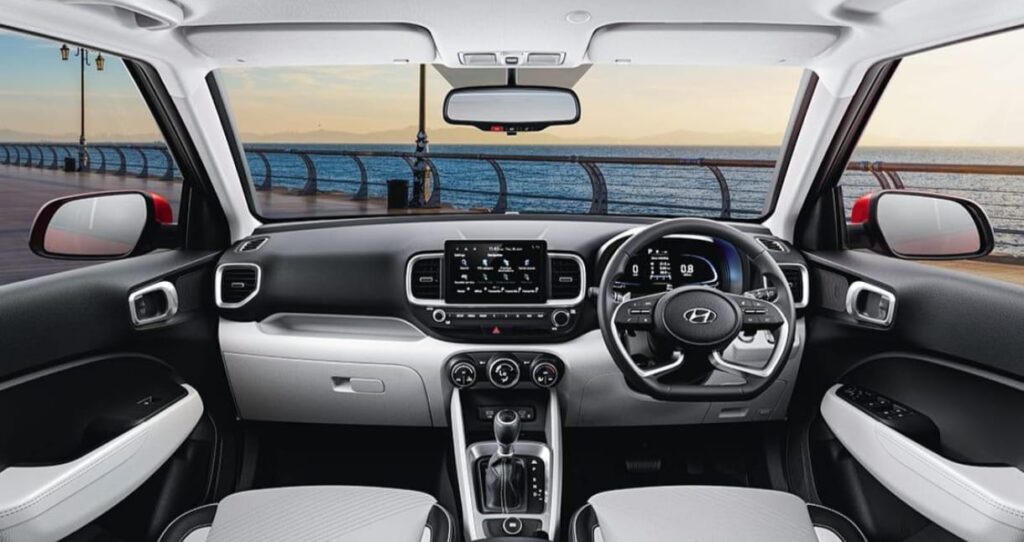
Walk into a Hyundai Venue showroom, sit in the new model, and then sit in the outgoing version. The difference in interior quality is immediately obvious and, in some ways, more impressive than the exterior redesign.
Hyundai’s designers have completely reimagined the cabin with materials and design details that genuinely punch above the car’s price class. The Terrazzo-textured crashpad (the dashboard panel) is a distinctive choice that adds a boutique, design-forward quality to the interior — it’s the kind of detail you’d expect in a hotel lobby, not a sub-₹16-lakh car. The D-cut flat-bottom steering wheel lends a sporty, modern feel to every drive. Moon white ambient lighting frames the centre console and crashpad, giving the cabin a calm, premium atmosphere at night.
The front seats are ventilated — a feature that Indian summers make genuinely essential — and the driver’s seat offers four-way powered adjustment so you can find your ideal driving position without stretching or slouching. The upholstery is fresh leatherette that feels soft and premium to the touch. A coffee table-style centre console provides a practical, flat surface between the front seats that makes the cabin feel more lounge-like.
In the rear, the 2025 Venue’s longer wheelbase translates to measurably more knee room — the scooped-out front seat backs also free up legroom in a clever, thoughtful way. Rear passengers get a two-step reclining seat, meaning you can actually lean back and relax rather than sitting bolt upright. Rear seat ventilation is also available on higher trims — again, an honest acknowledgment of India’s climate.
The boot space of 375 litres is practical and well-shaped. It’s not the largest in the segment, but it’s more than adequate for weekend trips, airport runs, and grocery hauls with the family.
7. The 8-Speaker Bose Sound System — Because Music Deserves Better Than Tinny Speakers
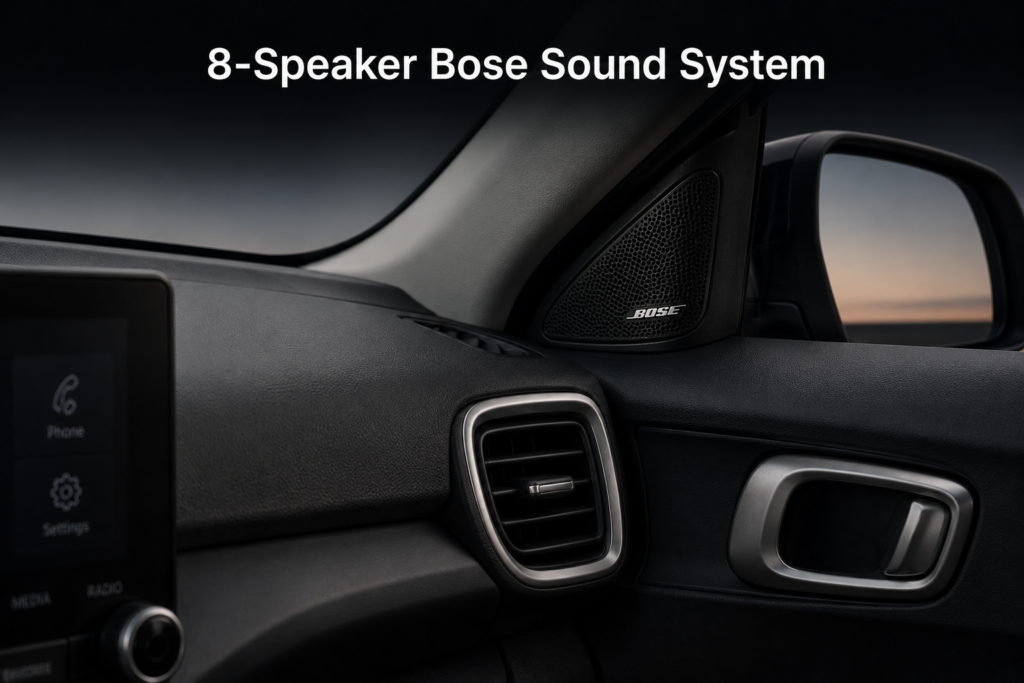
There’s an upgrade that car buyers often overlook on a spec sheet but immediately notice and appreciate in real life: the audio system. Hyundai has partnered with Bose to offer an 8-speaker sound system in the higher variants of the 2025 Venue, and it’s genuinely excellent.
Bose’s acoustic engineers don’t just add speakers — they calibrate the system specifically for the vehicle’s interior dimensions and materials, so the sound is balanced, rich, and immersive. Whether you’re playing Arijit Singh on a quiet evening drive or bumping an EDM playlist on a road trip, the Bose system makes the difference between music that fills the car and music that simply plays. Paired with wireless Apple CarPlay and Spotify integration, the Venue becomes something of a premium listening room on wheels.
This might sound like a luxury, but consider how much time the average Indian urban commuter spends in their car. For those logging 45 minutes to an hour each way in Delhi, Pune, or Chennai traffic, the quality of your in-car audio is not trivial. It’s a genuine contributor to daily quality of life.
8. Pricing That Makes Sense Across Every Budget — From ₹8 Lakh to ₹15.82 Lakh
One of the most important things Hyundai did with the 2025 Venue is restructure the pricing. The new variant lineup uses an ‘HX’ prefix system — HX2, HX4, HX5, HX5 Plus, HX6, HX7, HX8, and HX10 — and the prices have actually been made more competitive than the outgoing model. The range now starts at ₹8.00 lakh ex-showroom for the HX2 (base 1.2L NA petrol) and tops out at ₹15.82 lakh for the HX10 with the diesel automatic.
Here’s how the value stacks up across the range:
- HX2 (₹8.00 lakh): Entry point with 1.2L petrol. Gets 6 airbags, ABS with EBD, ESC, ISOFIX mounts, rear parking sensors, and a rear camera. Excellent value for safety basics.
- HX4 (₹8.99–9.50 lakh approx.): Adds TPMS, rear defogger, and more comfort features. A practical step up without spending too much.
- HX5 (₹9.99 lakh approx.): The sweet spot. All three engine options become available here, with a feature list fully suited for daily urban use. Highly recommended variant by most auto journalists.
- HX5 Plus (₹9.99 lakh, introduced January 2026): Hyundai added this variant specifically to plug a feature gap — offering attractive mid-range features at a price that competes sharply with rivals.
- HX7/HX8 (₹11–13.5 lakh approx.): More premium feel inside and out, with sunroof, Bose audio, ventilated seats, and BlueLink connectivity. The zone where most aspiring buyers will likely land.
- HX10 (₹14.82–15.82 lakh): The fully loaded top spec with Level 2 ADAS, dual 12.3-inch screens, 360-degree camera, ventilated rear seats, and the complete connected car experience.
This spread means there’s a Venue for almost every budget and lifestyle, which is a key reason the car has consistently ranked among India’s top 10 best-selling passenger vehicles.
9. The Sunroof — Because Every Indian Car Buyer Secretly Wants One
No list about a popular Indian car would be complete without addressing the sunroof, which has gone from being a luxury item to being a near-essential purchase criterion for the Indian buyer. The 2025 Hyundai Venue delivers a single-pane electric sunroof on mid-to-top variants, and it’s generously sized.
The sunroof experience in the Venue is clean and rattle-free — a detail that sounds obvious but is worth calling out because several cars in this segment suffer from sunroof-related cabin noise, especially at highway speeds. Hyundai’s engineering and sealing quality ensures it doesn’t become a source of wind noise or irritation. For evening drives along a quiet highway with the sunroof open and the Bose speakers playing, there’s a genuinely lovely quality-of-life reward built into this feature.
The sunroof also adds a sense of airiness and space to the cabin, especially for rear passengers who sometimes feel claustrophobic in compact cars. Even when closed, it floods the interior with natural light during the day.
10. 360-Degree Camera With NVIDIA-Powered Clarity — Parking in India Has Never Been Easier
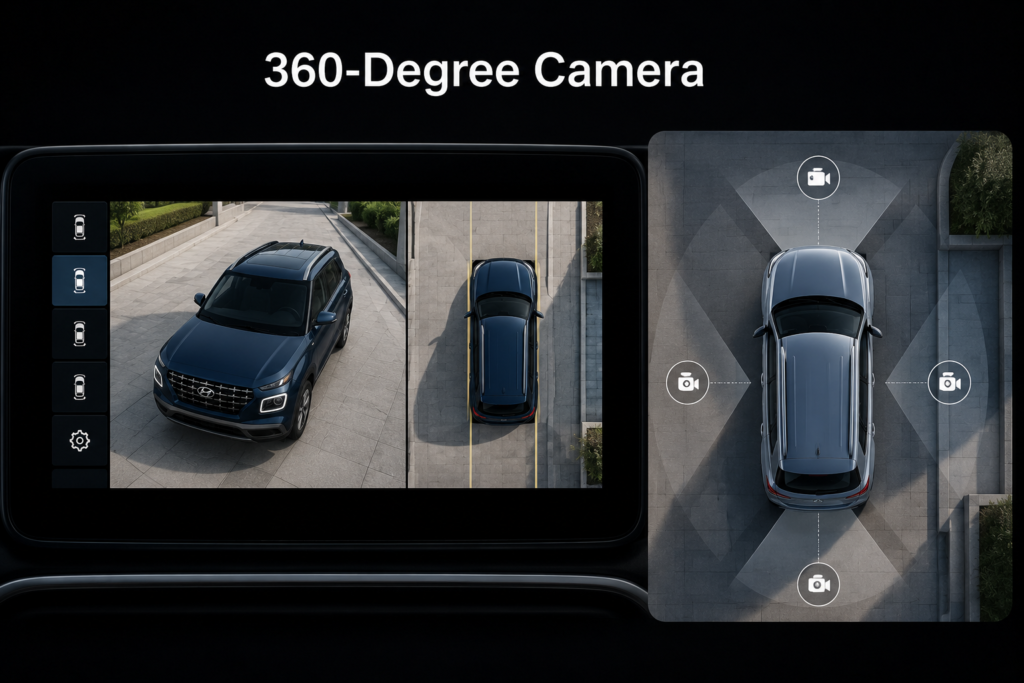
Parking in Indian cities is an extreme sport. Narrow lanes in residential areas of Mumbai, crowded commercial streets in Ahmedabad, parallel parking on Bengaluru’s congested roads — these are daily challenges that cause real stress. The 2025 Hyundai Venue addresses this directly with a 360-degree surround view camera system powered by NVIDIA computing technology.
What makes this system stand out is the clarity. Because the infotainment system is powered by NVIDIA hardware, the camera feed renders with exceptional sharpness and minimal distortion. You can see exactly where your bumpers are, exactly how much space is on each side, and exactly what’s behind the car — all from a bird’s-eye virtual overhead view stitched together from four cameras mounted around the vehicle.
The system also includes a Blind View Monitor — a feature borrowed from premium Hyundai and Genesis vehicles — that shows a live feed from the side cameras when you activate a turn signal. This lets you see into your blind spot before changing lanes, significantly reducing the risk of sideswipe accidents, particularly on multi-lane urban roads and expressways.
For the HX2 and HX4 variants without the full 360-degree system, there’s still a standard rear camera with guidelines, which is genuinely useful for everyday parking.
11. BlueLink Connected Car Technology — Your Car Is Now Always Online
Connectivity is no longer a premium feature — it’s an expectation. And the 2025 Hyundai Venue delivers it comprehensively through Hyundai BlueLink, one of the most mature and feature-rich connected car platforms available in India today.
What can BlueLink actually do for you? The list is impressively long. You can remotely start or stop the engine via your smartphone, lock or unlock the doors from anywhere, check your car’s real-time location, and even receive maintenance alerts before a service is due. If your car is towed or moves without authorization, you get an immediate notification. Parents who share the car with teenagers will appreciate the ability to set speed alerts and geofences — if the car exceeds a set speed or leaves a designated area, you’re notified instantly.
BlueLink also supports voice commands, so you can ask the car to navigate home, call a contact, or play a specific playlist without taking your hands off the wheel or eyes off the road. This isn’t just convenience — it’s genuinely safer than fumbling with a phone in traffic.
Hyundai Venue The system also ties into the OTA update capability of the K1 platform, meaning BlueLink features themselves can be enhanced over time. The car you buy today could gain new functions six months from now, simply through a software update.
12. Safety As Standard — Six Airbags From the Base Variant Onwards
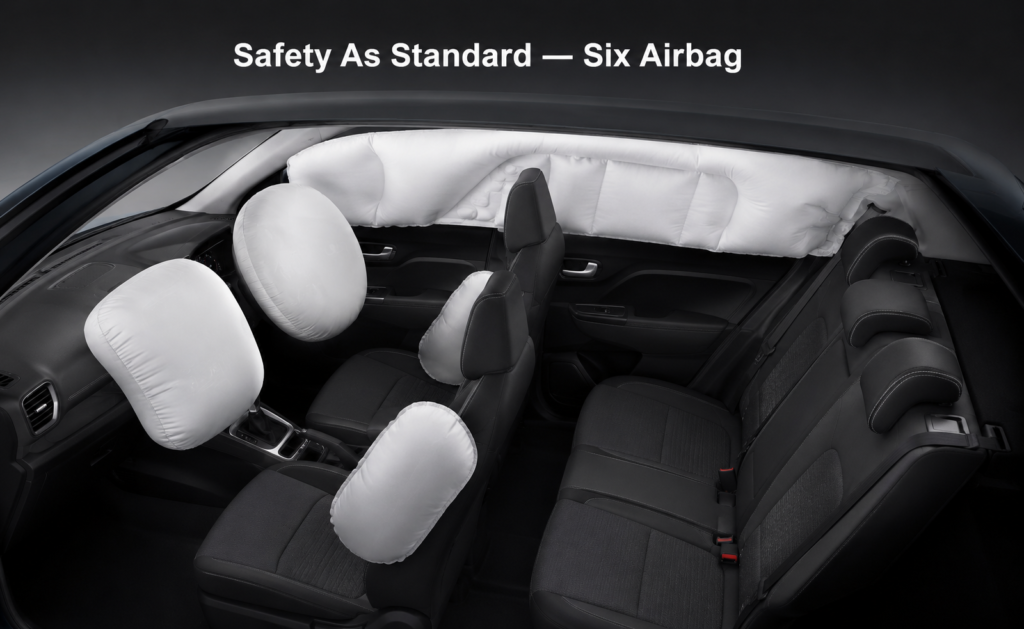
Safety should not be a premium upgrade. It should be the baseline. And Hyundai has taken a clear stance on this with the 2025 Venue by making six airbags standard equipment from the very base HX2 variant. This means even the most affordable version of the car gives you dual front airbags, dual side airbags, and dual curtain airbags — protecting all occupants in a side impact or rollover.
This is not something all rivals can claim at equivalent price points. Some competitors still offer only two or four airbags in base variants, leaving buyers in a difficult position where they must choose between budget and safety.
Beyond airbags, the standard safety suite across all Venue variants includes ABS with EBD (Anti-lock Braking System with Electronic Brakeforce Distribution), Electronic Stability Control (ESC), Vehicle Stability Management (VSM), ISOFIX child seat mounts, rear parking sensors, a rear camera, and a speed alert system. Higher variants add TPMS (Tyre Pressure Monitoring System), front parking sensors, and ultimately the full Level 2 ADAS suite.
The car has also secured a 5-star Bharat NCAP safety rating, which is a meaningful achievement given how rigorous India’s own crash testing protocol has become. For families buying a car they’ll use to transport their children and parents, this rating carries real weight.
13. Mileage That Won’t Break the Bank — Especially the Diesel and Turbo Petrol Variants
Fuel economy is always a top priority for the Indian buyer, and the 2025 Venue delivers convincing numbers across all three engine options. Let’s look at the ARAI-certified figures in context:
The 1.2-litre NA petrol manual returns 18.5kmpl — honest and consistent for a car of this size in stop-start urban traffic. The 1.0-litre turbo petrol with 7-speed DCT delivers an impressive 20kmpl, which is particularly notable given that it’s the more powerful, more exciting engine option. Hyundai’s engineers have done excellent work making the DCT efficient enough to return better fuel economy than the manual variant — a counterintuitive result that reflects the quality of the transmission calibration.
The 1.5-litre diesel manual returns 20.99kmpl on ARAI testing, making it one of the most fuel-efficient cars in the segment. Even the diesel automatic — which typically loses efficiency versus the manual — returns 17.9kmpl, which is entirely respectable for highway-heavy usage.
In real-world Indian driving, you can expect figures between 13–17kmpl for city driving and 16–22kmpl on highways, depending on the variant and driving style. For someone covering 1,500–2,000 km a month, the difference between the Venue’s mileage and a thirstier rival can add up to several thousand rupees in annual savings.
14. The Hyundai Venue N Line — For Buyers Who Want a Bit More Attitude
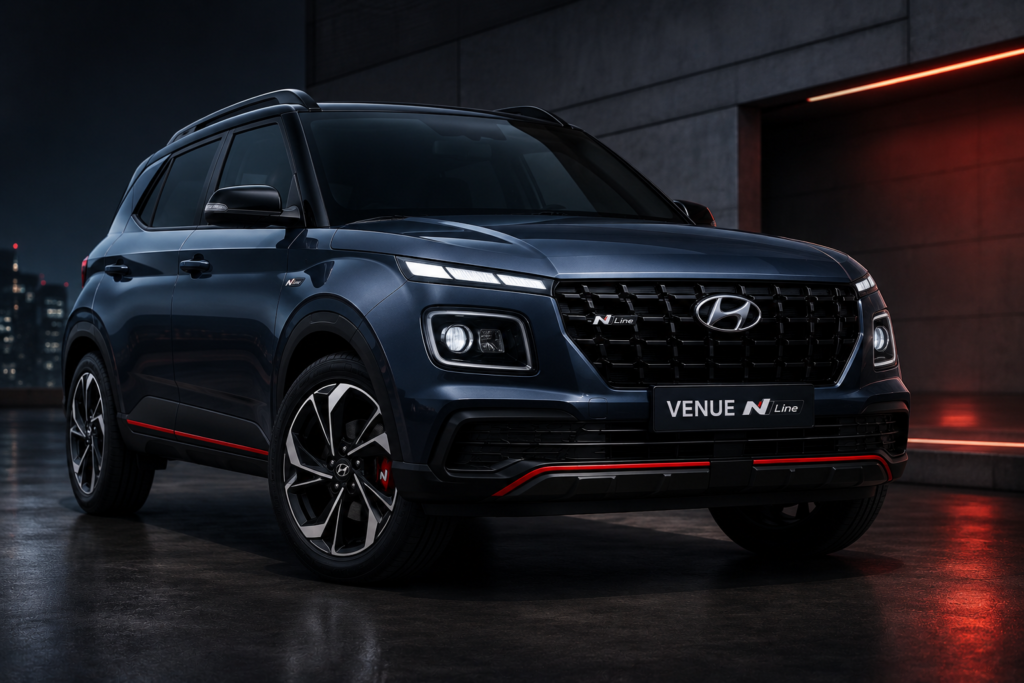
The standard Venue is a smart, composed, and well-rounded compact SUV. But for buyers who want their daily driver to feel a little more alive, Hyundai has the Venue N Line — a performance-flavored variant that draws directly from Hyundai’s N motorsport heritage.
The N Line brings 32 exclusive upgrades over the standard Venue. Visually, it’s immediately recognizable: the all-black exterior with red contrast elements, 17-inch N Line-specific alloy wheels, red brake calipers, a sportier front bumper with red inserts, and N Line badging throughout. Inside, the mood shifts with red contrast stitching on the seats, an N Line-specific steering wheel with performance control buttons, and a unique seat design that holds you in place better during spirited cornering.
Mechanically, the N Line shares engines with the standard Venue — but the suspension has been tuned for a slightly firmer, more involving feel. It’s not a track car. Hyundai isn’t pretending it is. But it offers enough extra engagement to make weekend mountain drives or highway stretches feel more purposeful. The Venue N Line is available in both turbo petrol (DCT) and diesel variants.
It also gets five additional ADAS features — including Rear Cross Traffic Avoidance Assist and Blind Spot Avoidance Assist — that the standard top-spec Venue doesn’t offer. So the N Line isn’t just about aesthetics; it’s also the safety technology leader in the Venue lineup.
Priced between ₹10.55 lakh and ₹15.48 lakh, the N Line occupies a well-defined space for buyers who want premium features and a more distinctive identity.
15. The Competition Is Strong, But the Venue Still Wins Where It Counts
Any honest review of the Hyundai Venue must acknowledge the competitive landscape. The compact SUV segment in India is one of the most hotly contested in the world. The Venue competes with the Tata Nexon, Kia Sonet, Mahindra XUV 3XO, Maruti Suzuki Brezza, Skoda Kylaq, Kia Syros, Maruti Suzuki Fronx, and Toyota Urban Cruiser Taisor. That’s a deeply talented field.
So where does the Venue win, and where does it face challenges?
Where the Venue leads:
- Technology per rupee: The NVIDIA-powered dual 12.3-inch displays, Level 2 ADAS, 360-degree camera, and OTA update capability at its price points are unmatched in the segment.
- Engine variety and refinement: Three engine options with five transmission choices — no other car in this segment offers this breadth while maintaining refinement across each combination.
- Build quality and platform maturity: The K1 platform’s rigidity and the Venue’s assembly quality are among the best in the segment. The car feels solid in a way that its price doesn’t suggest.
- Brand trust and after-sales network: Hyundai’s service network in India is one of the most extensive and reliable. Resale values for Hyundai cars in India have historically been strong, making them a smarter long-term investment.
- Feature democratization: Giving six airbags as standard from the base variant, offering ventilated seats, a Bose system, and ADAS — all in a sub-4-metre car — is genuinely segment-leading.
Where rivals have their own strengths:
- The Tata Nexon offers a fully electric variant (Nexon EV) — something the Venue doesn’t currently offer. For buyers committed to going electric, the Nexon EV deserves attention.
- The Mahindra XUV 3XO offers a larger, more powerful turbo petrol and a wider body — better for buyers who prioritize raw space.
- The Kia Sonet shares its platform and engines with the Venue but is often available at slightly lower variant prices, though it concedes some features.
The key insight is this: the 2025 Hyundai Venue isn’t just competing — it’s setting the benchmark. Auto journalists from Autocar India, CarDekho, CarWale, and ZigWheels have consistently highlighted it as the most complete product in the segment, particularly for buyers who prioritize technology, safety, and refinement over raw size.
Hyundai Venue 2025–26: Full Specifications at a Glance
| Parameter | Detail |
| Price Range | ₹8.00 lakh – ₹15.82 lakh (ex-showroom) |
| Platform | Global K1 (shared with Kia Syros) |
| Length | 3,995mm (sub-4m) |
| Wheelbase | 20mm longer than previous gen |
| Engines | 1.2L NA Petrol / 1.0L Turbo Petrol / 1.5L Turbo Diesel |
| Power Outputs | 82bhp / 118bhp / 114bhp |
| Transmissions | 5MT / 6MT / 7DCT / 6MT / 6-speed TC |
| Mileage (ARAI) | 18.5 / 18.74–20 / 17.9–20.99 kmpl |
| Boot Space | 375 litres |
| Airbags | 6 (standard across all variants) |
| Safety Rating | 5-star Bharat NCAP |
| ADAS | Level 2 (16 features; N Line gets 21) |
| Infotainment | Dual 12.3-inch NVIDIA-powered curved display |
| Connectivity | BlueLink + OTA updates (SDV) |
| Audio | 8-speaker Bose system (higher variants) |
| Camera | 360-degree surround view with Blind View Monitor |
| Variants | HX2, HX4, HX5, HX5 Plus, HX6, HX7, HX8, HX10 |
Who Should Buy the Hyundai Venue?
The Venue is built for a very specific kind of buyer — and if you recognize yourself in this description, it’s almost certainly the right car for you.
You are a first-time SUV buyer coming from a hatchback like the Swift, i20, or Baleno, who wants the elevated seating position, the perceived road presence, and the peace of mind of a proper body-on-frame-adjacent vehicle — without the physical bulk of a Creta or Seltos. You commute in an Indian city, deal with traffic every day, and value technology and safety more than sheer engine power. You want to impress at a family function, enjoy a weekend road trip, and still find parking in a tight residential colony without breaking into a sweat.
The Venue also works exceptionally well as a second car for families that already own a larger SUV. It’s the practical daily driver that you don’t mind taking into crowded markets or handing off to a driver, because it’s easy, intuitive, and loaded with the kind of connectivity features that make modern life smoother.
If you’re a performance enthusiast looking for track-day thrills, the Venue N Line scratches that itch without asking you to buy a completely different car. And if you want the maximum technology on a limited budget, the HX5 and HX7 variants offer outstanding value for everything you actually use day to day.
A Word on Variants: Which One Should You Actually Buy?
This is the question every Venue buyer ends up Googling at 11pm before their dealership visit. Here’s an honest guide:
For pure value seekers: The HX5 is the sweet spot. It unlocks all three engine options, has a usable feature list for daily life, and keeps costs under ₹11 lakh depending on the variant. Most auto experts agree on this one.
For the tech-focused urban buyer: The HX7 or HX8 is where the Venue’s character really shines. You get the sunroof, Bose audio, ventilated seats, and wireless connectivity — everything you use every day. Budget around ₹12–13.5 lakh.
For the ADAS and everything buyer: Go to the HX10. You’re paying a premium, but you get the most complete technology experience in the segment — and in some ways, the most complete technology experience in any car under ₹16 lakh in India.
For the sporty buyer: The Venue N Line (any variant) is worth the premium if design and driving feel matter to you. The 17-inch wheels, the firmer suspension, and the interior personality make every drive more engaging.
Final Verdict: Still the King, Now With Better Armor
The 2025 Hyundai Venue is the rare kind of product that makes you think Hyundai genuinely listened to everything owners and critics said about the first generation — and then methodically addressed every single point. The platform is newer and safer. The design is sharper and more confident. The technology is genuinely class-leading. The safety is comprehensive and democratized. The engine options are well-calibrated and honest about their fuel economy.
Does it have limitations? Of course. Seating three adults in the rear is still tight. The base 1.2-litre petrol without an automatic option may frustrate some buyers. And the top-spec variants, at ₹17–18 lakh on-road, brush up against the territory where larger SUVs become worth considering.
But for the buyer who wants a sub-4-metre SUV that feels genuinely premium, genuinely safe, and genuinely intelligent — the 2025 Hyundai Venue remains the most complete answer in the segment. Not by a narrow margin. By a comfortable one.
Frequently Asked Questions
Q: What is the starting price of the Hyundai Venue in India in 2025–26?
The Hyundai Venue starts at ₹8.00 lakh (ex-showroom) for the base HX2 variant with the 1.2-litre naturally aspirated petrol engine and 5-speed manual transmission.
Q: Does the Hyundai Venue have ADAS?
Yes. The 2025 Hyundai Venue features Level 2 ADAS with 16 functions in the top-spec HX10 variant, including Forward Collision Avoidance, Lane Following Assist, Smart Cruise Control with stop-and-go, and Driver Attention Warning. The Venue N Line gets 21 ADAS functions.
Q: What is the mileage of the Hyundai Venue diesel?
The Hyundai Venue 1.5-litre turbo diesel returns 20.99kmpl (manual) and 17.9kmpl (automatic) as per ARAI certification.
Q: How many airbags does the Hyundai Venue have?
The 2025 Hyundai Venue comes with 6 airbags as standard equipment across all variants, including the base HX2.
Q: What is the boot space of the Hyundai Venue 2025?
The Hyundai Venue 2025 offers 375 litres of boot space.
Q: Is the Hyundai Venue better than the Tata Nexon?
Both are excellent cars with different strengths. The Venue leads on technology (NVIDIA infotainment, Level 2 ADAS, OTA updates), while the Nexon offers more space and an EV option. For technology and refinement, the Venue is ahead; for size and the option of an electric variant, the Nexon has an edge.
Q: Which Hyundai Venue variant is the best buy?
The HX5 is the best value variant for daily use. For a more premium experience, the HX7 or HX8 with the sunroof, Bose audio, and ventilated seats offers excellent features without stretching to the top-spec price.
Q: Does the Hyundai Venue have a sunroof?
Yes, the 2025 Hyundai Venue has a single-pane electric sunroof, available from mid-range variants upwards.
Q: What platform is the new Hyundai Venue built on?
The 2025 Hyundai Venue is built on Hyundai’s global K1 platform, shared with the Kia Syros. It uses ultra high-strength steel and supports over-the-air software updates, making it a software-defined vehicle (SDV).
Q: What is the Hyundai Venue N Line price in India?
The Hyundai Venue N Line is priced between ₹10.55 lakh and ₹15.48 lakh (ex-showroom), available in turbo petrol DCT and diesel automatic variants.

 Sagar
Sagar