
 Sagar
Sagar Introduction: Why the Tata Punch Price Is Getting Everyone’s Attention
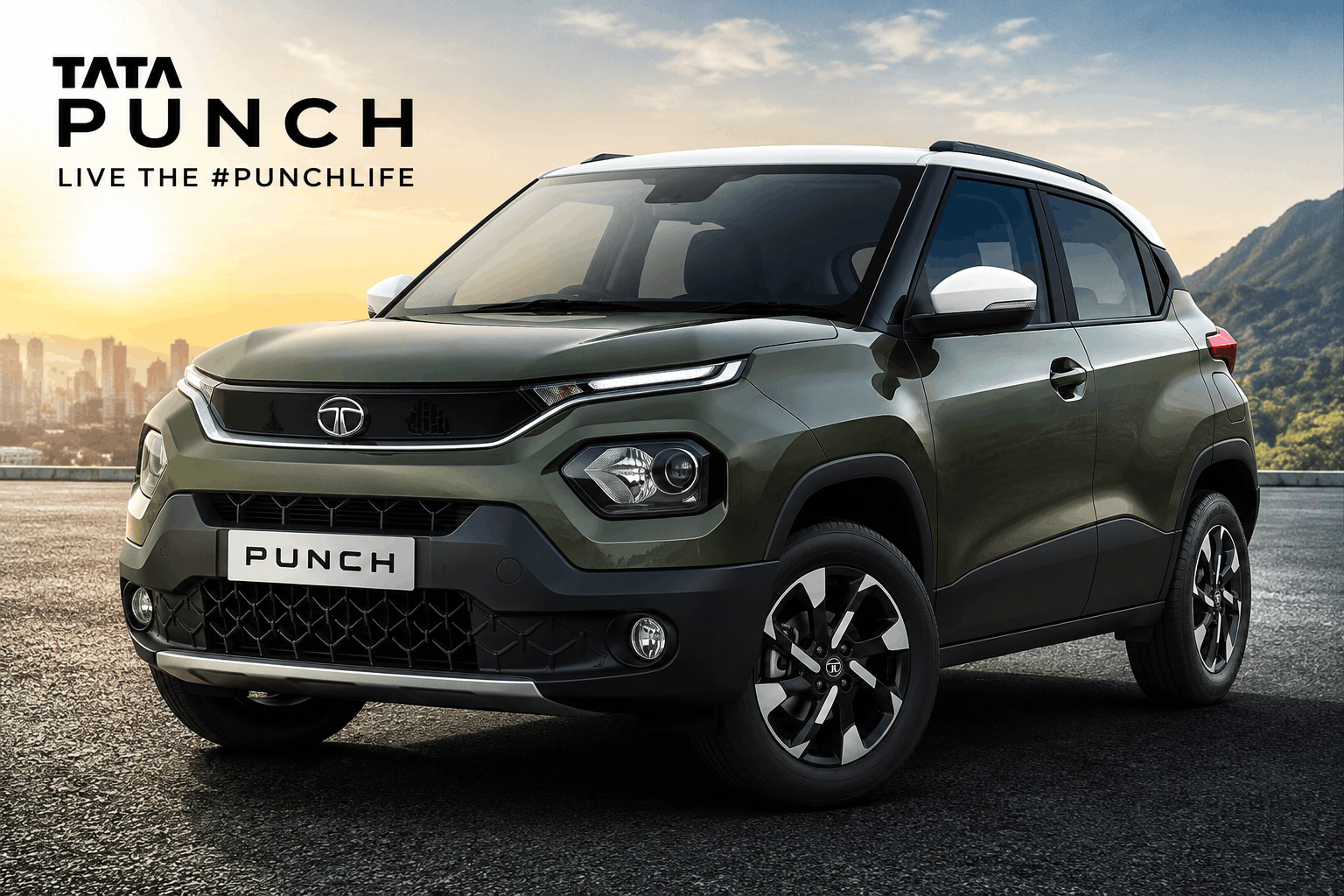
There’s something refreshing about a car that doesn’t try to be everything to everyone. The Tata Punch knows exactly what it is — a compact, confident, safety-first micro-SUV that packs a full-size attitude into a very approachable package. And in 2026, after a significant facelift that touched nearly every inch of the car, the Tata Punch price proposition has only gotten stronger.
For American car enthusiasts and Indian diaspora buyers researching this vehicle, the Tata Punch sits in a segment that the US market doesn’t really have an equivalent for. It’s a proper SUV in terms of stance, ground clearance, and road presence, yet it’s priced aggressively enough to be the first car purchase for millions of families. The 2026 facelift brought a bolder exterior, a completely revamped interior borrowed from the Punch EV, a brand-new turbocharged engine option, and a 5-star Bharat NCAP crash test rating that puts it in elite safety company.
Whether you’re comparing the Tata Punch price across its many variants, deciding between petrol and electric, or trying to understand how it stacks up against rivals like the Hyundai Exter and Nissan Magnite, this guide has you covered. Let’s break it down, one point at a time.
1. The Tata Punch Price Range: What You’re Actually Paying
The first thing anyone asks about any car is how much it costs — and when it comes to Tata Punch price, the answer is one of the most compelling in the segment. The 2026 Tata Punch facelift starts at ₹5.65 lakh (ex-showroom) for the base Smart variant and goes up to ₹10.60 lakh (ex-showroom) for the top-of-the-line Accomplished Plus S trim.
That’s a remarkably wide range, and it’s intentional. Tata Motors has architected the Punch lineup so that there’s a genuinely usable version at nearly every budget point within that window. The Smart variant at the entry level gives you the safety foundation — six airbags and LED headlamps — without unnecessary extras that would inflate the price. As you move up through the Pure, Adventure, and Accomplished trims, each tier adds meaningful features rather than cosmetic padding.
It’s also worth understanding what “ex-showroom” means in the Indian market context: the on-road Tata Punch price is typically ₹1 to ₹1.5 lakh higher than ex-showroom, once you factor in registration fees, road tax, and insurance. So a Smart variant that lists at ₹5.65 lakh will realistically cost somewhere between ₹6.75 lakh and ₹7 lakh when it’s fully registered and ready to drive home. That’s still extraordinary value for a 5-star-rated, properly equipped compact SUV.
For buyers in cities like Mumbai, Delhi, or Bengaluru, on-road prices will vary slightly based on local state taxes — something worth checking with your nearest Tata dealer before finalizing.
2. Variant-Wise Tata Punch Price Breakdown: Which One Makes Sense for You
Understanding the Tata Punch price across its variants is the key to getting the best value out of this car. The 2026 Punch is offered in six primary variants, and each one represents a distinctly different value proposition.
- Smart (₹5.65 lakh):
- This is the entry point into the Punch family. It handles daily commutes confidently with six standard airbags and LED headlamps. It’s aimed squarely at first-time car buyers who want genuine safety credentials without paying for features they won’t use. There are no frills here — no infotainment screen, no reverse camera — but the safety foundation is rock solid.
- Pure (₹6.55 lakh):
- The Pure adds rear AC vents and full power windows, which makes a real difference in everyday comfort. If you’re spending most of your time in city traffic, rear AC vents aren’t a luxury — they’re a necessity, especially during an Indian summer. The step-up in Tata Punch price here is well justified.
- Pure Plus (₹7.05 lakh to ₹8.60 lakh depending on powertrain):
- This is where the Punch starts to feel properly modern. The 20.32cm touchscreen infotainment system with wireless CarPlay lands here, which means no more phone mounting on the dashboard. The reverse parking camera that comes standard at this trim is one of those features you don’t realize you need until you have it — and then you wonder how you ever lived without it.
- Adventure (₹8.00–₹9.00 lakh range):
- Most experienced buyers land here. Adventure adds the 360-degree camera, push-button start, and auto climate control. You’re getting a genuinely premium-feeling car without stretching into the top-spec Accomplished territory. The Tata Punch price at this tier represents what most automotive reviewers call the sweet spot of the lineup.
- Accomplished and Accomplished Plus S (up to ₹10.60 lakh):
- These are the fully loaded expressions of the Punch. You get the 26.03cm touchscreen with wireless CarPlay, diamond-cut alloy wheels, voice-assisted electric sunroof, LED fog lamps, and a wireless charger. This is a car that genuinely surprises passengers who don’t expect this level of feature richness in a compact SUV.
3. The 2026 Tata Punch Facelift: What Actually Changed
The 2026 facelift isn’t just a coat of fresh paint — it’s a comprehensive overhaul that addresses the most consistent feedback the original Punch received since its 2021 launch. Understanding what changed helps you understand why the Tata Punch price remains competitive even with a substantially improved product.
The exterior received the most dramatic transformation. The front fascia is completely new, featuring a slimmer grille with slatted accents, sleeker DRLs, and a bumper that houses a vertically stacked headlamp cluster — a design language clearly borrowed from Tata’s larger, more premium models. The profile stays largely intact because it was already well-received, but the rear now gets a connected LED tail-lamp bar in a blacked-out casing that adds perceived width and brings the Punch in line with the brand’s latest design language.
Inside, the changes are even more significant. The dashboard has been completely replaced with a unit borrowed from the Punch EV, which includes a new two-spoke illuminated steering wheel, a touch-based climate control panel, and a digital instrument cluster. The interior now features a dual-tone charcoal-blue theme with white inserts on the dashboard and door panels. Rear passengers also benefit from extendable thigh support and a center armrest — features that previously required going to a higher segment.
Perhaps the biggest mechanical addition is the new 1.2-litre iTurbo petrol engine. This turbocharged unit produces 120 PS of power and 170 Nm of torque paired with a smooth 6-speed gearbox — and it transforms the Punch from a capable city commuter into something that’s actually fun to drive. This engine was the one thing the Punch always seemed to be missing, and its addition with the facelift finally delivers the performance the design always promised.
4. Tata Punch Price for the Turbo Petrol Variant: Is It Worth the Premium?
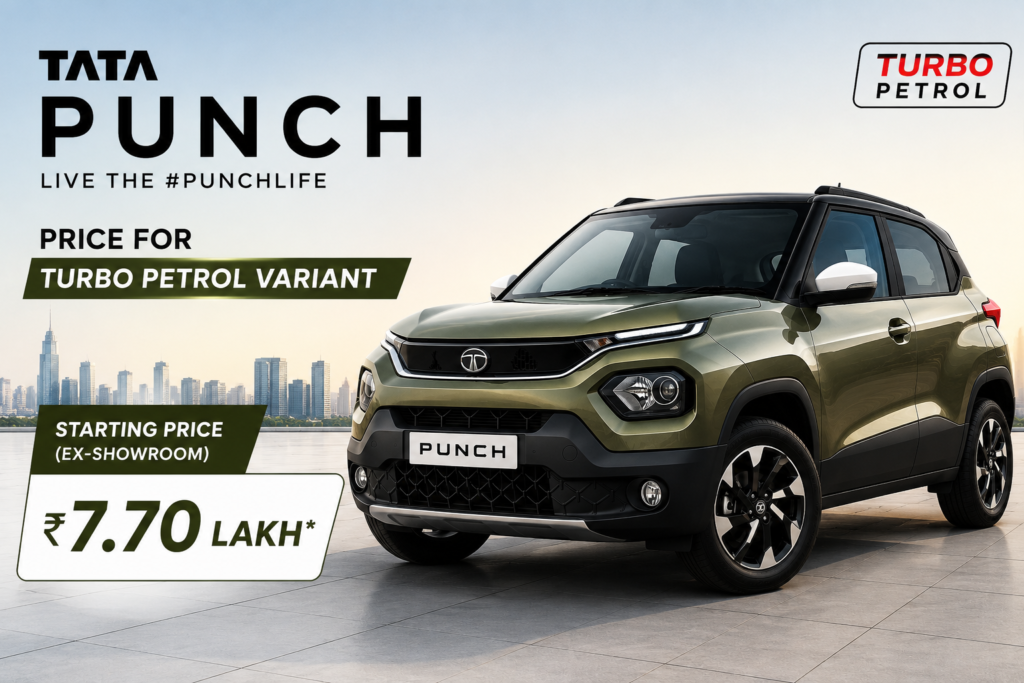
The introduction of the new turbocharged engine option is one of the most talked-about aspects of the 2026 Punch, and it raises a fair question about Tata Punch price relative to the performance gain. The turbo variants are naturally priced higher than their naturally aspirated equivalents, so you need to understand what you’re actually paying for.
The 120 PS turbo engine isn’t just about raw numbers. The 170 Nm of torque makes the car feel dramatically more responsive in real-world driving conditions — overtaking on highways, merging into fast-moving traffic, and climbing steep gradients all become noticeably more confident experiences. Automotive reviewers who drove the turbo variants described the throttle response as instantaneous, delivering the kind of muscle-car urgency you simply don’t expect from a micro-SUV at this price point.
The turbo engine is paired with a 6-speed manual gearbox, and it’s worth noting that Tata has not yet offered a turbo automatic combination — a point some city buyers find limiting. If your driving is primarily urban and you prefer automatic transmission, the naturally aspirated AMT variants remain the more practical choice despite the lower power output. The Tata Punch price advantage on those variants is real enough to factor into your decision.
That said, if highway driving or spirited weekend trips are part of your regular routine, the turbo petrol Punch delivers an experience that genuinely punches above its price class. It’s rare to find this kind of performance-per-rupee ratio in any segment.
5. Tata Punch Price for CNG Variants: The Frugal Choice That Makes Financial Sense
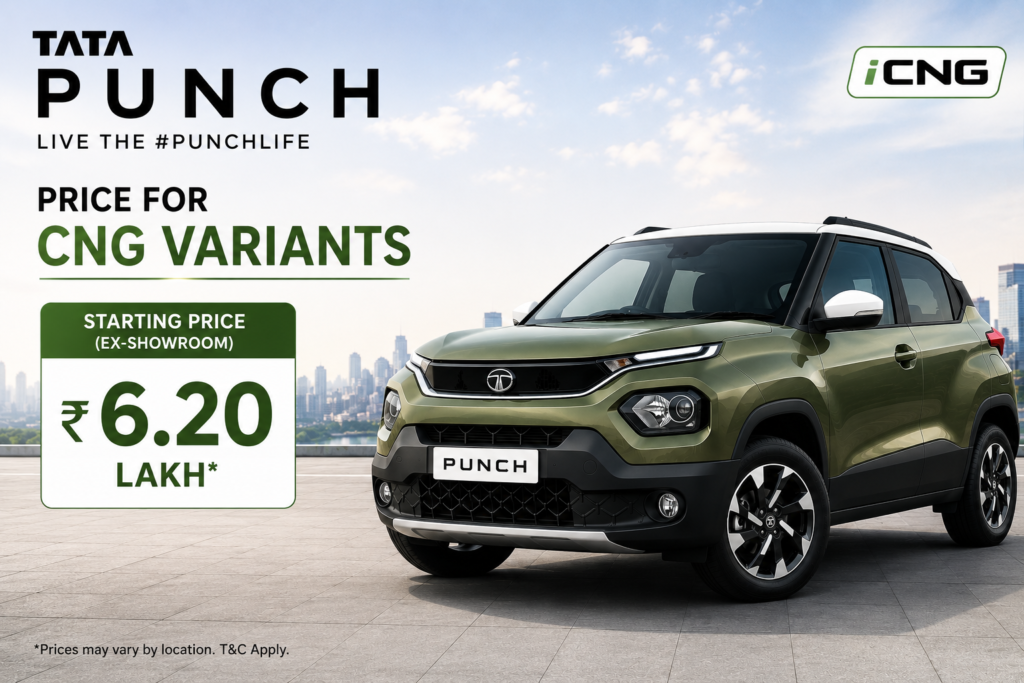
India’s compressed natural gas infrastructure has matured significantly over the past few years, and Tata has responded by building one of the most comprehensive CNG lineups in the compact SUV segment. The Tata Punch price for CNG variants is typically ₹90,000 to ₹1 lakh more than their equivalent petrol variants — and for high-mileage drivers, that premium pays for itself relatively quickly.
The Punch iCNG variants come with twin cylinders mounted below the luggage area, which is a clever engineering decision that maintains a usable 210-litre boot space even in CNG configuration. Direct CNG start means the engine fires on gas from the moment you turn the key — no waiting for the system to switch over from petrol. Seamless fuel switching means you never get stranded if CNG stations are unavailable on a long trip.
What makes the Tata Punch price particularly attractive for CNG buyers is the recently launched CNG AMT combination — the first of its kind in this SUV segment. CNG with automatic transmission eliminates the one major inconvenience of CNG driving in heavy city traffic, where frequent clutch operation can be tiring. For daily commuters covering 60 to 80 kilometers a day in cities with good CNG infrastructure, the Punch iCNG AMT represents perhaps the most economical-per-kilometer car available in this segment today.
Running costs on CNG can be 40 to 50 percent lower than petrol equivalents, which means the slightly higher Tata Punch price for CNG variants is effectively an investment that starts returning dividends almost immediately for high-usage drivers.
6. Tata Punch EV Price: The Electric Revolution at an Affordable Level
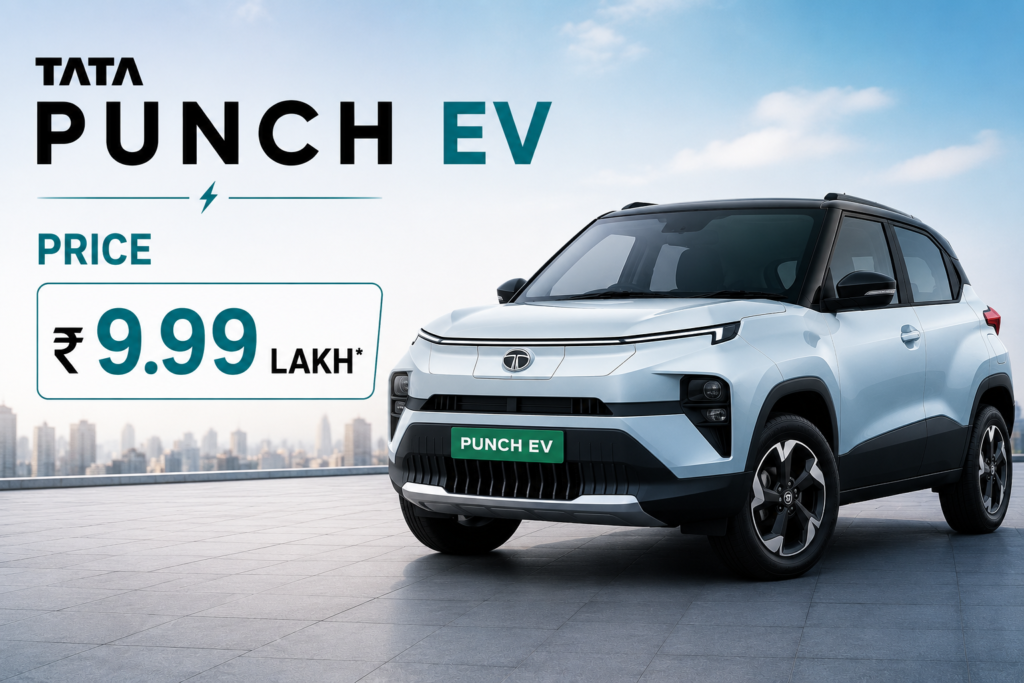
The Tata Punch EV deserves its own dedicated discussion because it’s a fundamentally different vehicle despite sharing a name and silhouette with the ICE Punch. The Tata Punch EV price in 2026 starts from ₹9.69 lakh (ex-showroom) for the Smart 30 variant and goes up to ₹12.59 lakh for the top-spec Empowered Plus S 40 kWh variant.
For context, that’s the most affordable long-range electric SUV available in India today. And the 2026 facelift of the Punch EV brings significantly improved range that eliminates most of the anxiety traditionally associated with EV ownership at this price point.
The Punch EV is offered with two battery options. The 30 kWh battery delivers an ARAI-certified range of 365 km and a real-world C75 range of approximately 260 to 275 km — more than enough for most daily urban driving patterns. The 40 kWh battery steps up to an ARAI-certified 468 km and a real-world range of 335 to 355 km, which makes this EV genuinely viable for weekend highway trips without constant charging anxiety.
- Smart 30 (₹9.69 lakh): Daily 30-40 km city commute territory, with six airbags and regenerative braking to recover energy in traffic stops.
- Smart Plus 30 (₹10.29 lakh): Adds the 20.32cm touchscreen with wireless CarPlay — the feature that most buyers actually notice every single day.
- Smart Plus 40 (₹10.89 lakh): Extends range to 468 km ARAI-certified for weekend trips without charging anxiety.
- Adventure 40 (₹11.59 lakh): Adds cruise control and hill descent for highway confidence — meaningful additions for buyers who occasionally venture beyond city limits.
- Empowered 40 (the sweet spot): This is where most buyers land, adding the 360-degree camera, 26.03cm touchscreen, wireless CarPlay, and cooled glovebox.
- Empowered Plus S 40 (₹12.59 lakh): The full expression — ventilated front seats, electric sunroof, and every connected feature the car has to offer.
The charging story is compelling, too. A 65 kW DC fast charger brings the 40 kWh pack from 20 to 80 percent in just 26 minutes. A 15-minute DC charge session adds up to 135 km of real-world range — roughly the equivalent of filling your fuel tank a quarter of the way in the time it takes to grab a coffee.
7. Lifetime Battery Warranty: The Feature That Changes the EV Value Calculation
No discussion of Tata Punch EV price is complete without understanding the battery warranty, because it fundamentally changes how you should think about the long-term cost of ownership.
The 40 kWh battery pack on the Tata Punch EV comes with a lifetime HV battery warranty with unlimited kilometres for the first registered private owner. Let that sink in. A lifetime battery warranty. Not 8 years, not 10 years — lifetime, with no mileage cap.
Battery degradation is the single biggest long-term cost concern for any EV buyer. Replacement battery packs for electric vehicles can cost anywhere from a significant fraction to nearly the full purchase price of the car itself. By eliminating that concern entirely for the first owner, Tata has made the Tata Punch EV price argument dramatically stronger. You’re not just buying a car — you’re buying a car with guaranteed protection against its most expensive potential failure point, forever.
For the 30 kWh variants, the warranty is 8 years or 1,60,000 km — still generous by industry standards, but not quite the lifetime coverage of the larger pack. If you’re buying the Punch EV primarily as a long-term ownership proposition, the slightly higher Tata Punch price for a 40 kWh variant is almost certainly the right financial decision.
Additionally, Tata offers a Battery-as-a-Service (BaaS) scheme for the first time on this model, allowing buyers to purchase the car at a significantly reduced upfront price of around ₹6.49 lakh and pay a per-kilometre battery rental charge of ₹2.60. For buyers with lower annual mileage who are sensitive to upfront Tata Punch price, this model makes the car accessible at a price point that was previously unimaginable for an electric SUV.
8. Safety Ratings: The Real Reason Tata Punch Price Is Justified
If there’s one thing that consistently differentiates the Tata Punch from every competitor in its segment, it’s safety. And in 2026, the Tata Punch facelift has made the safety argument even stronger by scoring a perfect 5-star rating from Bharat NCAP.
The Tata Punch recorded an adult occupant protection score of 30.58 out of a maximum 32 points — one of the highest scores ever achieved by a car in this price bracket under the Bharat NCAP protocol. In the frontal offset deformable barrier test, it showed good protection for the head, neck, pelvis, and thighs of both driver and front passenger. In the side movable deformable barrier test, it provided good protection to the head, abdomen, and pelvis. In the side pole impact test, all parts of the dummy received good protection.
This safety performance applies across the entire Tata Punch lineup, regardless of powertrain or variant. This means even the base Smart variant at ₹5.65 lakh delivers the same structural crash protection as the top-spec Accomplished Plus S. The safety hardware isn’t variant-dependent — it’s baked into the car’s architecture.
For comparison, the Nissan Magnite holds a 4-star Global NCAP rating, and the Hyundai Exter has also been rated, but neither matches the Punch’s near-perfect Bharat NCAP score. When you factor in that the Tata Punch price starts lower than some of these competitors, the safety advantage becomes a genuine differentiator rather than a tie-breaker.
Standard safety equipment across all variants includes six airbags, ABS with EBD, corner stability control, rear parking sensors, ISOFIX child seat mounts, and a high-strength steel body structure. The Punch is, quite simply, the safest car you can buy in this segment at this Tata Punch price range.
9. Technology Features That Feel Above the Price Point
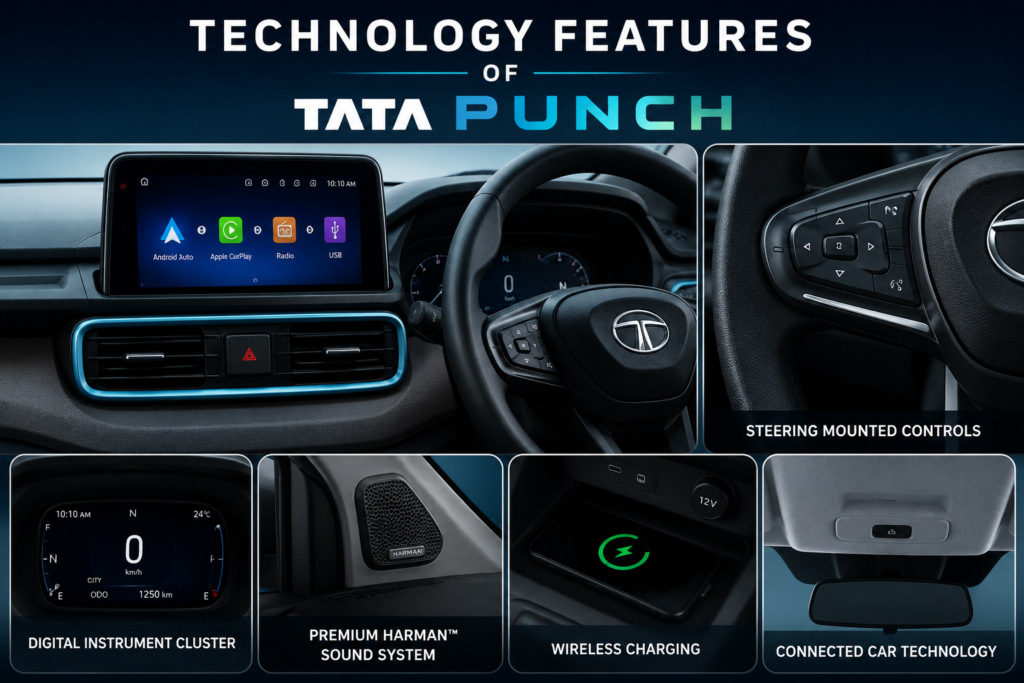
One of the recurring themes in Tata Punch reviews is surprise — specifically, the surprise buyers feel when they discover how much technology is packed into a car at this price. The Tata Punch price may suggest a basic commuter, but the feature list reads more like a mid-range luxury compact.
At the upper variants, the Punch comes equipped with a 10.25-inch Harman touchscreen infotainment system with wireless Android Auto and Apple CarPlay, so there’s no cable management needed on your morning commute. The voice-assisted electric sunroof can be operated hands-free, which is genuinely novel at this price point. The iRA connected car technology offers over 60 connected features including remote engine start, vehicle tracking, geofencing, and even smartwatch connectivity — features you’d typically associate with cars priced two or three times higher.
The 10.25-inch digital instrument cluster replaces traditional analog dials with a fully configurable digital readout that shows navigation prompts, driving statistics, and safety warnings in a clear, modern format. The two-spoke illuminated steering wheel with mounted controls for audio, phone, and cruise control gives the cabin a premium feel that consistently impresses passengers who step inside for the first time.
For the Punch EV specifically, the Arcade.ev app suite brings streaming entertainment and navigation apps directly into the infotainment system — meaning the car functions somewhat like a smartphone on wheels when parked or charging. The 26.03 cm HD infotainment system by HARMAN is paired with a 26.03 cm digital cockpit for a fully digital driving experience that feels genuinely impressive at the Tata Punch EV price point.
10. Ground Clearance and Real-World Capability: An SUV That Earns Its Name
One of the most frustrating things about many so-called compact SUVs is that they’re essentially hatchbacks with slightly raised suspensions and plastic body cladding. The Tata Punch is different, and its ground clearance numbers prove it.
The 2026 Tata Punch ICE variant offers 193mm of ground clearance, while the Punch EV delivers 195mm. For reference, many popular hatchbacks in India offer 165 to 175mm — meaning the Punch clears obstacles, speed bumps, and rough roads that would scrape lesser vehicles. The new 16-inch diamond-cut alloy wheels that come with higher variants complement this stance, giving the car a genuinely road-commanding presence that photographs don’t fully capture.
The 90-degree wide-opening doors are a practical touch that gets overlooked in spec comparisons but makes a real difference in daily life — particularly in tight parking spots or when helping elderly passengers in and out of the vehicle. The overall dimensions sit at 3,876 mm in length, 1,742 mm in width, and 1,615 mm in height, with a wheelbase of 2,445 mm. It’s compact enough to navigate urban traffic confidently while feeling genuinely spacious once you’re inside.
The boot space of 366 litres in petrol variants is class-leading for a micro-SUV, easily accommodating grocery runs, weekend bags, or the kind of miscellaneous cargo that families inevitably need to transport. The CNG variants offer 210 litres of usable boot space, which is reduced by the twin CNG cylinders but still practical for everyday use.
11. Fuel Efficiency: The Running Cost Advantage
Real-world fuel efficiency is where the Tata Punch price argument gets particularly interesting, because a car’s total cost of ownership is always more than just the sticker price. Owners consistently report real-world mileage of around 17 to 20 kilometers per liter for the naturally aspirated petrol variants under mixed driving conditions — figures that hold up reasonably well in city traffic compared to comparable vehicles.
The turbo petrol variants trade some efficiency for performance, which is the expected compromise. The new 1.2-litre iTurbo engine prioritizes driving enjoyment over maximum frugality, so buyers choosing it for highway driving should expect fuel economy in the 15 to 17 kmpl range in real-world conditions.
CNG variants, as noted earlier, dramatically reduce running costs — with CNG typically costing 40 to 50 percent less per kilometer than petrol in well-served urban markets. Over three to five years of ownership, those savings can effectively offset the higher initial Tata Punch price of the CNG variant.
For the Punch EV, running costs are where the case becomes overwhelming. Charging at home overnight on a standard 3.3 kW AC charger is genuinely economical — the cost per kilometer on electricity can be as low as ₹1 to ₹1.50 in most states, compared to ₹8 to ₹10 per kilometer on petrol at current fuel prices. Over the course of 50,000 to 60,000 km — a typical three-year ownership period for an active driver — the savings on fuel alone can easily exceed ₹2 to ₹3 lakh, making the higher Tata Punch EV price a compelling financial argument rather than a compromise.
12. Colors and Personalization: The Visual Identity of the 2026 Punch
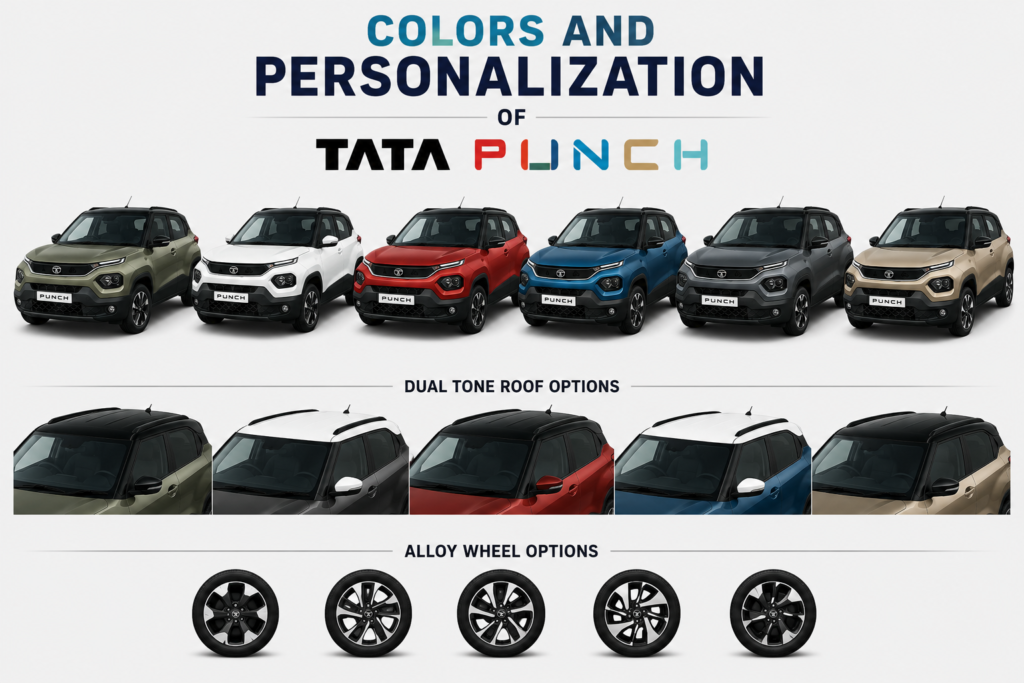
A car’s color might seem like a minor detail compared to engine specifications and Tata Punch price variants, but for a vehicle in this segment — one that urban buyers park on crowded streets and use to make a daily statement — color matters more than most people admit.
The 2026 Tata Punch facelift is available in six carefully curated shades: Coorg Clouds (a clean off-white), Pristine White, Daytona Grey, Caramel (a warm tan), Bengal Rouge (a deep, warm red), and Cyantific Blue. The new Bengal Rouge shade deserves special mention — it gives the Punch a warm, premium vibe that photographs beautifully and stands out in real-world traffic without being garish. Cyantific Blue brings youthful energy that works particularly well against the blacked-out trim elements.
Higher variants offer dual-tone paint schemes with contrasting roof colors, which dramatically enhance the Punch’s road presence and make it look considerably more premium than the Tata Punch price might suggest. The combination of a bold body color with a contrasting black roof is one of those subtle visual upgrades that shifts the car’s perceived value by more than the ₹10,000 to ₹15,000 premium it typically commands.
The Punch EV gets its own color palette that leans into the car’s electric identity — Fearless Yellow, Pure Grey, Bengal Rouge, Pristine White, and Empowered Oxide (a sophisticated deep brown) are the available options, with dual-tone choices reserved for Empowered variants.
13. How Tata Punch Price Compares to Key Rivals
No buying decision exists in a vacuum, and the Tata Punch price needs to be understood in the context of its competitive set. Its main rivals are the Hyundai Exter, Nissan Magnite, Renault Kiger, Maruti Suzuki Fronx, and Toyota Urban Cruiser Taisor — all competing in roughly the same micro-to-compact SUV price band.
Here’s an honest, balanced comparison of where each competitor stands:
- Hyundai Exter: Priced between ₹5.80 lakh and ₹9.61 lakh, the Exter offers a modern design with genuinely impressive first-in-segment features like a factory-fitted CNG kit and an in-built dashcam. Its interior feels slightly more refined at equivalent price points, but it doesn’t match the Punch’s 5-star Bharat NCAP safety credentials, which is a significant differentiator for family buyers.
- Nissan Magnite: The Magnite is generally priced between ₹5.65 lakh and ₹10.76 lakh and offers the highest engine power in the segment along with a CVT automatic transmission option. Its design is sporty and its CVT is genuinely smooth for city driving. The 4-star Global NCAP rating, however, lags behind the Punch’s perfect Bharat NCAP score.
- Maruti Suzuki Fronx: Priced from ₹6.85 lakh, the Fronx brings Maruti’s legendary service network and resale value, plus a turbo petrol engine option and a more premium-feeling interior in higher trims. It doesn’t offer the Punch’s level of standard safety equipment but competes strongly on brand trust and after-sale costs.
The honest conclusion: if safety is your absolute top priority — especially for a family’s primary vehicle — the Tata Punch price delivers the best safety-per-rupee ratio of any car in this segment. If service network, resale value, or automatic transmission variety matter more, some competitors have legitimate advantages.
14. Should You Buy the ICE or EV Punch? A Practical Decision Framework
This is the question that most 2026 Punch buyers face: given the significant but not massive difference in Tata Punch price between the petrol and electric versions, which one actually makes more sense for your situation?
The answer depends almost entirely on your daily driving pattern and charging access — not on brand loyalty or environmental values (though those matter too).
Choose the Tata Punch ICE (petrol/CNG) if: You regularly drive more than 150 km per day, live in a housing situation without dedicated parking and home-charging access, frequently make long highway trips between cities with limited EV charging infrastructure, or if the upfront Tata Punch price difference of ₹4 to ₹5 lakh between comparable ICE and EV variants is a genuine constraint on your budget.
Choose the Tata Punch EV if: Your daily commute is under 80 km, you have home charging access (even a standard 15-amp socket will overnight-charge the 30 kWh variant), your city has a reasonable public fast-charging network, and you plan to keep the car for at least four to five years. The running cost savings compound significantly over that timeframe, and the lifetime battery warranty on the 40 kWh pack protects your long-term ownership costs.
The BaaS scheme for the Punch EV also opens a third path — buying the car at a substantially lower upfront Tata Punch price of around ₹6.49 lakh and paying per kilometer for the battery. For urban buyers with predictable, lower-mileage daily use patterns, this could be the most financially efficient entry into EV ownership currently available in India.
15. The Verdict: Why Tata Punch Price Is One of the Best Value Propositions in 2026
After everything — the variant analysis, the safety data, the engine options, the EV considerations, and the competitor comparisons — what does the Tata Punch price actually represent in 2026?
It represents, quite simply, the best combination of safety, features, design, and value in the compact SUV segment at its price points. That’s not a soft endorsement. It’s a conclusion supported by the car’s perfect 5-star Bharat NCAP rating, its comprehensive variant lineup, its genuine segment-leading features at every price point, and the consistent praise it receives from both automotive press and everyday owners.
The 2026 facelift took a car that was already India’s bestselling micro-SUV and addressed its few legitimate weaknesses — the mediocre interior, the missing turbo engine option, the dated dashboard. The result is a car that now punches (appropriately) well above its price class in every area that matters.
For first-time car buyers, the base Smart variant at ₹5.65 lakh delivers safety credentials that would have been extraordinary at twice that price a decade ago. For families looking for a complete, feature-rich compact SUV, the Adventure or Accomplished variants offer genuine value in the ₹8 to ₹10 lakh range. And for buyers ready to embrace electric mobility, the Punch EV at ₹9.69 lakh is the most accessible long-range electric SUV available today, with a battery warranty that should erase the last remaining hesitation about EV ownership at this price point.
The Tata Punch price, in any variant and in any powertrain configuration, earns its ask. That’s the simplest and most honest way to put it.
Frequently Asked Questions About Tata Punch Price
What is the starting price of Tata Punch in 2026?
The 2026 Tata Punch facelift starts at ₹5.65 lakh (ex-showroom) for the base Smart petrol variant. On-road price is typically ₹1 to ₹1.5 lakh higher, depending on city and state taxes.
What is the Tata Punch EV price?
The Tata Punch EV price starts from ₹9.69 lakh (ex-showroom) for the Smart 30 variant and goes up to ₹12.59 lakh for the Empowered Plus S 40 kWh top variant.
Which Tata Punch variant offers the best value for money?
Most automotive experts recommend the Adventure variant as the sweet spot — it adds the 360-degree camera, push-button start, and auto climate control without reaching into top-tier pricing, placing it in the ₹8 to ₹9 lakh range.
Does the Tata Punch have a 5-star safety rating?
Yes. The 2026 Tata Punch facelift scored a perfect 5-star Bharat NCAP rating, with an adult occupant protection score of 30.58 out of 32 — one of the highest in its segment.
What is the real-world range of the Tata Punch EV?
The Tata Punch EV with the 40 kWh battery delivers a real-world C75 range of approximately 335 to 355 km. The 30 kWh variant delivers approximately 260 to 275 km in real-world conditions.
Is the Tata Punch available in the USA?
The Tata Punch is primarily a market vehicle for India and select export markets. It is not currently sold through official Tata Motors dealerships in the United States. US-based buyers can follow Tata’s international expansion plans for future availability updates.
How long does it take to charge the Tata Punch EV?
Using a 65 kW DC fast charger, the 40 kWh Punch EV charges from 20 to 80 percent in approximately 26 minutes. A 15-minute fast charge session adds around 135 km of real-world range.
All prices mentioned are ex-showroom prices as of June 2026. On-road prices vary by city and state. Specifications are subject to change at manufacturer’s discretion. Verify current Tata Punch price and availability at your nearest authorized Tata Motors dealership.

 Sagar
Sagar
[…] Creta Tata Punch Swift […]