
 Sagar
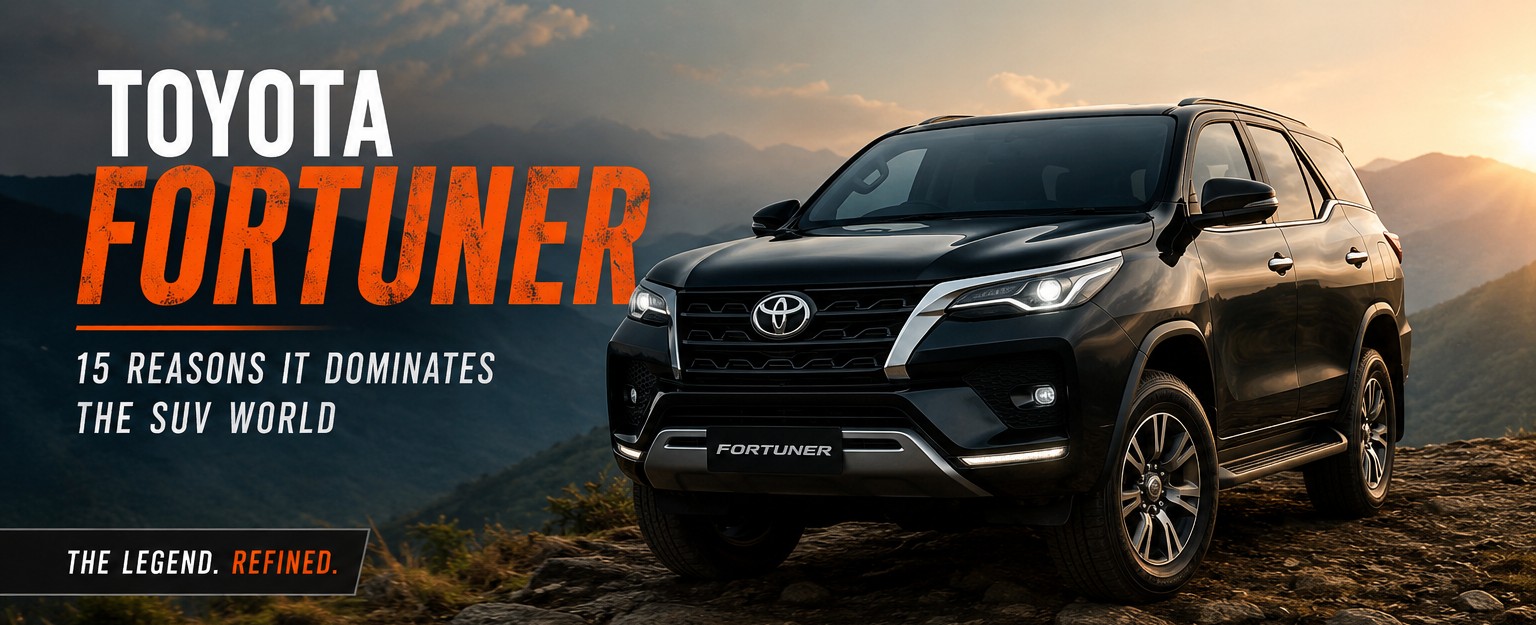
Sagar If the SUV segment were a dynasty, the Toyota Fortuner would be its longest-reigning monarch. It’s the kind of vehicle that crosses rivers without hesitation, hauls seven people without complaint, and quietly accumulates hundreds of thousands of miles without demanding expensive repair bills. And yet, in 2025, it isn’t resting on those laurels — it’s actively reinventing itself.
For American car buyers who are tuned in to international SUV culture, the Toyota Fortuner represents something genuinely exciting: a body-on-frame, ladder-chassis workhorse dressed in modern styling, loaded with driver assistance technology, and available in a fire-breathing GR Sport variant that turns every muddy trail into a racetrack. Though the Fortuner hasn’t been sold as a dedicated US-market vehicle through Toyota’s domestic dealer network, its global reputation has earned it a passionate following among enthusiasts who import it, cross-border buyers, and fleet purchasers who know exactly what they’re getting. As the 2026 model looms on the horizon — with reports suggesting a 204-horsepower mild-hybrid diesel and expanded availability — there’s never been a better moment to understand why the Fortuner continues to define what a proper SUV is supposed to be.
This guide unpacks fifteen concrete, research-backed reasons why the Toyota Fortuner sits at the top of the rugged-SUV conversation in 2025. Whether you’re a weekend overlander, a growing family that needs seven seats and a trailer hitch, or simply someone who refuses to drive a soft-road crossover masquerading as an adventure vehicle, this is your definitive breakdown.01
A Legacy That Actually Earns Its Stripes
Before diving into the spec sheets and feature lists, it’s important to establish what separates the Toyota Fortuner from the avalanche of modern SUVs that flood the market. The answer begins with history. The Fortuner was born in 2004 as part of Toyota’s IMV (Innovative International Multipurpose Vehicle) platform — a global architecture designed to serve rugged markets in Asia, Africa, Latin America, and the Middle East where roads are suggestions rather than guarantees. From day one, it was engineered to last, to endure, and to earn the loyalty of the people who depended on it.
That heritage matters more than marketing copy. The Fortuner was never designed to attract buyers by being stylish and then quietly softened for comfort. Every engineering decision — the ladder frame, the solid rear axle on early models, the beefy suspension geometry — was made in service of capability first and comfort second. Over the course of two generations spanning more than two decades, Toyota has refined that formula without abandoning it. The result is a vehicle that carries the DNA of genuine off-road purpose even as its cabin grows more luxurious and its dashboard more connected.
In global markets where the Fortuner commands real sales volume — Thailand, Indonesia, India, South Africa, Australia, and more — it is consistently one of the top-selling SUVs year after year. That commercial success isn’t the product of aggressive discounting. It’s the product of word-of-mouth from owners who drove their Fortuners into impossible terrain and came out the other side. Toyota’s reputation for reliability didn’t build itself; the Fortuner is one of the vehicles that earned it, mile by unforgiving mile.
📌 KEY CONTEXT
The Fortuner is built on Toyota’s IMV platform — the same lineage that underpins the Hilux pickup truck, one of the most battle-tested commercial vehicles in history. That shared architecture means the Fortuner inherits real-world durability validated in some of the harshest operating environments on earth.
For American buyers considering importation or cross-border purchase, this legacy translates into one practical advantage above everything else: predictability. You know what you’re getting. The Fortuner’s service intervals are manageable, parts are widely available through Toyota’s global network, and the ownership community is massive. It isn’t a niche experiment. It’s a proven quantity with millions of miles of documented real-world performance backing every claim on its spec sheet.02
The Engine — Diesel Muscle Done Right
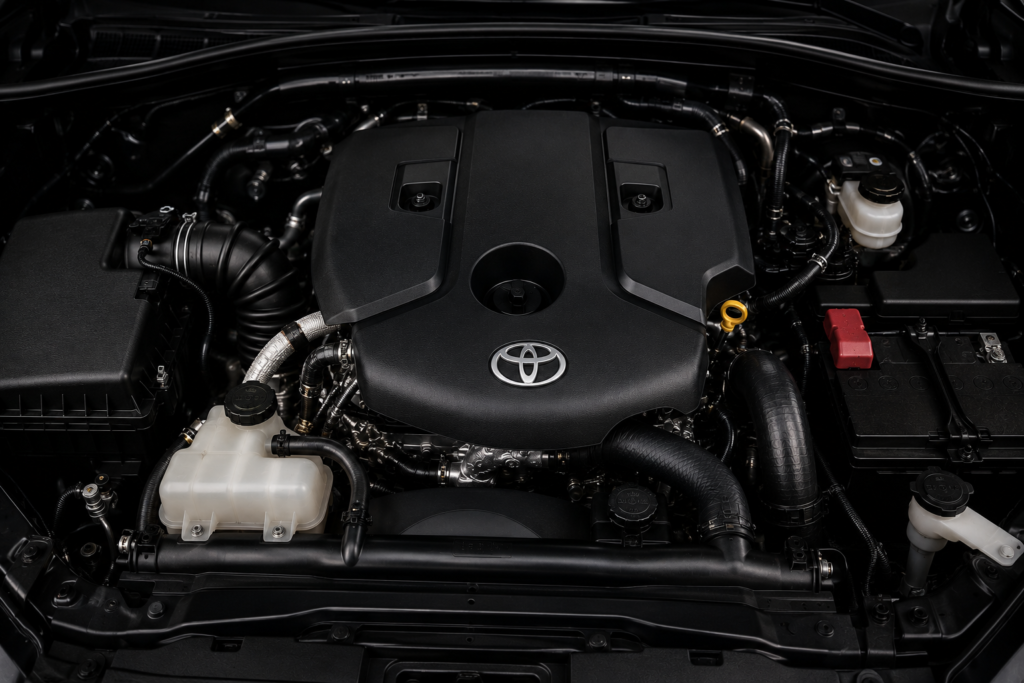
At the heart of every serious SUV is its powertrain, and the Toyota Fortuner’s engine story is one of progressive refinement rather than marketing-driven reinvention. The core of the current lineup is a 2.8-liter four-cylinder turbocharged diesel engine — known internally as the GD-series — that has been tuned, calibrated, and optimized across multiple iterations to deliver an exceptional balance of torque, durability, and fuel economy.
204HPExpected 2026 Output
550NmTorque – GR Sport
2.8LTurbodieselGD-6 Engine Family
In standard configuration, the 2025 Fortuner’s 2.8-liter turbo-diesel produces approximately 201 horsepower and around 369 lb-ft (500 Nm) of torque, delivered through a smooth six-speed automatic transmission. Those torque numbers are critical, because torque is what gets you unstuck in sand, what pulls a loaded trailer up a hill without drama, and what gives you confidence when merging onto a highway with seven passengers aboard. This isn’t an engine that needs to be revved hard to feel useful — it pulls strong from low RPM and sustains that pull through a wide powerband.
| SPEC | DETAIL |
|---|---|
| Engine TypeCore powertrain | 2.8L GD-series 4-cylinder Turbo Diesel |
| Power OutputStandard variant | ~201 hp / 150 kW |
| Torque (Standard)Peak diesel pull | ~369 lb-ft / 500 Nm |
| Torque (GR Sport)Upgraded tune | ~406 lb-ft / 550 Nm |
| TransmissionDefault on auto variants | 6-speed automatic |
| Drive Options | 4×2 and selectable 4×4 |
| 0–100 km/hDiesel automatic | ~10.2 seconds |
| Mild Hybrid (2026 Est.) | 48V system + 2.8L diesel |
What makes this engine configuration particularly compelling for buyers who prioritize real-world usefulness over 0-to-60 bragging rights is the sustained power delivery. The diesel’s torque curve is flat and accessible, meaning the Fortuner doesn’t hesitate on the highway or lag in city traffic. It accelerates decisively when asked to, and it tows with authority. The six-speed automatic pairs intelligently with the engine, holding gears under load and downshifting early enough to maintain momentum on inclines without hunting for ratios.
Looking ahead, the 2026 Toyota Fortuner is widely expected to introduce a mild hybrid system — a 48-volt architecture layered onto the existing diesel to improve low-speed refinement, reduce cold-start emissions, and provide a modest bump in fuel economy. This wouldn’t fundamentally change the Fortuner’s character, but it would address one persistent criticism: the diesel’s tendency to feel rough at idle and slightly noisy at low speeds in urban environments. With mild hybrid smoothing, that experience should noticeably improve, making the next-generation Fortuner more comfortable as a daily driver without sacrificing its off-road soul.03
The GR Sport — When Gazoo Racing Meets Serious Terrain
Toyota’s Gazoo Racing division — the motorsport arm responsible for the GR Yaris, GR Corolla, and GR Supra — has extended its performance philosophy into the off-road arena, and the Fortuner GR Sport is the most exciting expression of that ambition. This isn’t a sticker package and lowered suspension designed to look fast in a parking lot. This is a genuine performance upgrade developed by engineers who test vehicles at the Nürburgring and in the deserts of Baja California.
The 2025 Fortuner GR Sport begins with an uprated version of the same 2.8-liter GD-6 diesel engine, but tuned to produce 165 kW (approximately 221 hp) and, most critically, 550 Nm of torque — a significant jump over the standard output. That extra torque isn’t just a number; it’s felt immediately in the way the vehicle pulls away from stops, the confidence it projects when towing near its limit, and the authority it commands when navigating challenging off-road terrain that would leave lesser engines gasping for revs.
🏁 GR SPORT HIGHLIGHT
Toyota’s Gazoo Racing lineup positions the Fortuner GR-S alongside the Hilux GR-S and Land Cruiser GR-S in the GR-Sport performance tier — models that receive genuine mechanical upgrades, not just cosmetic differentiation. This is real engineering with motorsport intent behind every component choice.
- Uprated Monotube Shock Absorbers
- The GR Sport replaces the standard twin-tube dampers with performance monotube units, which offer faster response to terrain changes, better heat dissipation under sustained off-road use, and a notably more planted on-road handling feel. The result is a suspension setup that feels purposeful whether you’re navigating rocky switchbacks or cruising on an interstate.
- Exclusive 18-inch GR Alloy Wheels
- The bespoke wheel design not only sharpens the visual package but also accommodates slightly wider, more capable all-terrain tires. The wheel-and-tire combination contributes to the GR Sport’s enhanced cornering composure and improved traction on mixed surfaces.
- Sportier Body Styling
- A redesigned front bumper, black front spoiler, updated fog lamp housings, and GR Sport badging throughout give the exterior a sharper, more aggressive presence. Available in “Attitude Black” and other exclusive colorways, the GR Sport commands attention in a way the standard Fortuner simply doesn’t.
- Full-Time 4WD System
- Power is routed through a 6-speed automatic transmission to a full-time four-wheel-drive system — a setup that continuously distributes torque front-to-rear without requiring driver intervention. On loose surfaces, wet gravel, or muddy trails, the system reacts faster than a part-time 4WD conversion, making the GR Sport feel more capable and confidence-inspiring at all times.
- GR Sport Interior Treatment
- Inside, GR-branded seats with lateral bolstering, a flat-bottom steering wheel with GR logo, aluminum pedals, and contrast stitching throughout elevate the cabin ambiance to match the performance credentials. It’s a reminder that “sport” in this context means more than a badge on the tailgate.
Toyota Fortuner Testing conducted by automotive journalists confirms a 0-to-100 km/h time of just over 10 seconds — impressive for a body-on-frame seven-seat SUV with this much torque on tap. More meaningfully, the mid-range acceleration — the 80-to-120 km/h passing maneuver — felt genuinely brisk, making highway overtaking a confident rather than anxious experience. For buyers who want the Fortuner’s legendary durability and off-road credibility in a package that also rewards spirited driving, the GR Sport is the definitive expression of what this vehicle can become.04
Off-Road Capability That Sets the Benchmark
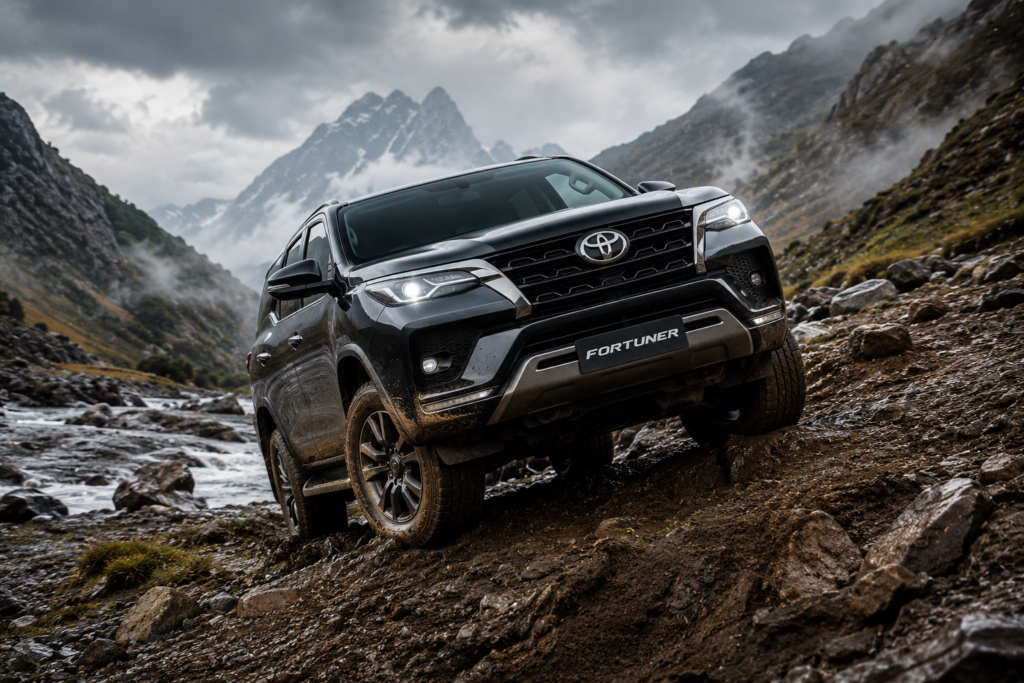
The word “off-road” is one of the most abused terms in automotive marketing. Manufacturers slap it onto crossovers with slightly raised ride heights and call it adventure-ready. The Toyota Fortuner doesn’t need that kind of language inflation — its off-road credentials are architectural, built into every dimension of the vehicle’s construction rather than sprayed on as a marketing afterthought.
Start with the chassis. The Fortuner rides on a ladder-frame platform — the same fundamental construction used in the Toyota Hilux, the Land Cruiser, and every serious off-road vehicle on earth. Ladder frames flex and absorb terrain irregularities in ways that unibody platforms simply cannot, and that flex translates into wheel articulation: the ability to keep all four tires in contact with the ground when the terrain becomes unpredictable. Where monocoque crossovers become unsteady on deeply rutted trails, the Fortuner’s frame allows the suspension to work through its full range of travel without compromising structural rigidity.
225mm+Ground Clearance
900mmWater Wading Depth
39°GradeMax Slope Capability
- 225mm+ Ground ClearanceThe Fortuner’s generous underbody clearance means rocks, logs, and high-centered terrain that would damage the underpinnings of a conventional SUV simply pass beneath it. This is particularly important for overlanding, forest roads, and construction site access where road surfaces are undefined.
- 900mm Water Wading DepthA wading capability of 900 millimeters — nearly three feet — allows the Fortuner to ford rivers, flooded roads, and water crossings that would stall, damage, or destroy most other vehicles. The engine air intake, ECU, and critical electrical systems are positioned high enough that the Fortuner can push through deep water with confidence.
- Selectable 4WD Drive ModesThe Fortuner’s transfer case offers selectable modes including 2H (rear-wheel drive for normal roads), 4H (high-range 4WD for slippery surfaces and moderate off-road), and 4L (low-range for extreme terrain requiring maximum torque multiplication). The low-range mode is especially valuable for rock crawling, steep descents, and deeply rutted trails where maintaining control at ultra-low speeds is paramount.
- Hill Start Assist & Descent ControlToyota’s hill-start assist prevents rollback when moving forward from a standing start on steep inclines, while the downhill descent control system (available on 4×4 variants) modulates braking automatically on steep descents, allowing the driver to focus on steering rather than speed management. These aren’t luxury features — on genuinely demanding terrain, they’re safety systems.
- Traction Control & Vehicle Stability ControlThe electronic systems continuously monitor wheel slip and redistribute torque or apply selective braking to maintain directional stability. On loose surfaces like sand, gravel, or wet clay, these systems work in concert with the mechanical 4WD hardware to keep the Fortuner composed and pointed in the intended direction.
The Toyota Fortuner is also capable of managing steep gradients of up to 39 degrees when fully loaded — a figure that speaks to the combination of engine torque, drivetrain gearing, and chassis stability working in concert. This isn’t a vehicle you coddle on easy trails. It’s a vehicle you take into places where confidence in your machine is the difference between a memorable adventure and a very expensive recovery operation.05
Towing Capability That Means Business
There is a significant difference between an SUV that technically can tow and one that’s genuinely built for it. The Toyota Fortuner belongs firmly in the second category. Its towing credentials flow directly from the same engineering decisions that make it a formidable off-roader: the ladder-frame chassis, the diesel engine’s generous torque output, and the robust drivetrain that connects them.
Depending on configuration, the Fortuner’s maximum towing capacity reaches up to 3,100 kilograms — approximately 6,800 pounds — on 4×4 manual variants. For context, that’s enough to tow a large boat and trailer, a medium-sized horse trailer, a loaded utility trailer, or a considerable camper setup. The 4×2 automatic configuration offers up to 2,800 kg (approximately 6,170 pounds), still a genuinely capable number for most real-world towing tasks.
⚡ TOWING IN PRACTICE
The diesel engine’s torque delivery makes highway towing significantly more relaxed than a petrol equivalent. The flat torque curve means the Fortuner doesn’t need to be floored to maintain highway speeds with a loaded trailer — it simply pulls, steadily and without drama, at whatever speed the situation demands.
What separates the Fortuner’s towing experience from vehicles that meet similar capacity numbers on paper is the confidence it projects under load. The diesel engine’s torque arrives early and stays available throughout the rev range, which means merging with a loaded trailer, climbing grades, and maintaining cruise speeds all happen without the anxiety of wondering whether the drivetrain is working too hard. The six-speed automatic holds gears appropriately when the transmission detects trailer weight, avoiding the constant up-and-down hunting that plagues some competitors under tow.
The chassis rigidity of the ladder frame also contributes to towing stability in ways that are difficult to quantify but immediately felt. When a trailer pushes laterally in crosswinds or during sudden lane changes, the Fortuner’s structural stiffness helps damp that motion rather than transmit it into the cabin as instability. This is a fundamentally different experience from towing with a crossover-based SUV, where the unibody construction can amplify trailer sway in ways that demand constant steering correction.06
Seven-Seat Interior — Practical Luxury at Every Row
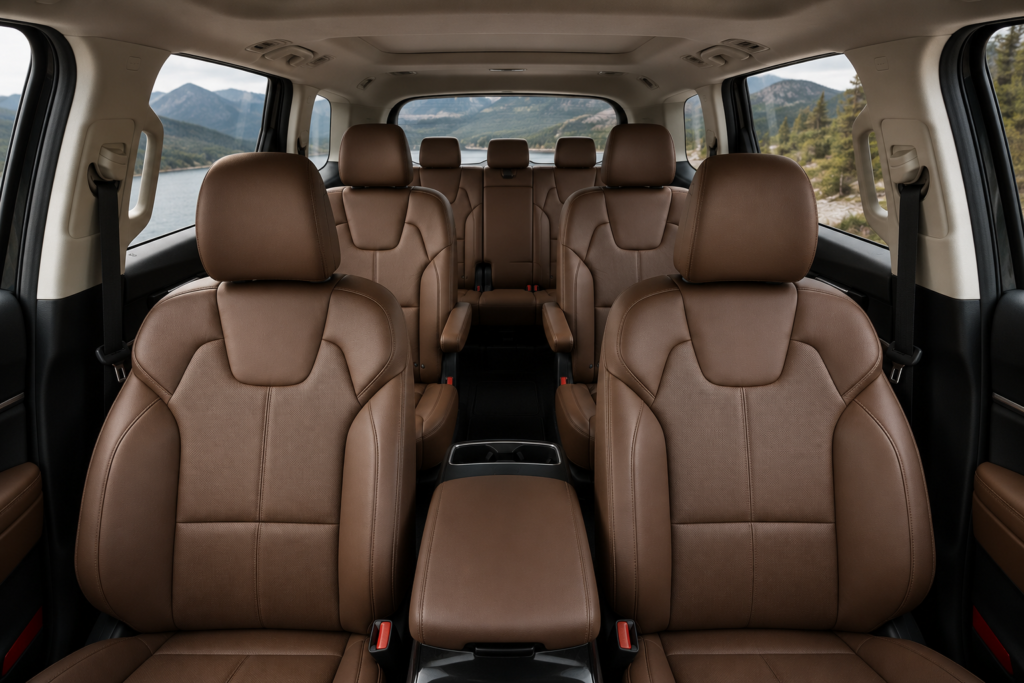
An SUV that can conquer terrain but fails to comfortably carry its passengers has missed half the point. The Toyota Fortuner understands this, and while its interior has historically been criticized for lagging behind some competitors in premium material quality, the 2025 iteration makes a compelling case that practical luxury and rugged purpose are not mutually exclusive.
The Fortuner’s three-row, seven-seat layout is arranged in a 2-3-2 configuration. The second row benefits from approximately 980mm of legroom — a generous figure that allows six-foot-plus passengers to sit without their knees pressing against the front seatback. The second row also features a one-touch tumble mechanism, which folds and slides the seat forward to allow third-row access without requiring contortion from adult passengers. This sounds trivial until you’re actually managing kids, car seats, and gear at the trailhead.
- Three-Row 7-Seat Configuration (2-3-2)The standard seven-seat layout accommodates a family of five comfortably on the first two rows, with the third row available for children, occasional adult use, or simply folded flat to expand cargo capacity. The 50/50 split-fold third row stows cleanly when not needed.
- Rear AC Vents & Climate ComfortDedicated air conditioning vents for second-row passengers are a practical necessity that many buyers underestimate until experiencing a summer road trip without them. The Fortuner’s rear climate delivery ensures that the vehicle can be genuinely comfortable for all occupants on long journeys, not just those in the front seats.
- Premium Material Quality (Higher Trims)Upper-spec Fortuner variants feature leather-trimmed seats with contrast stitching, soft-touch materials on primary contact surfaces, and genuine metal accent pieces. The leather offers both comfort and practicality — it’s easier to clean than fabric after muddy boots and adventure gear make their way into the cabin.
- Generous Headroom Across All RowsThe Fortuner’s tall roofline — a product of its high-riding body-on-frame architecture — translates into comfortable headroom even in the third row. This is a meaningful differentiator from lower-profile competitors where the third row feels claustrophobic for anyone over five feet tall.
- Practical Storage SolutionsLarge door pockets, a deep center console, multiple cupholders, and available overhead grab handles reflect the Fortuner’s design philosophy: a vehicle used by real people doing real things. Storage is distributed throughout the cabin in places that make intuitive sense for daily use rather than optimized purely for showroom presentation.
The 2025 Fortuner’s cabin also benefits from improved sound insulation over earlier models. Toyota has added additional acoustic dampening material throughout, reducing diesel clatter intrusion at low speeds and road noise at highway velocity. The cabin is still not as whisper-quiet as some luxury-focused seven-seat SUVs, but it represents a meaningful step toward a more civilized daily driving experience without compromising the vehicle’s fundamental rugged character.
“The Fortuner interior combines rugged practicality with premium touches — the cabin is designed to withstand long journeys while keeping passengers comfortable and connected.”
Drivers in the 2025 Fortuner enjoy a power-adjustable seat with lumbar support, a tilt-and-telescoping steering column, and a driving position that sits high enough to provide commanding road visibility while remaining ergonomically natural for long highway drives. It is a cabin that rewards familiarity — after a few hours behind the wheel, the controls fall to hand instinctively, and the seat’s support makes multi-hour drives feel less fatiguing than in many competitors.07
Technology & Infotainment — Modern Without Losing the Plot
One of the criticisms occasionally leveled at the Toyota Fortuner is that its interior technology has trailed some competitors who offer larger screens, more colorful interfaces, and more aggressive feature stacking. The 2025 update addresses this head-on while maintaining the Fortuner’s philosophy of technology that serves the driver rather than distracting them.
The centerpiece of the updated Fortuner’s technology suite is a 9-inch touchscreen infotainment system featuring wireless Apple CarPlay and Android Auto integration. The wireless implementation is a quality-of-life improvement over wired systems — there’s no cable required to mirror your phone, which means the center console remains cleaner and phone connectivity is effortless. The screen resolution and touch response have been upgraded for sharper visuals and more responsive interaction, addressing feedback from earlier generations where the system felt sluggish compared to modern smartphones.
- 9-inch Touchscreen with Wireless Connectivity
- The system supports full wireless Apple CarPlay and Android Auto, along with Bluetooth audio and hands-free calling. Navigation, music streaming, and communication apps all work seamlessly through the interface, reducing the need to interact with the physical screen while driving.
- Digital Driver Information Display
- A color multi-information display in the instrument cluster provides real-time data on fuel consumption, trip computer figures, terrain mode status, and driver assistance system activity. This information is presented clearly and positioned within the driver’s natural sightline without requiring eye movement away from the road.
- Multi-Zone Climate Control
- Available dual-zone automatic climate control allows the driver and front passenger to maintain independent temperature preferences, while rear vents distribute conditioned air to second-row occupants. On long family road trips, this eliminates the thermostat negotiations that plague single-zone systems.
- 360-Degree Camera System (Upper Trims)
- A surround-view camera system stitches together feeds from multiple cameras to create a bird’s-eye composite view of the vehicle and its immediate surroundings. This feature is particularly valuable for off-road navigation — knowing where your wheels are relative to rocks, ledges, and drop-offs is critical information — and equally useful for urban parking maneuvers.
- Rear-Seat Entertainment (Optional)
- Available rear-seat screens allow passengers in the second row to watch media independently of the front infotainment system, keeping children occupied on long journeys without requiring dedicated tablets or streaming devices.
- Toyota has also integrated the Fortuner’s technology with its broader connected services ecosystem, allowing remote vehicle monitoring, service alerts, and trip data through a companion smartphone application on equipped variants. This connectivity layer transforms the Fortuner from a capable standalone vehicle into part of a digital ownership experience that matches the expectations of modern buyers without requiring them to pay luxury-brand prices to access it.
- One area where the Fortuner’s technology deserves honest assessment is menu navigation. Some users report an adaptation period when getting comfortable with the system’s menu structure, which prioritizes depth over simplicity. This is a real observation rather than a dealbreaker — after familiarity sets in, the system is logical and comprehensive — but buyers should plan for a brief learning curve during the first week of ownership.08
Safety Architecture — Built Like a Shield
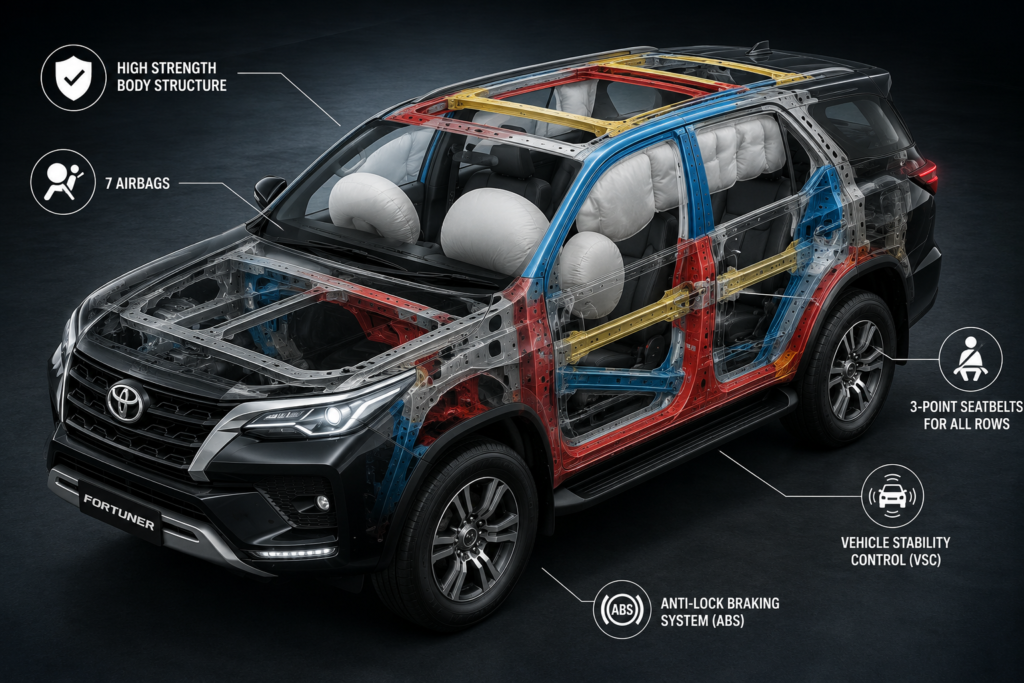
Toyota’s commitment to safety is not a recent marketing decision — it’s a foundational principle that has driven vehicle engineering at the company for decades. The 2025 Fortuner reflects that commitment comprehensively, earning a 5-star ASEAN NCAP safety rating and incorporating a multi-layered protection architecture that addresses both passive crash protection and active collision avoidance.
Passive safety begins with the Fortuner’s structural engineering. The vehicle’s high-strength steel reinforcement zones are designed to absorb and redirect crash energy away from the occupant compartment, while seven airbags — including front dual airbags, side curtain airbags, and a driver’s knee airbag — provide supplemental protection across the full range of collision scenarios. The ISOFIX child seat anchoring points in the second row ensure that child restraints are properly secured regardless of driver installation technique.
| SAFETY FEATURE | DESCRIPTION |
|---|---|
| Airbags | 7 airbags including front, side curtain & knee airbag |
| ABS + EBD | Anti-lock braking with electronic brake-force distribution |
| VSC | Vehicle Stability Control — prevents skidding in corners |
| TCS | Traction Control System for slip surfaces |
| Adaptive Cruise Control | Maintains set distance to vehicle ahead automatically |
| Lane Departure Warning | Alerts driver when unintentional lane deviation detected |
| Lane Keeping Assist | Applies gentle steering correction to maintain lane position |
| Blind Spot Monitor | Alerts driver to vehicles in adjacent lanes |
| Automatic Emergency Braking | Applies brakes automatically if collision is imminent |
| Forward Collision Warning | Audio/visual alert for rapidly closing distance ahead |
| Hill Start Assist | Prevents rollback on steep inclines |
| ISOFIX | Standardized child seat anchoring points in 2nd row |
The active safety systems — grouped under Toyota’s Safety Sense suite — are the Fortuner’s second layer of protection, designed to prevent accidents rather than simply manage their consequences. Adaptive cruise control maintains a set following distance to the vehicle ahead, automatically adjusting speed to account for traffic flow changes. Lane keeping assist applies gentle corrective steering inputs when the vehicle drifts toward lane boundaries without a turn signal active. Automatic emergency braking intervenes when forward collision detection determines an impact is unavoidable without driver input.
For families, the blind-spot monitoring system deserves particular mention. At highway speeds, detecting vehicles in the rear quarter-panel blind zones is a genuine safety concern, and the Fortuner’s system provides a consistent, reliable alert that reduces the cognitive load of lane-change maneuvers. This isn’t a feature that shows up in spec comparison tables in a dramatic way, but it’s one that real owners cite repeatedly as adding meaningful peace of mind in daily driving.
Vehicle Stability Control works constantly in the background, monitoring yaw rate, steering input, and individual wheel speeds to detect and correct oversteer and understeer situations before they escalate. On rain-slicked roads, in sudden evasive maneuvers, or when the Fortuner is carrying maximum passenger and cargo loads, VSC is the invisible co-driver that keeps the vehicle pointed where the driver intends.09
Exterior Design — Bold Without Being Desperate
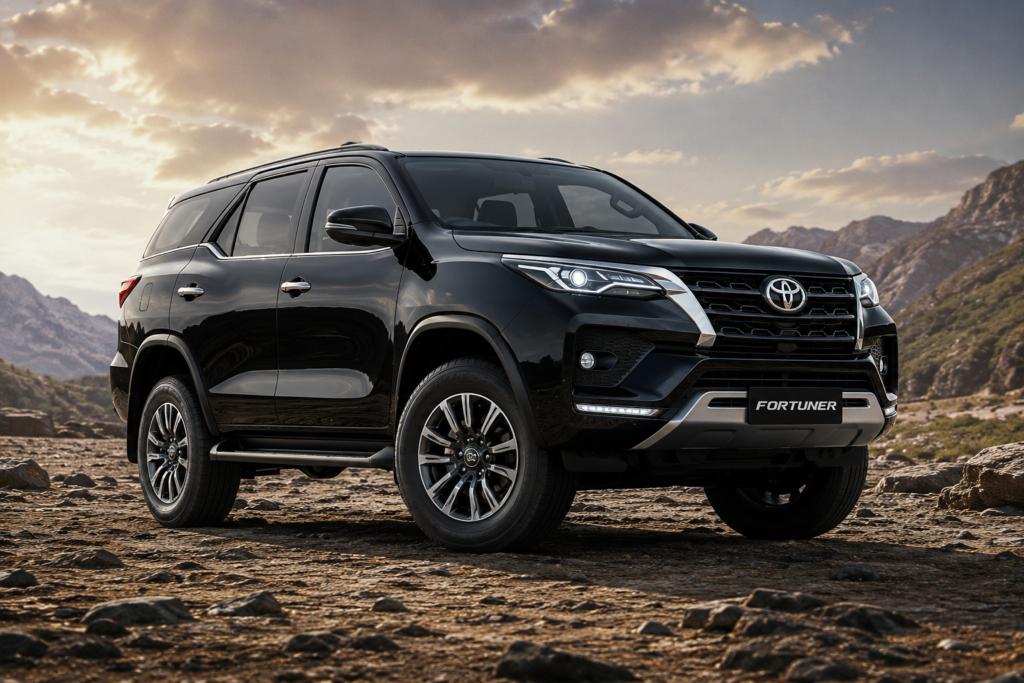
There is a current trend in SUV design toward exaggerated aggression — massive plastic cladding, oversized grilles, angular swooshes that suggest speed on a vehicle weighing two and a half tons. The 2025 Toyota Fortuner takes a different approach: confident, purposeful design that communicates capability without straining for attention it hasn’t earned.
The front fascia of the updated Fortuner features redesigned LED headlamps with integrated daytime running lights that wrap into the upper corners of the grille surround. The grille itself is wider and bolder than previous generations, with a horizontal slat pattern that reads as premium without the cartoonish scale that plagues some competitors. The bumper has been resculpted to accommodate larger air intakes and a more structured lower section that hints at the serious off-road hardware behind it.
In profile, the Fortuner’s silhouette is decisively upright — a conscious rejection of the sloped rooflines that sacrifice third-row headroom for aesthetic sleekness. This pragmatic decision is immediately visible and just as immediately appreciated by anyone who has tried to fit an adult into the third row of a style-compromised competitor. Flared wheel arches accommodate the wide-footprint all-terrain tires, adding visual width and reinforcing the vehicle’s planted, confident stance. Integrated roof rails are standard across most configurations, providing practical mounting points for cargo carriers, roof tents, and auxiliary lighting without requiring aftermarket modification.
The rear of the 2025 Fortuner features restyled LED tail lamps that echo the design language of the front lighting cluster, creating visual continuity across the vehicle’s profile. The tailgate design is clean and functional, opening to a wide, accessible cargo area without the complex powered mechanisms that add cost and potential failure points. Color choices across the range include options that read as sophisticated and others that lean adventurous — there is sufficient range to serve both the family buyer who wants their Fortuner to look at home in a suburban driveway and the overlander who wants their rig to project purposeful capability at the trailhead.10
Fuel Efficiency — Diesel Economics That Make Sense
Body-on-frame SUVs carrying seven seats and a serious off-road drivetrain are not efficiency champions — that’s simply a function of physics. The Toyota Fortuner doesn’t pretend otherwise, but it does make a compelling case that its fuel consumption figures, considered in context, represent genuine value for the capability delivered.
The turbo-diesel powertrain averages approximately 7.6 to 8.5 liters per 100 kilometers in real-world mixed driving — translating to roughly 28-31 miles per gallon for comparison purposes. For a vehicle that weighs over two tons, seats seven, and can tow nearly 7,000 pounds, those figures are genuinely impressive. Diesel fuel’s higher energy density compared to petrol means the Fortuner travels further per tank fill, and the engine’s low-RPM torque delivery means it isn’t working hard — and consuming disproportionately — during normal highway driving.
The upcoming 2026 model’s anticipated 48-volt mild hybrid system promises a further 10–15% improvement in fuel economy by recovering energy during deceleration and providing electric assistance during low-speed acceleration — the scenarios where combustion engines are least efficient. This would push the Fortuner’s real-world efficiency into territory that makes it genuinely competitive with some crossover-based rivals that sacrifice capability in pursuit of economy numbers.
💡 OWNERSHIP MATH
Diesel fuel’s higher energy content per gallon means fewer fill-ups on long trips. For buyers who regularly drive 20,000+ miles annually or tow frequently, the fuel cost savings over a petrol equivalent can offset a meaningful portion of the Fortuner’s initial price premium over less capable alternatives.
Tire Pressure Monitoring System (TPMS) — standard on 2025 models — contributes to real-world fuel efficiency by alerting drivers to underinflation, which can increase rolling resistance and reduce economy by 2–3% for every 5 PSI of underinflation. It’s a small system, but in the context of long-haul driving and adventure touring, keeping tires at optimal pressure makes a measurable difference in both economy and handling.11
Resale Value — The Investment That Holds
The total cost of vehicle ownership extends well beyond the purchase price. Depreciation — the rate at which a vehicle loses value over time — is one of the most significant financial factors in the ownership equation, and it’s one where the Toyota Fortuner performs exceptionally well relative to both its price point and the broader SUV segment.
Toyota’s reputation for reliability translates directly into strong resale values across all of its SUV lineup, and the Fortuner benefits from this halo effect as well as its own track record. In global markets where the Fortuner sells in significant volume — Australia, Southeast Asia, the Middle East, and Southern Africa — the vehicle consistently holds 60–70% of its purchase price after three years of normal use. This is a retention rate that rivals or exceeds that of premium European competitors selling at significantly higher initial prices.
The reasons for this strong residual performance are structural. First, the Fortuner’s diesel engine and drivetrain have documented longevity — with proper maintenance, these powertrains routinely reach 300,000 to 400,000 kilometers without major mechanical intervention. Second-hand buyers know this history, which means a high-mileage Fortuner commands prices that reflect remaining useful life rather than mileage anxiety. Second, Toyota’s parts availability and dealer network density mean that used Fortuner ownership carries lower risk of expensive repair bills — a factor that buyers and fleet operators price into their willingness to pay for used examples.
Third, and perhaps most importantly, the Fortuner occupies a product segment — capable, seven-seat, body-on-frame SUV with diesel power — that has no close equivalent at the same price point from most competing manufacturers. Limited direct competition at similar capability levels keeps demand for used Fortuners consistently healthy, which supports pricing throughout the depreciation curve.12
Trim Levels & Value — Something for Every Buyer
The Toyota Fortuner’s trim structure is designed to serve a broad spectrum of buyers without requiring compromises that undermine the vehicle’s core value proposition. Whether you’re a first-time buyer seeking reliable, capable transportation on a defined budget or a discerning buyer wanting the full capability-and-comfort package, the Fortuner range offers an appropriate entry point.
Base configurations of the Fortuner deliver the ladder-frame chassis, the turbo-diesel engine, and the essential safety suite — ABS, stability control, and multiple airbags — along with a practical interior featuring cloth seating, an 8-inch infotainment screen with wired smartphone connectivity, and manual climate control. This base package represents extraordinary value for a vehicle with genuine off-road credentials and legitimate towing capacity — capabilities that competitors offering similar feature counts often cannot match.
Mid-range variants add leather-trimmed seating, dual-zone automatic climate control, wireless Apple CarPlay and Android Auto, the full Toyota Safety Sense driver assistance suite, and power-adjustable front seats. These additions meaningfully improve the daily-driving experience without inflating the price to premium-brand territory.
Upper-spec and GR Sport variants complete the range with the 360-degree camera system, the upgraded shock absorbers and performance engine tune, exclusive alloy wheel designs, full leather interiors with GR badging, and in some markets, a premium audio system with up to 10 speakers. The GR Sport premium is justified not just by the cosmetic additions but by the genuine engineering work that goes into the suspension and powertrain upgrades — buyers paying for the top-of-range Fortuner are getting mechanically differentiated performance, not just a richer equipment list.
| TRIM LEVEL | KEY ADDITIONS | TARGET BUYER |
|---|---|---|
| Base / Entry | 8″ screen, cloth seats, core safety suite, diesel engine | Fleet buyers, value-focused families |
| Mid-Range | Leather, wireless CarPlay, dual-zone HVAC, full ADAS | Family adventure buyers |
| Luxury / Top-Spec | 360° camera, 10-speaker audio, powered seats, premium trim | Premium comfort seekers |
| GR Sport | 165kW engine, 550Nm, monotube shocks, GR alloys & interior | Performance + off-road enthusiasts |
How the Fortuner Compares to Its Rivals
No SUV exists in isolation, and the Toyota Fortuner’s strengths are best understood in the context of what its competitors offer. The primary rivals in the body-on-frame, seven-seat, diesel-powered SUV segment are the Ford Everest (sold as the Ford Explorer in some markets), the Mitsubishi Pajero Sport, the Isuzu MU-X, and in some configurations, the Nissan Patrol. Each vehicle has genuine merits, but the Fortuner competes distinctively across key purchase considerations.
The Ford Everest is frequently cited as the Fortuner’s most complete challenger, offering a more technologically sophisticated interior, a larger infotainment screen, and in some variants, a more refined on-road ride. The Everest’s bi-turbo diesel engine produces strong power figures and its independent rear suspension gives it a noticeable comfort advantage on paved roads. However, the independent rear suspension that makes the Everest comfortable on pavement is also a compromise off-road: it limits the suspension articulation available when all four wheels need to find purchase on uneven terrain. The Fortuner’s solid rear axle gives up some on-road refinement but delivers superior wheel-travel off-road, maintaining traction in scenarios where the Everest can lose grip.
| CRITERIA | TOYOTA FORTUNER | FORD EVEREST | MITSUBISHI PAJERO SPORT | ISUZU MU-X |
|---|---|---|---|---|
| Chassis Type | Ladder Frame | Ladder Frame | Ladder Frame | Ladder Frame |
| Max Torque | 550 Nm (GR-S) | 500 Nm | 430 Nm | 450 Nm |
| Towing Capacity | 3,100 kg | 3,500 kg | 3,100 kg | 3,500 kg |
| Seating | 7 seats | 7 seats | 7 seats | 7 seats |
| Wading Depth | 900 mm | 800 mm | 700 mm | 800 mm |
| Reliability Record | Exceptional | Good | Good | Very Good |
| Resale Value | Outstanding | Very Good | Good | Good |
| Interior Quality | Good | Excellent | Good | Good |
| Performance Variant | GR Sport | ST-Line | None | None |
The Mitsubishi Pajero Sport is a credible alternative that shares the ladder-frame philosophy but offers a slightly more car-like interior experience and Mitsubishi’s Super Select 4WD II system, which is genuinely excellent off-road. The Pajero Sport gives up some ground on engine output and torque figures compared to the Fortuner, and its resale value trajectory, while decent, doesn’t match the Toyota’s retention curve.
The Isuzu MU-X is perhaps the most underrated vehicle in this comparison, offering strong towing credentials, a genuinely capable diesel engine, and a practical interior at a price that often undercuts the Fortuner. Where the MU-X falls short is in refinement — the cabin, while functional, lacks the polish of the Fortuner’s higher trim levels — and in the breadth of its performance variant lineup. There is no MU-X equivalent to the Fortuner GR Sport.
Ultimately, the Fortuner’s position in this competitive set rests on the combination of reliability record, resale value, performance variant availability, and the depth of its global service network. For buyers who value these factors — and most buyers making long-term ownership decisions should — the Fortuner’s case is compelling even where individual specification comparisons might appear to favor a competitor.14
Long-Term Reliability — The Ownership Story Nobody Tells
The purchase decision and the ownership experience are two different stories, and for the Toyota Fortuner, the ownership story is one of the strongest in the SUV segment. This isn’t a claim Toyota makes loudly in advertisements — it’s a reality documented by hundreds of thousands of owners over two decades and multiple continents.
The GD-series turbo-diesel engine at the heart of the 2025 Fortuner is a mature, well-understood powertrain with documented longevity. When maintained on schedule — which in practice means diesel particulate filter checks, injector servicing, and gearbox fluid changes at recommended intervals — these engines routinely deliver 400,000 to 500,000 kilometers of reliable service. That figure is not marketing copy. It’s the reported experience of commercial operators in mining, agriculture, and fleet transportation who depend on the Fortuner’s powertrain for their livelihoods and document its performance rigorously.
The ladder-frame chassis, while heavier than monocoque alternatives, is also significantly more repairable. Frame damage that would write off a unibody SUV can often be straightened or sectioned on a ladder-frame vehicle, reducing repair costs and extending the vehicle’s serviceable life. In markets where road conditions are challenging and comprehensive insurance is expensive, this repairability is a genuine economic advantage.
- Documented Engine LongevityThe 2.8L GD-series diesel has accumulated a track record spanning millions of vehicles across diverse operating environments. Fleet operators who run Fortuners in high-cycle commercial applications report minimal unscheduled downtime, which is the ultimate reliability test.
- Wide Parts AvailabilityToyota’s global manufacturing and distribution network means that Fortuner parts are available quickly and competitively priced in virtually every market where the vehicle is sold. This reduces both repair time and cost uncertainty — two factors that contribute significantly to total ownership cost.
- Comprehensive Dealer NetworkToyota’s dealer footprint is among the densest in the world. Regardless of where a Fortuner owner travels, the probability of a qualified Toyota service center being accessible is high — a consideration that matters enormously for buyers who use their vehicles for genuinely remote adventure touring.
- Established Owner CommunityThe Fortuner’s global ownership community is massive and active, with forums, social media groups, and regional clubs providing a deep knowledge base for troubleshooting, modification guidance, and long-term ownership tips. This peer-support ecosystem reduces the anxiety of ownership and accelerates problem resolution when issues do arise.
It is also worth acknowledging the few areas where Fortuner ownership requires attention. The diesel particulate filter — standard on modern diesel vehicles to reduce particulate emissions — requires periodic regeneration, either passively during sustained highway driving or actively through a dealer service procedure. Owners who primarily drive short urban trips without regular highway use may need to schedule active DPF regenerations more frequently. And while the turbo-diesel is robust, the turbocharger itself is a wear item that should be monitored as high-mileage examples accumulate kilometers. Neither of these represents a meaningful ownership concern for buyers who maintain their vehicles properly, but they are honest considerations in the total reliability picture.15
Who Should Actually Buy the Toyota Fortuner?
After fourteen reasons documenting what the Toyota Fortuner does well, the most honest and useful thing this guide can do is define who the vehicle is genuinely for — and who it is not. The Fortuner is a purpose-built vehicle, and its purpose is specific enough that it will be exactly right for some buyers and genuinely wrong for others.
The Toyota Fortuner is built for buyers who need genuine capability in a single vehicle. If your life involves towing a boat or trailer regularly, navigating unpaved access roads to work sites, going off-road on weekends, and also needing a comfortable seven-seat family vehicle for the daily school run — the Fortuner is one of very few vehicles that can do all of these things reliably. It doesn’t ask you to compromise between capability and practicality because it was engineered to serve both simultaneously.
The Bottom Line
The Toyota Fortuner in 2025 is not a vehicle for everyone, and it knows it. It doesn’t pretend to be the quietest ride, the most technologically extravagant option, or the most fuel-sipping choice in a world moving toward electrification. What it is — and what it has always been — is an honest vehicle that delivers genuine capability, documented reliability, and real-world usefulness in a package that holds its value, serves its owners well, and earns its reputation through performance rather than promise.
From the torquey diesel heart that pulls trailers and climbs slopes with equal authority, to the GR Sport variant that injects Gazoo Racing performance DNA into the formula, to the seven-seat interior that genuinely accommodates a family and their gear — the Fortuner remains one of the most complete SUV propositions available at its price point in the global market. For American buyers willing to explore it, the Fortuner represents what the SUV was always meant to be: a vehicle that goes anywhere, carries everything, and comes back ready to do it again.

 Sagar
Sagar
[…] N Scorpio N Jeep […]