 Sagar
Sagar Walk into any Maruti Suzuki showroom in a smaller Indian city and ask the salesperson which SUV moves fastest off the floor. Chances are, the answer is still the Brezza. It’s been the default compact SUV for middle-class India for years now, and this 2026 facelift didn’t mess with that formula — it sharpened it with a new engine, a bigger screen, six airbags as standard, and, oddly enough, a lower starting price than before.
That last part deserves a proper explanation, not just a passing mention. Facelifts almost always cost more. But Maruti dropped the entry price on this Brezza car by nearly ₹90,000 compared to the old base variant, starting it at ₹7.40 lakh ex-showroom for the LXi turbo. The reason isn’t marketing generosity — it’s tax engineering. The new 998cc turbo-petrol engine falls under a smaller displacement bracket that attracts a lower GST slab on sub-four-metre SUVs, so Maruti passed that saving straight onto the price tag. It’s a smart move that quietly undercuts the segment.
If you’re cross-shopping this Brezza car against a Venue, a Sonet, a Nexon, or even Maruti’s own Fronx, here’s what you need to actually know before booking a test drive — not the surface-level spec sheet, but the details that decide whether it’s the right SUV for your money.
1. Full Brezza Car Variant-Wise Pricing, Broken Down Properly
Most articles just quote a starting and ending price and move on. That tells you almost nothing about what you’ll actually pay for the trim you want. Here’s the real Brezza car pricing breakdown across all three powertrains.
- 1.0L Turbo-petrol (LXi to ZXi+):
- Starts at ₹7.40 lakh for LXi, climbing to roughly ₹11.16–11.60 lakh for the fully-loaded ZXi+. It’s paired exclusively with a 6-speed manual gearbox across all four trims — no automatic option here.
- 1.5L naturally aspirated petrol (LXi to ZXi+):
- Starts around ₹8.30 lakh and stretches up to ₹13.70–13.71 lakh for the ZXi+ automatic, which is the single most expensive variant in the entire range.
- CNG (LXi, VXi, ZXi only):
- Priced from ₹9.30 lakh to roughly ₹11.50–11.65 lakh. Notably, the CNG option isn’t offered on the range-topping ZXi+ at all, so buyers wanting both maximum features and factory CNG will have to compromise on trim.
The pricing logic gets genuinely interesting once you compare like-for-like trims. The ZXi Turbo costs about ₹9.85 lakh, nearly ₹65,000 cheaper than the equivalent ZXi 1.5-litre petrol-manual — despite the turbo engine making more power. That’s the tax-bracket advantage working in the buyer’s favour, and it’s rare to see a manufacturer pass on that kind of saving so directly.
2. Two Distinct Brezza Car Engines, Not Just One With Different Badges
This is the single biggest mechanical change to this Brezza car, and it deserves more than a one-line mention. The new 998cc, 3-cylinder Boosterjet turbo-petrol produces 110.1 PS and 170 Nm of torque, with that peak torque available across a wide 2,000–3,500 rpm band — which in practical terms means less gear-shifting in city traffic and a noticeably stronger mid-range punch than the outgoing naturally aspirated engine ever offered. It’s matched only to a 6-speed manual, so if you want an automatic gearbox, this engine currently isn’t an option.
Sitting alongside it is the familiar 1.5-litre K15C petrol engine, now producing 103 PS and 139 Nm — a mild bump from before — and available with either a newly upgraded 6-speed manual (replacing the older 5-speed unit) or a 6-speed torque-converter automatic starting from the VXi trim upward. Buyers who want a smoother, more linear power delivery without turbo lag, or who specifically need an automatic gearbox, will end up in this engine regardless of budget, since the turbo simply doesn’t offer one.
3. Brezza Car Mileage Figures That Differ by Trim, Not Just by Engine
Fuel economy claims usually get rounded off into one vague number, but the ARAI-certified figures actually vary by variant and gearbox, which matters if you’re budgeting fuel costs precisely. The LXi and VXi turbo trims are certified at 20.47 kmpl, while the heavier ZXi and ZXi+ turbo variants drop slightly to 19.96 kmpl due to added equipment weight. On the 1.5-litre side, the LXi and VXi manual return 21.09 kmpl, the ZXi manual delivers 20.81 kmpl, and the automatic gearbox variant is rated at 20.17 kmpl. The CNG version, unsurprisingly, is the efficiency champion at 26.90 km/kg. Real-world owner reports on this Brezza car tend to land 2-3 kmpl below ARAI figures in mixed city-highway driving, which is fairly standard and still competitive within the segment.
4. A Cabin Upgrade That’s More Than Just a New Screen
Step inside this Brezza car and the change is obvious immediately, but it’s worth detailing exactly what changed rather than calling it “premium” and moving on. The dashboard now wears a bronze-and-black colour theme with new leatherette seat upholstery, replacing the flatter, all-black cabin of the outgoing model. The centrepiece is a 10.1-inch touchscreen running Smartplay Pro X — the same software borrowed from Maruti’s larger Victoris SUV — bringing wireless Apple CarPlay and Android Auto as standard, not an optional add-on buried in a top trim. A cooled wireless charging pad and 64-colour ambient lighting round out the cabin’s tech push, while the ZXi trim specifically adds an electric sunroof, LED projector headlamps, push-button start, and ambient lighting as a combined package — making it, according to most reviewers, the genuine sweet spot in the range rather than just a mid-tier compromise.
5. Ventilated Seats Solve a Very Real Indian Summer Problem
Anyone who’s sat on black leatherette seats in a Delhi parking lot in June knows exactly why this matters. This Brezza car now offers ventilated front seats on higher trims, something rivals like the Nexon have had for a while but Maruti had held back until now. It’s not a flashy headline feature, but on a 42-degree May afternoon with the car parked in direct sun for three hours, it’s genuinely the difference between a bearable first five minutes of driving and an uncomfortable one.
6. Six Airbags on the Brezza Car Are Now Standard, Not a Paid Upgrade
Safety has moved from optional extra to baseline expectation in India, and this Brezza car responds to that shift properly rather than gatekeeping it behind higher trims. Every single variant, right from the base LXi, comes with six airbags and electronic stability control as standard equipment — a meaningful change from older Maruti models that often locked side and curtain airbags behind top-spec pricing. The car also holds a 5-star Bharat NCAP rating for both adult occupant protection and child occupant protection, putting it firmly among the safer choices in this price bracket.
- Front parking sensors and blind-spot warning are available across most trims, catching what mirrors alone tend to miss in dense city traffic.
- Rear cross-traffic alert genuinely helps when reversing out of crowded parking lots or narrow society gates where visibility is poor.
- Hill-hold assist and traction control come standard too, useful for buyers in hilly states or anyone who regularly deals with waterlogged roads during monsoon.
7. Suzuki Connect Gen 3.0 on the Brezza Car Brings Real Functionality, Not Gimmicks
Maruti’s Suzuki Connect Gen 3.0 system ships with this Brezza car and packs in more than 35 connected features — live vehicle tracking, geo-fence alerts that notify you if the car leaves a defined area, remote AC pre-cooling, and remote engine start among them. For families who occasionally lend the car to a teenager or a household driver, or simply want to check whether the vehicle is parked where it should be, this shifts the Brezza from a purely mechanical product into something with genuine smart-device utility built in.
8. Brezza Car Boot Space and the CNG Trade-Off, Explained Honestly
CNG SUVs have historically had one brutal drawback — the gas cylinder eats deep into boot space, sometimes leaving barely enough room for a weekend bag. This Brezza car addresses that with an underbody dual-cylinder CNG kit design, which keeps a workable amount of usable boot room intact even on the gas variant, unlike older top-mounted tank setups. Overall boot capacity across the range sits at 328 litres — enough for a family’s weekly groceries or a mid-size suitcase, though not class-leading. One real compromise worth flagging honestly: there’s no spare wheel included, only a puncture repair kit and tyre inflator, a cost-cutting call that won’t sit well with buyers who regularly drive on highways or in areas with poor road quality.
9. Brezza Car Styling Changes Are Deliberately Restrained
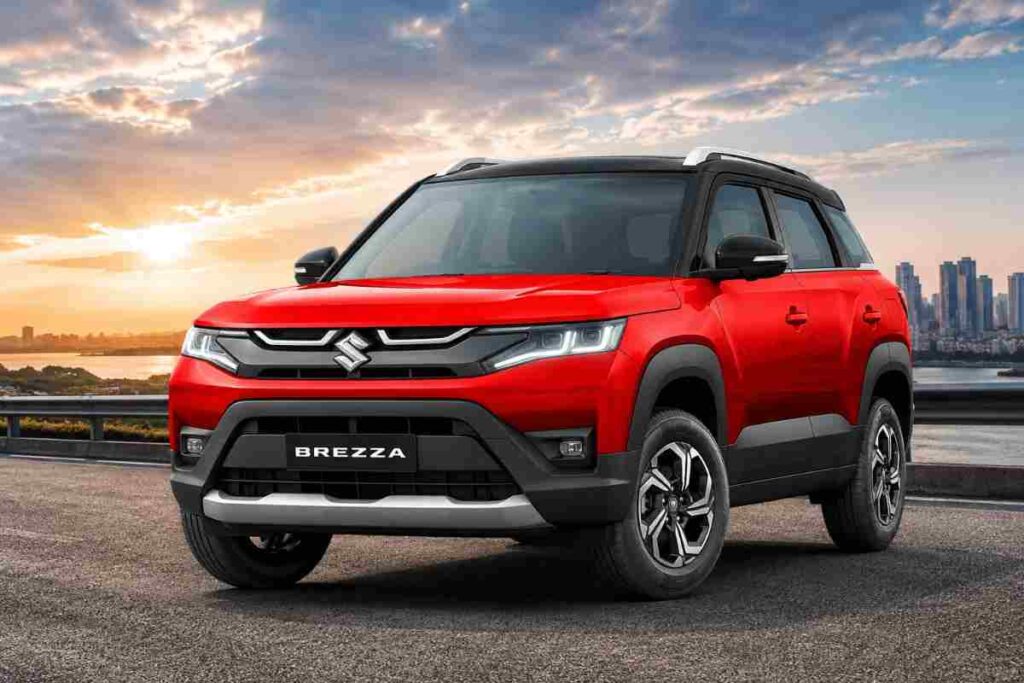
Maruti clearly decided not to reinvent this Brezza car’s look, and given how recognisable the silhouette already is on Indian roads, that’s arguably the right call rather than a missed opportunity. The update brings a slimmer chrome-finished grille, sculpted bumpers with triangular fog lamp surrounds, new 16-inch alloy wheel designs, and dual-tone paint options available on the ZXi and ZXi+ for an extra ₹15,000–16,000. Turbo variants specifically get subtle red accents to visually separate them from the regular petrol and CNG trims on showroom floors. It’s an evolution rather than a redesign, which will please existing Brezza owners far more than it will excite first-time SUV shoppers hunting for something visually dramatic.
10. One Real Gap: No Panoramic Sunroof, and a Crowded Rival List
Not everything about this update is a clean win, and it’s worth being direct about where the Brezza car actually loses ground. Rivals such as the Hyundai Venue, Tata Nexon, Mahindra XUV 3XO, Skoda Kylaq, and Kia Sonet all offer panoramic sunroofs at comparable price points, while the Brezza sticks with a single-pane electric unit even on its top trim. It also faces a genuinely crowded competitive set that most buyers underestimate — beyond the usual names, this Brezza car also competes directly against the Kia Syros, Maruti’s own Fronx, Toyota Taisor, Nissan Magnite, and Renault Kiger, making the sub-four-metre SUV segment in India one of the most contested price brackets in the entire market. Powered seats and more advanced Level 2 ADAS features are also missing here, which cross-shoppers coming from a Nexon or a Creta-adjacent test drive will notice fairly quickly.
11. It Still Understands Its Core Buyer Better Than Most Rivals
What keeps this Brezza car relevant isn’t any single standout feature — it’s how deliberately Maruti has engineered the ownership experience around its actual buyer base. This isn’t primarily a car for someone chasing the flashiest spec sheet; it’s for a buyer who wants dependable service at any of Maruti’s thousands of service centres spread across India, predictable and low-cost maintenance, strong resale value backed by sheer sales volume, and a badge that neighbours and relatives already trust without needing convincing. That combination of practical, unglamorous strengths — more than any single new feature on this facelift — is why the Brezza has stayed near the top of India’s compact SUV sales charts for years and looks set to keep doing so through 2026.
How the Brezza Car Actually Compares to Its Closest Rivals
Spec sheets only tell half the story, so it’s worth placing this Brezza car directly against what Indian buyers are genuinely cross-shopping it with. The Hyundai Venue brings a punchier turbo option at the top end along with a longer features list, but typically costs more for a comparable trim level once you match equipment. The Kia Sonet leans harder into design flair and offers more colour and roof combinations, appealing to younger, style-first buyers who cross-shop on looks first. The Tata Nexon counters with a stronger crash-test reputation historically and, critically, that panoramic sunroof this Brezza car still lacks even at the top of its range.
Where this Brezza car pulls decisively ahead is total cost of ownership over a five-to-seven-year period. Maruti’s service network is larger and easier to access outside metro cities than any rival’s, genuine spare parts tend to be noticeably cheaper, and resale value has historically stayed stronger than most competitors thanks to sustained demand in the used-car market. For a buyer in a tier-2 or tier-3 city, where the nearest authorised Kia or Skoda service centre might be an hour’s drive away, that after-sales convenience often outweighs an extra feature or two sitting on a rival’s brochure.
Frequently Asked Questions About the New Brezza Car
What is the on-road price of the new Brezza car in India right now?
Ex-showroom prices range from ₹7.40 lakh to ₹13.71 lakh depending on engine and trim. On-road prices typically run ₹1–2.5 lakh higher depending on your city, RTO charges, and insurance package — Mumbai on-road prices, for reference, have been quoted between roughly ₹8.6 lakh and ₹16.2 lakh across the full range.
Which Brezza car engine should I pick — turbo-petrol, 1.5-litre petrol, or CNG?
If you drive mostly in the city and want a stronger mid-range punch, the 1.0-litre turbo is the standout choice, and it’s also cheaper trim-for-trim than the 1.5-litre. If you specifically want an automatic gearbox, the 1.5-litre petrol is currently your only option, since the turbo is manual-only. Buyers focused purely on running costs should lean toward the CNG variant, keeping in mind it isn’t available on the top ZXi+ trim.
Which variant of the Brezza car should most buyers actually choose?
The ZXi trim is widely considered the sweet spot. It includes an electric sunroof, LED projector headlamps, wireless charging, push-button start, and ambient lighting, while still being available across all three powertrains — turbo, 1.5-litre petrol, and CNG — giving buyers maximum flexibility without stepping up to ZXi+ pricing.
Does the Brezza car have a panoramic sunroof?
No. This Brezza car offers only a single-pane electric sunroof, even on the top ZXi+ trim, while rivals like the Nexon, Venue, and XUV 3XO offer panoramic units — a genuine gap worth weighing before you decide.
Is the new Brezza car safe for family use?
Very much so. This Brezza car carries a 5-star Bharat NCAP rating for both adult and child occupants, with six airbags and electronic stability control standard across every single variant, including the base LXi.
Final Word
This 2026 Brezza car isn’t trying to reinvent what a compact SUV should be — it’s trying to be the smartest, safest, and most cost-sensible version of what it already was. A lower starting price backed by real tax-bracket logic, a genuinely punchy turbo engine, standard six airbags across the range, and a properly upgraded cabin make this Brezza car hard to ignore, even with the missing panoramic sunroof and no-spare-wheel compromise working against it. For Indian buyers who value reliability, low running costs, and long-term ownership peace of mind as much as they value feature counts on a brochure, this remains one of the easiest SUVs in its segment to recommend without much second-guessing.

 Sagar
Sagar
[…] Brezza Swift Dzire […]
[…] Brezza Car TATA Sierra Kia Sonet […]