 Sagar
Sagar It’s Still the Kingof Luxury Sedans
There’s a reason the BMW 5 Series has been in continuous production since 1972. It’s not nostalgia, and it’s not brand loyalty on autopilot. It’s that BMW has managed to keep this car relevant through eight generations by understanding something that a lot of luxury manufacturers have struggled with: that the people who buy a five series want a car that is genuinely fun to drive, genuinely comfortable to live with, and genuinely impressive when they hand the keys to a valet.
The eighth generation, which arrived for 2024 and carries forward largely unchanged into 2025 with meaningful additions, is arguably the most accomplished 5 Series ever made. It’s faster than before, quieter than before, more technologically advanced than before, and now available as a proper plug-in hybrid that does zero-to-sixty in four seconds while returning over 30 miles of all-electric range. That’s a lot to unpack. So let’s unpack it — twelve reasons, in detail, why the 2025 BMW 5 Series remains the benchmark of its segment
Four Trims, Three Engines — Every Configuration Gets It Right

One of the smartest things BMW did with the 2025 5 Series was to simplify the trim structure without oversimplifying the powertrain options. You have four variants — 530i, 530i xDrive, 540i xDrive, and the new 550e xDrive — and between them, they cover every type of luxury sedan buyer without leaving gaps.
The base 530i uses a 2.0-litre turbocharged four-cylinder with mild hybrid assistance producing 255 horsepower. It’s paired with an eight-speed automatic and is available in rear-wheel drive only. On paper, a four-cylinder base might sound underwhelming for a $59,000 car, but the reality is considerably more impressive. The 5 Series may not be as sporty as it once was, but it still delivers a performance-oriented feel with athletic handling and punchy engines. The mild hybrid system recovers energy under braking and uses it to reduce turbo lag, which makes the 530i feel more responsive than the spec sheet would suggest. EPA estimates of 28 city / 35 highway mpg are impressive for a car this size.
Step up to the 540i xDrive and the character changes substantially. The 3.0-litre turbocharged inline-six produces 375 horsepower and comes standard with BMW’s xDrive all-wheel drive. This is the engine that most automotive journalists single out as the sweet spot of the lineup — enough power to make every on-ramp exciting, enough refinement for a silent interstate cruise, and just the right amount of feedback through the steering wheel to remind you that this is a driver’s car and not just a comfortable appliance.
Then there’s the 550e xDrive. The 550e features a powerful 3.0-liter turbocharged inline-six engine paired with an electric motor to generate a combined 483 horsepower. With all-wheel drive and an eight-speed automatic transmission, the 550e can accelerate from 0 to 60 mph in just four seconds, delivering both impressive power and efficiency. That’s supercar-territory acceleration wrapped in a four-door sedan that seats five, has a trunk large enough for a week’s worth of luggage, and can be plugged in at home overnight.
| 530i from $58,700 255 hp · 2.0L I4 Mild Hybrid · RWD · 28/35 mpg |
| 530i xDrive from $61,200 255 hp · 2.0L I4 Mild Hybrid · AWD |
| 540i xDrive from $69,900 375 hp · 3.0L I6 Mild Hybrid · AWD ★ EDITORS’ CHOICE |
| 550e xDrive from $73,400 483 hp · 3.0L I6 PHEV · AWD · 0–6 in 4.0s |
The Handling Is Still BMW’s Greatest Argument

The phrase “the ultimate driving machine” has been BMW’s tagline for so long that it’s easy to dismiss as marketing. But spend an hour behind the wheel of a 2025 5 Series on a winding road, and it becomes clear that BMW’s engineers still take the idea seriously. The steering is weighted precisely — not artificially heavy, not numb, but communicative in a way that tells you exactly what the front wheels are doing. Body roll is controlled without being absent. The car feels planted at speed and responsive at lower velocities.
BMW offers the standard suspension tuning on the 530i models and an M Sport suspension package on the 550e as standard, and as an option elsewhere. The M Sport suspension lowers the ride height by about 10mm and stiffens the dampers, sharpening the handling response. The trade-off is a slightly firmer ride on broken road surfaces, but on smooth American interstates and mountain highways, the combination is genuinely excellent.
Adaptive dampers are available as a stand-alone option and are worth the investment if you drive in varied conditions. They read the road surface and adjust the damping rate continuously, allowing the car to feel sporty when you’re pushing it and comfortable when you’re not. The transition between the two is seamless — there’s no artificial softening or hardening, just a constant recalibration to the conditions at hand.
Worth knowing: The 540i xDrive is the pick for handling enthusiasts. The inline-six’s weight distribution across the front axle is more balanced than the four-cylinder, and the added power means you’re always in the right part of the rev range when you need a response. Multiple reviewers, including those at TrueCar and Autoblog, have singled out the 540i as their recommended configuration specifically for driving feel.
Drive 8.5 and a 14.9-Inch Curved Display That Actually Makes Sense

The interior technology story of the 2025 BMW 5 Series centres on two things: the BMW Curved Display and the iDrive 8.5 operating system running it. The Curved Display houses a 12.3-inch digital gauge cluster on the left and a 14.9-inch central touchscreen on the right, both seamlessly integrated into a single flowing panel that arcs across the dashboard. It looks genuinely architectural inside the car — not like a screen that’s been bolted onto a dashboard, but like a piece of the car’s design vocabulary.
The iDrive 8.5 software is a huge improvement over 8.0. Activating or turning off your heated/ventilated seats and heated steering wheel is now a breeze. The always-there bottom row of quick toggles makes switching between tasks a million times easier. The whole system is smoother and quicker to react. The persistent quick-access bar at the bottom of the screen means you can adjust climate, seat heat, and media without navigating through menus — a seemingly small improvement that makes an enormous difference in daily use.
That said, the system isn’t perfect. A real-world long-term test published in late 2025 noted that the vastness and variety of apps felt impenetrable, and Apple CarPlay eliminated the need to dive into the chaos. This is a fair critique. BMW has packed the system with games, a YouTube app, an interior camera feature, and dozens of other add-ons that most owners will never use. The core navigation, media, and vehicle functions are well-organised; the extended app library is not. If you’re someone who connects their phone via CarPlay and uses that for everything, none of this will bother you. If you’re someone who wants to master the native system, budget some time for the learning curve.
- 14.9-inch Central Touchscreen
- The largest centre display in the 5 Series’s class-rivals. High resolution, fast touch response, and well-separated into functional zones. The display is angled toward the driver rather than straight ahead, reducing reach for the most-used functions.
- Wireless Apple CarPlay and Android Auto
- Both are standard across all trims. No cable required — your phone connects automatically once paired. Music, navigation, calls, and messaging all work through the native screen without plugging anything in.
- Natural Language Voice Control
- Say “Hey BMW” followed by a plain-English command. The system handles complex requests like “Find a gas station that’s open now near my next highway exit” without requiring structured input phrasing.
- Over-the-Air Software Updates
- BMW pushes software updates remotely, meaning your car’s systems improve over time without a dealer visit. This has already addressed early bugs in iDrive 8.5 since the system launched.
- My BMW App Integration
- Lock, unlock, pre-condition the climate, locate the car in a parking garage, and monitor charging status on the 550e — all from your smartphone. Settings profiles created in the app carry over when you get in the car.
Hands-Free Driving at 85 mph — Highway Assistant Is the Real Deal
The 2025 BMW 5 Series’s Highway Assistant is one of the most practical semi-autonomous driving features available on any production car in this price range. It allows hands-free driving on compatible divided highways at speeds up to 85 miles per hour. Unlike systems that require you to keep your hands lightly resting on the wheel, the Highway Assistant uses an in-cabin driver-monitoring camera to track your eye gaze and head position, confirming you’re paying attention to the road without physical contact.
The Highway Assistant is not a gimmick; by using an active driver-monitoring camera to ensure your attention remains on the road, it reduces the physical micro-fatigue of long-distance travel while keeping safety as the priority. On a three-hour interstate run from, say, New York to Philadelphia and back, the difference between traditional adaptive cruise and Highway Assistant is significant. Your arms and hands are at rest, but your eyes remain on the road and your brain remains engaged. It’s the right balance of automation and attentiveness.
The broader Active Driving Assistant Professional package goes well beyond highway driving. The Driving Assistant Professional maintains lane position and safe following distances at speeds up to 130 mph. In emergencies, your BMW autonomously slows, brakes to a stop, and adjusts speed to match the vehicle ahead. The Parking Assistant Professional autonomously parks and unparks your vehicle. It can maneuver up to 200 meters independently and allows you to store the parking maneuver for future use.
Storing a parking maneuver is particularly useful for a specific parking spot you use regularly — your garage at home, a tight spot at the office. The car memorises the exact sequence of movements needed and can repeat it autonomously on command. This is the kind of feature that genuinely changes how you interact with your car rather than being a spec-sheet footnote.
Safety note: The Highway Assistant is a Level 2 system, meaning you remain responsible for the car at all times. BMW’s driver monitoring is not permission to look at your phone — it’s a tool to reduce physical fatigue on long journeys while keeping your attention where it belongs. The system will alert and disengage if eye gaze leaves the road for more than a few seconds.
The Cabin Is Where the 5 Series Makes Its Strongest Case

You can read a thousand spec sheets about a luxury car and still not understand what it’s like to actually sit in one. The interior of the 2025 BMW 5 Series is the kind of space that communicates quality instantly — not through ostentation, but through precision. The materials feel selected rather than just adequate. The textures vary in ways that make sense. The silence at speed is the kind you notice only because you’ve grown accustomed to it and then sit in something else.
Front seats are power-adjustable across all trims, with heating now standard across the entire lineup as part of the 2025 updates. Ventilated seats are available as an option and should be on your list if you live in a warm climate. The seats themselves are well-bolstered for support without being aggressive — a careful balance that BMW has refined over decades of asking the same question: how do you make a seat that’s comfortable for both a long freeway cruise and an engaged canyon drive?
Rear passenger space is genuinely generous. Despite a midsize body, it also has a roomy cabin that’s lined with high-end materials and has first-class convenience features. An adult passenger sitting behind another adult of average height will have reasonable knee room, and the rear seat itself is well-cushioned. Two rear passengers are well-served; three is possible but not ideal for long trips, as the transmission tunnel intrudes into the footwell of the centre seat.
The ambient lighting system deserves particular mention. BMW’s My Modes feature stages the interior lighting across different driving modes — Efficient, Comfort, Sport, and Personal — each with its own light colour and intensity setting. The effect is genuinely atmospheric rather than garish. Each My Mode is meticulously staged in the ambient lighting bar, offering a customisable and visually captivating experience.
- Harman Kardon Standard Audio (12 speakers, 205W)
- The standard audio system is better than most cars’ optional upgrades. It fills the cabin evenly without the harsh high-frequency peaks that cheaper systems produce at volume. Bowers & Wilkins Diamond Surround Sound is available as a premium upgrade for serious audio enthusiasts.
- Panoramic Glass RoofStandard on most trims, it extends across the majority of the roof and opens electrically. The glass has UV filtering built in. It transforms the mood of the interior, particularly useful on overcast days where natural light becomes the primary source of atmosphere.
- Trunk Space: 18 cubic feetOne of the largest trunks in the midsize luxury sedan segment. For comparison, the Mercedes E-Class offers 13.1 cubic feet and the Audi A6 offers 13.7. The 5 Series’s additional five cubic feet is the difference between fitting golf clubs and luggage versus choosing one or the other
The 550e xDrive Is the Most Compelling Reason to Buy the 5 Series in 2025

If there’s one addition to the 2025 5 Series lineup that changes the conversation around this car, it’s the 550e xDrive. This is a plug-in hybrid that starts at $73,400 and delivers 483 combined horsepower from its turbocharged inline-six and electric motor combination. It’s the most powerful 5 Series you can buy without stepping into the M5 (which starts over $100,000), and it’s also the most efficient in the lineup when driven in EV mode.
The electric-only range is EPA-estimated at over 30 miles — enough to cover the average American’s daily commute entirely on electricity, with the petrol engine available for longer trips. Charge at home overnight on a Level 2 charger (included) and you leave for work every morning on a full battery. The combustion engine never starts until you need it, which means real-world fuel costs for daily use are dramatically lower than a traditional luxury sedan.
When you do need the petrol engine — on a highway run, or when the battery is depleted — the two power sources work together so seamlessly that you genuinely can’t tell which one is doing what. The eight-speed automatic transmission is tuned specifically for the hybrid drivetrain, and the result is acceleration that feels linear and relentless rather than the sudden power surge you sometimes experience in less refined hybrid systems. Zero to sixty in four seconds, from a car that weighs over 4,500 lbs and seats five adults, is a remarkable achievement.
Federal tax credit note: The 2025 BMW 550e xDrive may qualify for the federal clean vehicle tax credit under the Inflation Reduction Act, depending on income limits, MSRP caps, and assembly requirements. Consult your tax advisor and verify current eligibility at fueleconomy.gov before purchasing.
Standard Safety Tech That Most Competitors Charge Extra For
One of the recurring criticisms of the BMW 5 Series is that adaptive cruise control isn’t standard on the base trim — it trails key rivals when it comes to standard features; a lot of competitors even have standard adaptive cruise control, which is optional with the BMW. That’s a fair point for the 530i specifically. However, once you move to the 540i or the 550e, or if you add the Driving Assistant package to the 530i, the safety technology on offer is genuinely comprehensive and in some areas class-leading.
Automatic emergency braking with pedestrian, intersection, and rear detection is standard across all trims. Blind-spot monitoring and lane departure warning are standard. The forward collision system’s intersection-turn coverage — which warns you when you’re turning across oncoming traffic — is more sophisticated than what many rivals offer, detecting not just the vehicle directly ahead but cross-traffic scenarios that represent a significant proportion of urban accidents.
- Automatic Emergency Braking (AEB)
- Standard on all trims. Covers front pedestrian detection, intersection/junction cross traffic, intersection turn warnings, and rear cross-traffic alert. The system performed well in IIHS testing, which evaluated both front-pedestrian and intersection scenarios.
- Blind Spot Monitoring with Lane Change Warning
- Standard across the lineup. The system alerts with a tactile steering wheel vibration, not just a visual indicator — more immediate feedback, particularly useful when the driver’s eyes are focused on merging.
- Active Park Assist with Surround View Camera
- The surround view camera stitches a top-down composite image from four cameras, allowing you to see your exact position relative to parking space lines and obstacles. The Parking Assistant Professional adds the autonomous parking capability described in Item 4.
- Emergency Stop Assistant
- If the system detects that the driver is incapacitated — through a combination of steering inactivity and driver monitoring — it will autonomously slow the car to a stop in its lane and activate hazard lights. This is a genuinely important feature on a car built for long highway drive
The Design Divides Opinion — and That’s Exactly the Point


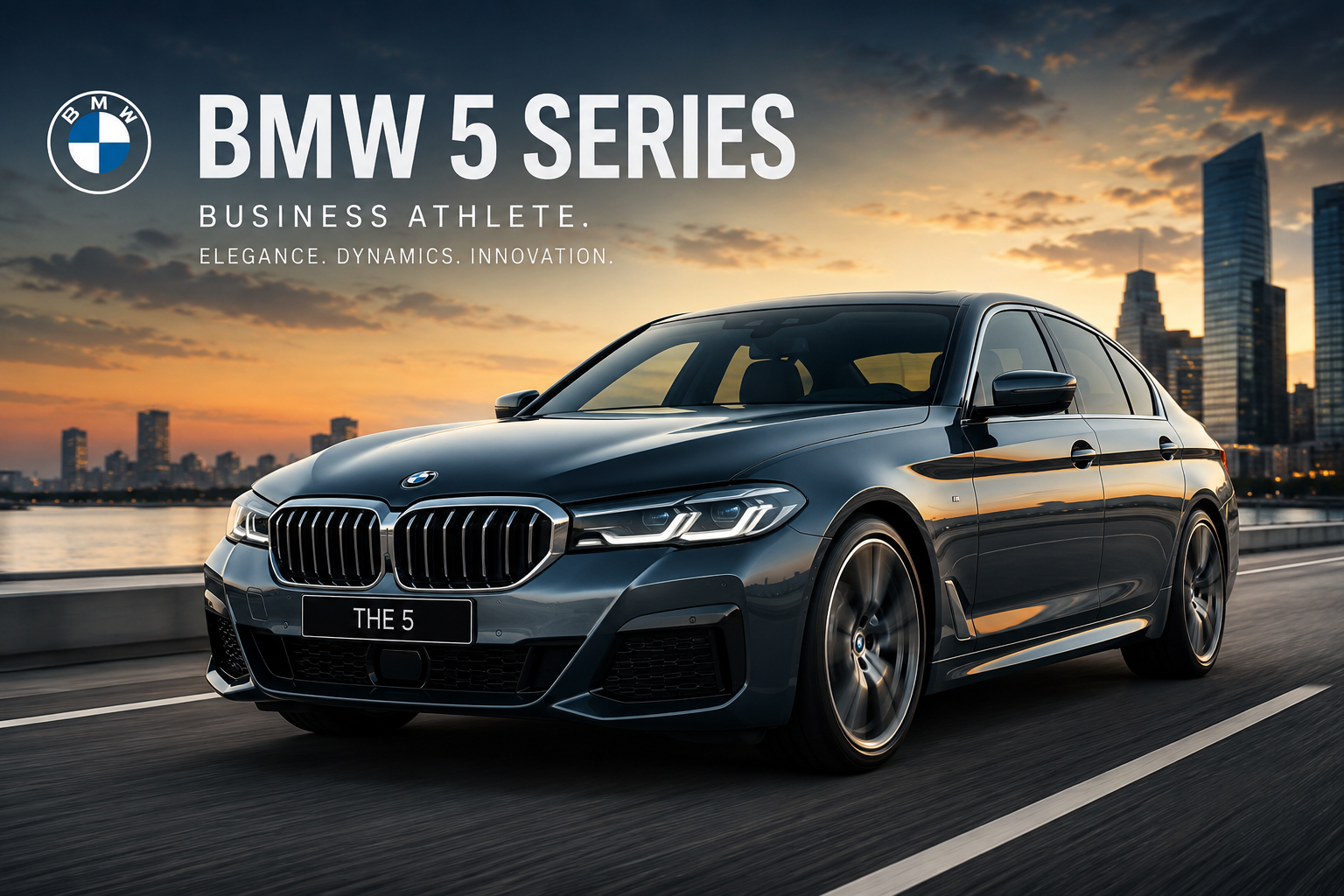
BMW’s eighth-generation 5 Series arrived with a design that generated considerable debate. The kidney grille is wider and more assertive than any previous 5 Series. The body sides have more pronounced creases than the smoothly surfaced seventh generation. The overall silhouette is more fastback than classic three-box sedan. Some people love it immediately; others warm to it over time. A long-term review published in late 2025 noted a polarizing design but also acknowledged that glossy black details mix with backlit LED elements to satisfying effect.
What’s less debatable is the quality of the detailing. The LED headlights have a distinctive signature that makes the car recognisable from distance. The flush door handles give the body sides a clean, uninterrupted line. The available 19- and 20-inch wheel designs are proportionally matched to the car’s dimensions in a way that lesser cars’ wheels often aren’t — wide enough to look right, not so large as to ruin the ride.
Inside, a gently curving touch screen running from the driver’s position to the center of the car floats above the mass of the dashboard — a description that captures exactly how the Curved Display integrates into the interior architecture. The cabin design is modern without being dated by current trends: in five years, the inside of this car will look intentional rather than of-its-moment.
BMW 5 Series vs. Mercedes E-Class vs. Audi A6 — An Honest Comparison

The German midsize luxury sedan segment has always been a three-way conversation — BMW 5 Series, Mercedes-Benz E-Class, and Audi A6. In 2025, that conversation is genuinely close, which makes understanding where each car excels more important than picking a winner on a single metric.
The Mercedes E-Class is the most technology-forward of the three, particularly in its Superscreen infotainment presentation which is a visual spectacle. It’s also slightly more rear-seat focused, offering more legroom for tall passengers, and the ride quality on its standard suspension is arguably the most pillowy of the three. If you prioritise passenger comfort over driver engagement, the E-Class is a serious consideration.
The Audi A6 offers standard all-wheel drive — Audi’s Quattro system comes with every A6 sold in America, whereas BMW and Mercedes both offer RWD base configurations that some buyers prefer. Audi was the first company to ship cars with full-time AWD with their revolutionary Quattro system. Every A6 sold in America has AWD standard. The A6’s interior, however, is newer in design age but some reviewers note its infotainment screens feel less current than the 5 Series’s Curved Display. It also has a notably smaller trunk at 13.7 cubic feet versus the 5 Series’s 18.
| FEATURE | BMW 5 SERIES | MERCEDES E-CLASS | AUDI A6 |
|---|---|---|---|
| Starting MSRP | $58,700 | $58,150 | $59,135 |
| Base Power | 255 hp | 248 hp | 201 hp |
| Max Power (std lineup) | 483 hp (PHEV) | 375 hp | 335 hp |
| Trunk Space | 18.0 cu ft | 13.1 cu ft | 13.7 cu ft |
| Centre Screen | 14.9 inch | 14.4 inch (Superscreen) | 10.1 inch |
| AWD Standard | Optional | Optional | Standard |
| Hands-Free Driving | Up to 85 mph | Up to 37 mph (DRIVE PILOT) | Available |
| Plug-In Hybrid | 550e (483 hp) | E 350e (308 hp) | Not available |
The comparison table tells most of the story. The 5 Series wins on trunk space — decisively — on maximum power with the PHEV option, on hands-free driving speed, and on centre screen size. The Mercedes wins on the visual drama of the Superscreen and on rear-seat comfort. The Audi wins on standard all-wheel drive availability and arguably on brand discretion — fewer A6s on the road means it reads as a rarer choice.
For the American buyer who wants the most complete package, the BMW 5 Series has the better powertrain spread, the most usable cargo space, and the most capable semi-autonomous driving system. That makes it the rational pick, even in a segment where emotion plays a substantial role in the purchase decision
28 City / 35 Highway — Surprisingly Efficient for Its Power Output
Fuel economy is rarely the primary reason someone buys a $60,000 BMW. But the 2025 5 Series’s numbers are worth understanding because they’re better than you’d expect from a car that delivers this level of performance, and they’re genuinely competitive within the luxury sedan segment.
The 2025 BMW 5 Series is capable of achieving 28 mpg in the city and 35 mpg on the highway. For the 530i, those figures represent real-world attainability for drivers who are reasonably measured with the throttle on the highway. The mild hybrid system’s energy recovery under braking contributes meaningfully to the city figure, which is often the hardest to achieve for a car of this performance level.
The 550e xDrive changes the equation entirely for daily driving. If your daily commute is under 30 miles and you have home charging, your annual fuel cost on the 550e could be a fraction of what you’d spend on a conventional luxury sedan. The combustion engine becomes a range extender for longer trips rather than the primary power source, and the EPA’s combined MPGe figure reflects an efficiency level that no traditional petrol sedan in this segment can match.
How to Buy a 2025 BMW 5 Series Without Overpaying
The 2025 BMW 5 Series has an MSRP range from $58,700 to $73,400 across the four standard trims, but the price you should pay is almost certainly lower than sticker. The base model of the 2025 BMW 5 Series has an MSRP of $60,150, but the average price paid is $55,665 based on 47 transactions from the past 20 weeks. Shoppers are paying 7.5% less than MSRP. That’s a meaningful discount on a car at this price point.
BMW dealerships have more negotiating room than the brand’s premium positioning might suggest. Because the 5 Series competes directly with the E-Class and A6, dealers frequently have incentive to close deals rather than lose a buyer to Stuttgart or Ingolstadt. The end-of-quarter months — March, June, September, December — are traditionally when the best deals appear, as salespeople work to hit quarterly targets.
- Use competing quotes strategically
- Get quotes from multiple BMW dealers and let each know you’re shopping. In a competitive luxury segment, dealers will often match or beat each other rather than lose a sale. This is particularly effective when you’re looking at the same configuration at two or more regional dealers.
- Consider a certified pre-owned 2024 model
- The 2024 and 2025 5 Series are functionally identical in most respects — the 2025 adds heated front seats as standard and introduces the 550e. If you’re buying a 530i or 540i, a 2024 CPO model represents significant savings with BMW’s factory warranty coverage and the same core driving experience.
- Build-to-order vs. dealer inventory
- If you’re not in a hurry, building your 5 Series to your exact specification through BMW’s order system often results in a better-spec car at a similar or lower price than accepting whatever a dealer has on the lot. Allocations for built cars typically arrive within 10–16 weeks from European production.
- Essential packages vs. optional extras
- The Driving Assistance Professional package is worth it if you do significant highway miles. The Executive package (soft-close doors, active lane change assistant, gesture control) is a reasonable add for buyers who want the full experience. The Bowers & Wilkins audio upgrade is genuinely excellent but expensive — Harman Kardon is sufficient for most listeners.
Reliability, Maintenance, and the Real Cost of Owning a BMW 5 Series
No honest review of a BMW should skip this section. BMW’s ownership costs are higher than average, and the 5 Series is no exception. Understanding what those costs look like before you sign helps you plan rather than be surprised. RepairPal gives the 5 Series a reliability rating of 3.5 out of 5, ranking it 14th out of 48 among Luxury Full-size Cars. That’s a middle-of-the-road reliability score — not concerning, but not class-leading. The turbocharged engines, complex electronics, and sophisticated suspension systems have more potential points of failure than a simpler car, and repair costs when something goes wrong are typically higher than non-premium brands.
BMW includes three years or 36,000 miles of free scheduled maintenance with every new 5 Series through their BMW Ultimate Care programme. This covers oil changes, brake fluid service, and other routine items. Beyond that period, costs depend heavily on how much you drive and whether you maintain the car at a BMW dealership (more expensive) or an independent specialist familiar with the brand (often significantly cheaper for out-of-warranty owners).
Five recalls have been noted on the 2025 model as of the latest available data. Recalls are common across the industry and don’t necessarily signal a quality problem — they reflect BMW’s monitoring of their fleet and the NHTSA’s active oversight. All recall work is performed free of charge at any BMW dealer, and the My BMW app will alert you if a recall is issued for your VIN.
“A secure daily driver that somewhat overplays its hand in the name of technology. The model to get: 540i xDrive.”— The Interior Review, long-term owner assessment, October 2025
The 5 Series depreciates at a rate broadly in line with the segment — approximately 61% of its value lost over five years, according to iSeeCars data. This is actually slightly better than the Audi A6 (60.9% depreciation) on an absolute basis, though the difference is marginal. The practical implication is that a well-spec’d 5 Series bought at or below MSRP will lose roughly $36,000–$45,000 in value over five years of ownership. Factor that into your total cost calculation alongside insurance, fuel, and maintenance.
Final Verdict: Who Should Buy the 2025 BMW 5 Series?
After six thousand words, the answer is actually straightforward. The 2025 BMW 5 Series is the best choice in its segment for drivers who want to genuinely enjoy the act of driving, who use their car’s trunk seriously, who want hands-free highway driving without paying $100,000 for it, and who want a powertrain option — the 550e xDrive — that makes them feel good about their fuel choices without sacrificing a single unit of performance.

 Sagar
Sagar