 Sagar
Sagar First time buyer, or a weathered off-roader on your second or third Wrangler? It doesn’t matter; the 2025 Jeep Wrangler remains America’s off-road SUV like no other on the market. But that’s something that most buying guides won’t let you know: the Wrangler is not an all-encompassing, one size fits all vehicle. Choosing the wrong model at the dealership, between seven possible trims, four engine choices, two body configurations, hybrid configuration, and an assortment of available options bundles to fit a small binder, can cost you thousands in incorrect purchases and years of regret. The following has been written to prevent this from happening.
What Exactly Is The Jeep Wrangler- and why is it still number 1 in 2025?
The Jeep Wrangler is not an SUV one parks in a driveway, rather it’s an 80 year-old American icon born on the WWII battle fields as the Willys MB. After decades of developing into one of the more distinctive, specialized vehicle types available in America today it has come full circle as arguably one of the best. Not one other mass market vehicle sold in America lets you take the doors off, drop the windshield down and drive into the woods as it is a symbol for off-road adventurers, for a large, devout, and loyal community.
As of 2025 the Wrangler is the best off-road SUV in the US by a mile, consistently topping quarterly sales numbers and boasting a resale value that nobody can match. More than 70% of owners keep and/or customize their Jeeps longer than five years, a loyalty rating that few vehicles can boast. That being said, not “worth buying” equal “worth it to buy.” With this being one of the hardest purchase decisions you’ll face in the SUV segment due to its numerous configurations, packages, and powertrains, we offer the following 15 points that should help you buy with confidence .
1. 2025 Jeep Wrangler Has an MSRP That Starts at $32,690, But the Sticker Is Just the Beginning
What not all buyers realize is the actual difference in price between the advertised MSRP and your “out the door” price. There are destination and delivery fees alone of $1,500-$2,000, add the documentation fees, state sales tax, registration, and you can generally find yourself $2,500-$4,500 over MSRP before any bargaining can take place. Here’s the 2025 trim-level pricing to understand from the beginning:
| Trim Level | Starting MSRP (Approx.) | Body Style Available |
| Sport | ~$32,690 | 2-door & 4-door |
| Sport S | ~$36,000 | 2-door & 4-door |
| Willys | ~$38,000 | 2-door & 4-door |
| Sahara | ~$42,000 | 4-door only |
| Rubicon | ~$47,000 | 2-door & 4-door |
| Rubicon X | ~$54,000 | 2-door & 4-door |
| Rubicon 392 | ~$100,000+ | 4-door only |
Buyer’s Pro Tip: Dealers frequently discount prior model-year Wranglers significantly — sometimes $4,000–$8,000 below MSRP — when a new model year arrives. If the current model year’s changes are minor (as is the case for 2025 vs. 2024), buying the prior year’s model from remaining inventory is one of the best value plays in the segment.
2. Seven Trim Levels — and Each One Is a Fundamentally Different Vehicle

Here’s where the well-informed Wrangler shopper deviates from the person who enters the dealership without doing their homework. The seven trims of the 2025 Wrangler aren’t just a set of features and comfort options built on top of the same chassis. The disparity between a Sport and a Rubicon has to do with different axles, different 4WD systems, different suspension tunes, different tires, and different underlying mechanical bits. . Choosing the wrong trim doesn’t mean you missed out on leather seats — it means you may have bought a vehicle that literally cannot do what you intended it to do.
Here is what each trim actually represents in terms of real-world purpose and engineering:
- Sport — The Blank Canvas for the Budget-Minded Purist:
- The Sport is the entry point, but calling it “basic” misses the point. It ships with a Command-Trac part-time 4WD system, solid Dana front and rear axles, and skid plates protecting the fuel tank, transfer case, and transmission. For 2025, power windows and door locks are now standard — a long-overdue upgrade that previous Sport owners will recognize as a daily-life frustration finally resolved. The Sport is ideal for buyers who plan to customize heavily over time, or those who need genuine 4WD capability at the most accessible price point.However this is not the spec for a buyer that wants factory fitted trail gear.
- Sport S- Practicality Upgrade for everyday use: Sport S offers more comfort features over base Sport – upgraded cloth interior, self-dimming rearview mirror, more electronics – but no real change in the off road package. Essentially, it’s a Sport but with the luxury for the daily drive to be a pleasure and not just a convenience. For anyone that’s looking for a ‘one vehicle’ fit for weekday use and weekend trails this feels like the correct spot to be.
- Willys — The Off-Road Value Champion:
- In honor of the original WWII Willys MB Jeep, this is a trim made for those who wish for real trail hardware, but cannot afford the premium the Rubicon charges. The Willys brings an electronic rear axle locker (e-locker), heavier-duty Dana 44 rear axle, Off-Road Plus Mode for increased off-road traction control, and larger off-road all-terrain tires. All of this combined provides arguably the most true off-road capability per dollar of any of the trims available. If Rubicon pricing is keeping you away, and you need a true trail machine the Willys is a good consideration.
- Sahara — The Daily Driver That Still Goes Off-Road:
- In honor of the original WWII Willys MB Jeep, this is a trim made for those who wish for real trail hardware, but cannot afford the premium the Rubicon charges. The Willys brings an electronic rear axle locker (e-locker), heavier-duty Dana 44 rear axle, Off-Road Plus Mode for increased off-road traction control, and larger off-road all-terrain tires. All of this combined provides arguably the most true off-road capability per dollar of any of the trims available. If Rubicon pricing is keeping you away, and you need a true trail machine the Willys is a good consideration.
- Rubicon — The Genuine Off-Road Machine:
- The Rubicon is an off-road machine. It is not a name they use to sell it. The Rubicon has a set of features that make it good at driving on tough terrain. It comes with the Rock-Trac 4:1 heavy-duty 4WD system. This system is very good at helping the Rubicon climb over rocks and steep hills. The Rubicon also has an electronic sway bar disconnect. This helps the Rubicon move its wheels a lot when it is driving on rocks. The Rubicon has locking rear differentials. It also has 33-inch BFGoodrich all-terrain tires. The Rubicon has rock rails to protect its body.. It has a stronger rear axle.
- The Rubicon is perfect for people who like to take their Wrangler on adventures. They like to drive on fire roads and rocky trails. They like to cross rivers and climb mountain passes. The Rubicon is made for people who do these things. It is the trim for the Wrangler if you like to drive on tough trails. The Rubicon is the one you want if you like to go, off-road.
- Rubicon X — Where Capability Meets Genuine Comfort:
- The Rubicon X layers the Rubicon’s full trail hardware with a premium interior experience — Nappa leather seating, steel bumpers front and rear, the 9-speaker Alpine premium audio system, advanced safety technology, and additional interior refinements. It is the trim for the buyer who wants absolutely no compromise between trail performance and daily driving luxury. If you have the money a lot of people who own a Wrangler for a time think the Rubicon X is the best deal.
- The Rubicon 392 is a cool Jeep. It has a V8 engine.
- Jeep said they would not make the Rubicon 392 anymore and made a Final Edition for 2024.. Then they decided to make it again for 2025 because so many people wanted one. The Rubicon 392 has a 6.4L SRT HEMI V8 engine that produces 470 horsepower and 470 lb-ft of torque. It can go from zero to sixty miles per hour in 4.2 seconds. The Rubicon 392 is a Rubicon, with a four wheel drive system. It is the Rubicon Wrangler that has ever been made. The Rubicon 392 is also the powerful production Wrangler ever built.
- t. It is also limited in availability and priced above $100,000 when options are added — this is a collector-grade vehicle as much as it is a trail machine.
3. Four Engine Options Mean You’re Effectively Buying Four Different Vehicles
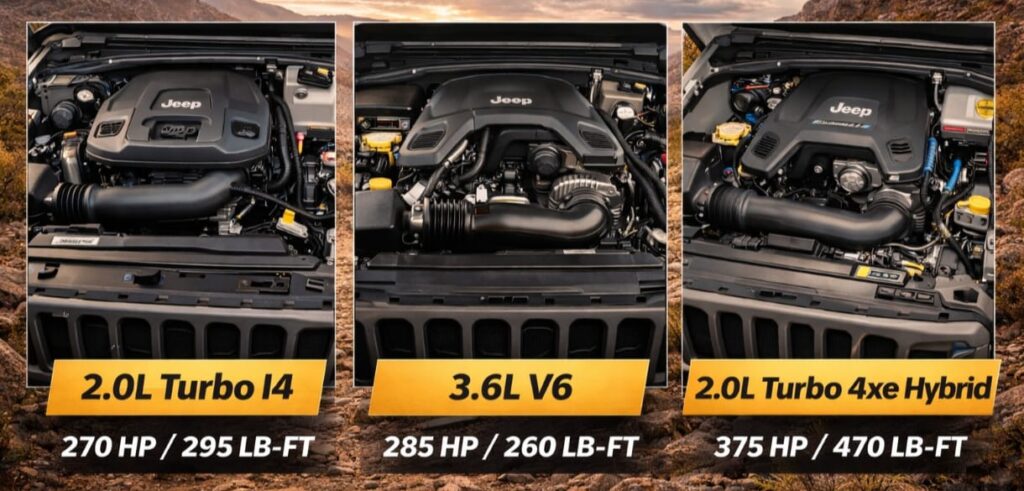
The powertrain you choose for a Wrangler affects things.It impacts your fuel costs how much you can. How comfortable you are on the highway.It also affects how well you can drive, off-road and how much your Wrangler is worth when you want to sell it.Choosing a powertrain is a decision.You should learn about each option before visiting a dealer.The Wranglers powertrain options are something you should understand well.This will help you make a choice
- 3.6L Pentastar V-6 (285 hp | 260 lb-ft torque | Available on most trims):
- This is the Wranglers heritage engine. The one that millions of Americans know from years of being very reliable in FCA vehicles. The Wranglers heritage engine delivers predictable power when you are driving. The Wranglers heritage engine is very strong. Can last a long time.
- For 2025 the Pentastar V6 engine is only available with a six-speed transmission. This means that people who want the Pentastar V6 engine must know how to drive a stick shift.
- The Pentastar V6 engine gets around 17 miles per gallon in the city. 23 Miles per gallon on the highway when you have a two-door Wrangler.
- For people who love driving a car with a gearbox and trust the Wranglers heritage engine the Pentastar V6 engine is still a great choice. The Wranglers heritage engine is an option for people who like to feel connected, to their car when they are driving.
- 2.0L Turbocharged I-4 (270 hp | 295 lb-ft torque | Standard on Sahara, available on others):
- The turbocharged four-cylinder engine does not make much horsepower as the V6 engine. However the turbocharged four-cylinder engine makes torque. The turbocharged four-cylinder engine also delivers this torque a lot earlier when the engine is running. This is really good when you are driving on rocks and you need to climb. You get a response when you press the gas pedal. The turbocharged four-cylinder engine is also good for driving in the city because it helps you save gas when you are stopped a lot. When you are driving on the highway with the eight-speed transmission the turbocharged four-cylinder engine is really smooth. The turbocharged four-cylinder engine is great, for the highway because it is so smooth. . The Sahara uses this as its standard engine for good reason. For buyers who prioritize a balance of efficiency, modern performance, and automatic transmission convenience, the 2.0L turbo is arguably the most well-rounded engine in the Wrangler lineup today.
- 6.4L SRT HEMI V8 (470 hp | 470 lb-ft torque | Rubicon 392 only):
- The Rubicon 392 engine is not about being practical it is about being something. The Rubicon 392 has a lot of power with 470 horsepower it can go from zero to 60 miles per hour in 4.2 seconds. This is faster than a lot of sports cars. When you hear the V8 engine it is like an event. But there is a downside to all this power the Rubicon 392 does not get good gas mileage. In the city it gets around 13 miles per gallon. On the highway it gets around 16 miles per gallon. This means that the Rubicon 392 will cost a lot more to fill up with gas two thousand to three thousand dollars more per year than a car with a smaller engine. If you do not mind spending that money on gas the Rubicon 392 is a great choice because it has a lot of power and it can handle off-road driving very well. There is no car on the market that combines the Rubicon 392 off-road hardware with the power of an American muscle car, like the Rubicon 392.
- 4xe Plug-In Hybrid (375 hp combined | 470 lb-ft torque | Wrangler 4xe models):
- The 4xe has a 2.0L turbocharged engine and two electric motors and a 17-kWh battery pack. This gives the 4xe around 21 miles of range when it is just using electricity. The 4xe can go up to 370 miles when you use both the electric motors and the gas engine.When you are driving on trails the 4xe is really good at crawling quietly when it is in electric mode. This is great for driving on trails. On the highway the gas engine kicks in. You can drive normally.The 4xe might also get you a discount on your taxes. You might be able to get up to $7,500 from the government under the Inflation Reduction Act. This depends on how money you make and what your tax situation is.. If you do get this discount it can really help make up for the fact that the 4xe costs more, than the gas-only versions. The 4xe is an option because of this discount..
4. Two-Door vs. Four-Door:The Wrangler is completely different based on how you use it
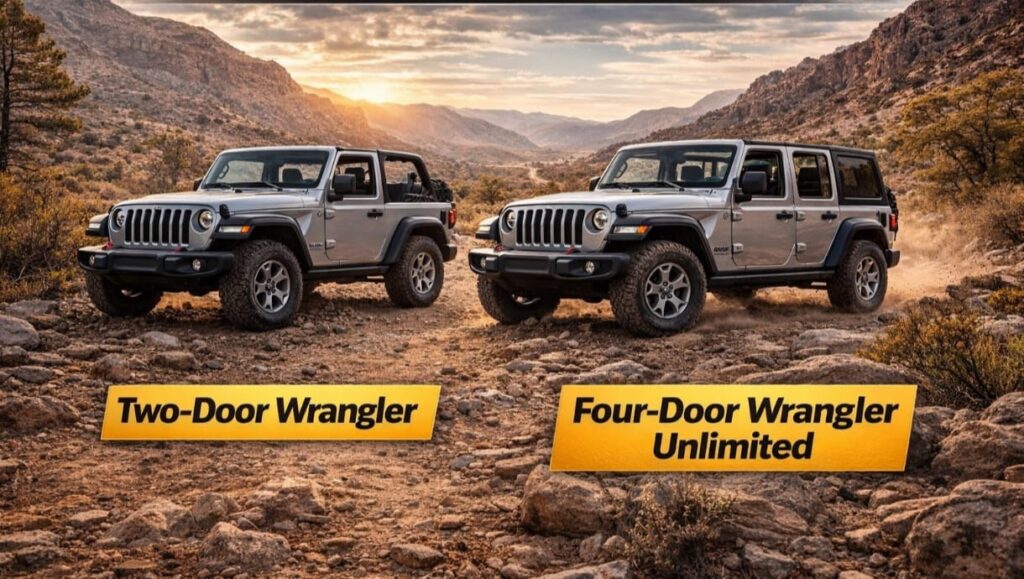
When you choose between the two-door Wrangler and the four-door Unlimited Wrangler it is a decision. The Wrangler you pick changes the size of the vehicle how stuff you can carry how many people can ride in it and how well it does on trails and in daily life. The two-door Wrangler and the four-door Unlimited Wrangler are basically two vehicles with the same name.
The two-door Wrangler is shorter and lighter which makes it really good at driving on trails where you have to make tight turns. The two-door Wrangler can carry four people has 12.9 feet of space for your stuff behind the seats and 31.7 cubic feet when you fold the seats down. The two-door Wrangler also costs money to buy at first. A lot of people who like driving off-road like the way the two-door Wrangler looks. However the two-door Wrangler has some problems: it is really small for grown-ups in the back seats. There is not a lot of room for your stuff compared to other SUVs.
The four-door Wrangler Unlimited fixes these problems. The four-door Wrangler Unlimited can carry five people has 31.7 feet of space behind the seats and a lot of space. 72.4 Cubic feet. When you fold the seats down. This makes the four-door Wrangler Unlimited a choice for families. The four-door Wrangler Unlimited can also pull a trailer that weighs up to 5,000 pounds when it has the parts, which makes it a good choice for people who need to pull a small boat. The only bad thing about the four-door Wrangler Unlimited is that it is a little longer which makes it not as good at driving on small trails.. Most people do not drive on trails that are that small so this is not a big problem, for the four-door Wrangler Unlimited.
Two-Door Wrangler:
- The cargo space is pretty small when the seats are up it is 12.9 cu ft. This is room for a weekend trip for two people but it would be really tight for a whole family.
- The car is really good at handling turns and rocky roads because it has a shorter wheelbase.
- It is also a lot lighter than the Unlimited, which means it has power. This is because it weighs hundred pounds less.
- You can fit four people in the car. The back seats are not very comfortable for adults on long drives.
- The price of this car is lower than the four-door version, by $3,000 to $5,000.
Four-Door Wrangler Unlimited:
- Cargo space is really big when you fold the seats: it can hold up to 72.4 feet. This is as good as what you get in family SUVs.
- The car has five seats and the people in the seat have enough room for their legs, which is great for long trips.
- You can tow things with this car: it can pull up to 5,000 pounds when it is set up right. This means you can tow trailers or boats.
- This car is good for use: it is easy to get in and out of and it has lots of doors which makes it good for buying groceries or picking up kids from school.
- This car is really good, for families: it is the choice if you have kids or if you travel with a lot of people all the time.
5. The Rubicon’s Off-Road Hardware Is Genuinely Unlike Anything Else in Its Class

It’s easy to use the word “capable” about any modern SUV. Nearly every crossover sold in America today has some version of all-wheel drive and a “terrain mode” selector. What separates the Rubicon isn’t marketing language — it’s specific, measurable mechanical hardware that has been engineered for the kind of terrain that would strand lesser vehicles.
The Rubicons off-road design goes further than most people think.
Understanding what each system really does helps explain why this trim costs a lot more than the Sport or Sahara.The Rubicon has special features for off-road driving.Each system in the Rubicon is made for off-road use.The Rubicons price is higher because it has advanced systems.The Sport and Sahara trims do not have these systems.The Rubicons systems make it a great choice for people who want to drive off-road.The extra cost of the Rubicon is worth it for, off-road drivers:
- The four to one crawl ratio means that for every time the engine turns around the wheels only turn one quarter of the way. This lets the driver of the Rubicon go on steep or really loose terrain or really tough trails at speeds that are as slow as walking and the driver has complete control over the throttle. The Rubicon has this ability because of the crawl ratio. It is something that no computer program can do not even the traction control software. The crawl ratio is what makes the Rubicon so good, on trails
- Electronic Sway Bar Disconnect:
- On roads a sway bar helps reduce body roll and thats a good thing.On a rocky trail it can limit how much the wheels can move up and down.This means one wheel can’t drop down far into a hole while the other wheel stays on the ground.The Rubicons electronic sway bar can be turned off with a button.This allows the suspension to move freely and keeps all four tires on the ground on terrain.The Wrangler Rubicon is the vehicle, at this price that has this feature..
- Locking Front and Rear Dana 44 Differentials:
- When you are driving a car with a differential something bad can happen. If one of your wheels starts slipping the power will go to that wheel. This is the wheel that is spinning around and not touching the ground or it is on ice. It is not good because the wheel is not helping you move.A locking differential is different. It makes both wheels turn at the speed. This happens even if one wheel does not have traction. So the power goes to the wheel that is actually touching the ground. The Rubicon has lockers in the front and the back. This means you can lock both sets of wheels at the time. You can do this when you are driving on tough terrain.The Rubicon is a car for driving off road. It is not something that the company says it can do. The lockers are a part of what makes the Rubicon so good, at driving off road. The Rubicon has both rear lockers
- Electronic Front Axle Disconnect:
- When you are not driving on terrain the Rubicon can disconnect the front axle completely.This helps to decrease drag on the drivetrain and increase fuel efficiency on highways.Most four-wheel-drive systems keep the driveshaft spinning even when in two-wheel-drive mode.The Rubicon is different.The Rubicons design is thoughtful. Shows it was made for daily use not just for occasional off-road driving in a Rubicon.The Rubicons features make it suitable, for people who use the Rubicon every day. people who use it every day, not just occasionally.
- 33-Inch BFGoodrich All-Terrain T/A KO2 Tires (Standard):
- The KO2 tires are really well liked by people who drive off road. Lots of people who drive on trails and go on long adventures in the American West use these tires. When you buy a Rubicon with these tires it is ready to go on trails right away. You do not need to add anything to it.The Rubicon also has a Xtreme 35 package. This package comes with 35-inch tires. There is also an Xtreme Recon package. This package comes with 37-inch tires. The Xtreme Recon package makes the Rubicon sit higher off the ground. It has a lot of ground clearance. 13.4 Inches to be exact. The KO2 tires on the Rubicon make it a great vehicle, for driving on trails
- Ground Clearance:
- The Rubicon is really big at 10.8 inches. This is when it is in the configuration. The Rubicon is already better than most of its competitors.When you add the Xtreme Recon 37-inch tire package the number gets even bigger. It climbs to 13.4 inches. This is high enough for the Rubicon to clear obstacles. These are obstacles that would cause problems for trucks. The Rubicon can also do better, than crossover SUVs.
6. The 4xe Hybrid Might Be the Single Smartest Buy for Many American Drivers

The Wrangler 4xe has been misjudged since its introduction, a fact that we ought to rectify. For one niche (and rather large slice) of American consumers — suburban or urban dwellers during the week, but requiring real off-road prowess on weekends — the 4xe might just be the most sensible Wrangler you can buy. On paper, the 4xe churns out a 375-hp, 470-lb-ft combined total, besting even the most potent non-V8 Wranglers by a vast margin. Its 21-mile electric range is more than capable of handling the average American commute using only electrons, thereby freeing up gas stations on weekday mornings for everyone but short-hoppers. Once the battery’s juice is gone, the gas engine kicks in, making the transition smooth, and the total combined range of around 370 miles, easily competitive with any gas Wrangler. Out on the trail, the instant low-RPM torque of pure electric is ideal for rock crawling, where fine control at slow speeds can be more useful than high-horsepower acceleration.
The money part of buying a 4xe is really good. People often do not think about it. The 4xe gets a tax credit of up to $7,500 because of the Inflation Reduction Act. This means the buyer has to make under an amount of money and the 4xe has to be put together and have batteries from certain places. If you qualify for this credit it helps make the 4xe cheaper than you think. Sometimes it is even cheaper than a Rubicon. Some states also give you money to buy an electric vehicle like the 4xe.. If you charge your 4xe at home when electricity is cheap it is very inexpensive to drive every day. The 4xe can cost pennies, per mile to drive. This is because you are using electricity at home to charge your 4xe.
7. The 2025 model year is here. It brings some important updates that buyers will actually care about.
The 2025 Jeep Wrangler is not a new design. It is more like a refinement of the old model that Jeep last updated in 2024.The changes they made for 2025 are the kind of things that make owning a Jeep Wrangler easier and more enjoyable every day
- Power windows and door locks are now standard on all Jeep Wrangler models. This might sound like a thing but it is actually a big deal.In the past the base model Jeep Wrangler Sport did not come with power windows. You had to roll them up and down by hand.This was a problem, for people who bought the base model because it felt fashioned, especially for a car that costs around $32,000.Now every 2025 Jeep Wrangler comes with power windows and door locks no matter which model you buy.This is an improvement and it makes the Jeep Wrangler a better car to own.The 2025 Jeep Wrangler is still the basic car but these updates make it more convenient and easier to live with.
- Active Cabin Ventilation Is Now Available as an Option: This new feature allows Wrangler owners to pre-ventilate the cabin remotely through the Jeep smartphone app before they get in the vehicle. If you’ve ever opened the door of a black Wrangler that’s been sitting in Phoenix, Arizona summer heat for six hours, you understand exactly why this feature exists. Being able to start cabin airflow two minutes before you reach the vehicle can make the difference between a comfortable entry and a near-unbearable one. It’s a small feature with real-world summer-heat significance for buyers in the American Southwest, Southeast, and anywhere temperatures regularly exceed 90°F.
- New Exterior Color ’41 Joins the Lineup: Named for the year 1941 — when the original Willys MB entered production for the U.S. Army — ’41 is a military olive drab-inspired color that speaks directly to the Wrangler’s WWII heritage. It’s not just another color option; it’s a historically meaningful choice that resonates with the Wrangler’s origin story and gives buyers a way to wear that heritage visually. Early buyer response has been strongly positive, particularly among enthusiast communities.
8. The Interior Technology Is Far More Advanced Than the Wrangler’s Reputation Suggests

- The Wrangler has historically had a reputation for being a “primitive” vehicle – crude interior, hard plastics, very little tech. That stereotype, for the 2025 model, couldn’t be further from the truth: it features a technology suite that could rival a typical mainstream SUV. While the 2024 model did a much-needed overhaul on the interior, the 2025 model continues the advancement.
- The Uconnect 5 infotainment system is standard on all 2025 Wranglers, centered around a 12.3-inch screen, one of the largest in any vehicle in this class. This system supports Apple CarPlay and Android Auto (wired standard, wireless available on higher trims), includes a Wi-Fi hotspot and Bluetooth audio streaming, and is both intuitive to use and far more responsive than the older 8.4-inch Uconnect 4 system.
- Perhaps the most uniquely valuable tech offered with the Wrangler is the Off-Road Info Pages; available on the touchscreen, these pages display live information about your vehicle’s pitch (front to back angle), roll (side to side angle), articulation of each wheel individually, your direction, and how well you are climbing a trail. To off-road, knowing exactly what your angle of pitch is when cresting a hill, or your angle of roll traversing a sidehill, are legitimate safety-related pieces of data, not fluff.
- The tech option upgrades available throughout the Wrangler range are as follows:
- 9-Speaker Alpine Premium Audio system: Available on Rubicon X models and higher, this system has been specially engineered for an open-air listening experience, meaning they deliver superior quality sound even without the soft-top and doors in place, a trickier proposition for a sound system designer than building for a sealed passenger cabin.
- Uconnect 5 NAV with Integrated GPS Navigation: Available on the Rubicon trim level and higher, this feature provides turn-by-turn navigation with satellite information, a welcome bonus for areas without a signal strong enough for phone-based navigation.
- Adaptive Cruise Control with Stop-and-Go: Available on the Sahara and Rubicon trims, this feature maintains a set following speed between you and the car ahead, and can bring the Wrangler to a complete stop in traffic and even resume driving on its own once traffic is moving again. This is huge for reducing fatigue while driving in heavy traffic.Full-Speed Forward Collision Warning with Automatic Emergency Braking: Available on higher trims, this system can detect and warn of an impending frontal collision, applying the brakes automatically if the driver fails to react, representing a significant leap in safety over the historically longer stopping distances of the Wrangler compared to the rest of the industry.
- 12-Way Power Adjustable Front Seats with Four-Way Power Lumbar Support: Available on the highest trims, the added precision that this provides compared to the manual seat controls of the lower models will be appreciated by anyone who spends long hours behind the wheel of a Wrangler daily.
9. Safety Has Improved Significantly — With One Honest Caveat
The 2025 Jeep Wrangler is vastly safer than Wranglers of even just 5 years ago and the buyer who thinks the Wrangler is still a bare-bones utility vehicle when it comes to safety technology needs to update their information. However, with that being said, disclosure of one persistent weakness is essential for any potential buyer.
The 2024 redesign that carries forward to 2025 includes first and second row side curtain airbags on all trims of the vehicle, which provide critical head protection during rollovers. Given the Wrangler’s body-on-frame chassis and high center of gravity make rollover protection that much more critical in this vehicle than a crossover; the inclusion of side curtain airbags standard on all trims is essential. Aside from standard side curtain airbags, 2025 Wranglers also offer a significant number of safety tech:
ParkView Rear Backup Camera (Standard on All Trims)- With its bulky, externally mounted spare tire, visibility behind the vehicle is very limited. A standard camera removes the guesswork of parking or backing out into a busy lot.
Forward Collision Warning with Full-Speed Automatic Braking (Sahara and Above)- A system of sensors in the front of the vehicle can detect objects in the Wrangler’s path, and if they are approaching too quickly the system will autonomously apply the brakes. Unlike many automatic emergency braking systems in crossover vehicles that only operate at highway speeds this one works even when crawling in heavy traffic.
Blind Spot Monitoring with Rear Cross Path Detection (Higher Trims)- With the Wranglers’ straight, boxy body design creating more blind spots than that of a sleeker, crossover styled vehicle, the ability to detect objects in these blind zones, and alert the driver, is quite useful. It will even warn of objects when reversing out of parking spaces. With all that being said, a word on its greatest weakness. A very significant drawback with any Wrangler, even with its extensive updates, is the longer than normal emergency stopping distances of virtually all competitors in its class. This can be attributed to the Wrangler’s larger and heavier, knobby off-road tires (on the Rubicon and Willys) and its overall heavier curb weight. During test evaluations of previous model year Wranglers many publications noted that the Wrangler required significantly more distance than other similarly classed SUVs to stop from highway speeds, a fact that buyers should seriously consider in maintaining a larger than normal gap with any vehicles that the Wrangler is following on the highway.
10. Fuel Economy Is the Wrangler’s Most Honest Weakness — Here’s How to Manage It
The 2025 Jeep Wrangler was not engineered to win fuel economy comparisons, and no amount of positive framing changes that reality. The aerodynamics of a vertical windshield and a boxy body are fundamentally at odds with efficiency, and buyers need to internalize this trade-off before making a purchase decision. For context, a Toyota RAV4 averages approximately 28 combined mpg. A Wrangler with the V6 and manual transmission in two-door configuration gets approximately 17 city and 23 highway — a gap of roughly 30% in combined efficiency.
| Engine | City MPG | Highway MPG | Best For |
| 3.6L V6 (manual, 2-door) | 17 | 23 | Purists, manual transmission lovers |
| 3.6L V6 (auto, 4-door) | 16 | 22 | Four-door V6 daily drivers |
| 2.0L Turbo I-4 (auto) | 20 | 23 | Sahara daily drivers, efficiency-minded buyers |
| 6.4L V8 (4-door Rubicon 392) | 13 | 16 | Performance enthusiasts — cost be damned |
| 4xe Plug-In Hybrid | ~49 MPGe electric / ~20 combined gas | – | Commuters with home charging access |
The practical consequence of the Wrangler’s fuel consumption is real money over the ownership period. At current U.S. average gasoline prices, a V6 Wrangler driver averaging 15,000 miles per year will spend approximately $2,200–$2,600 annually on fuel compared to $1,400–$1,800 for a comparable crossover SUV. Over five years, that difference compounds to $4,000–$6,000 in additional fuel costs.
The most practical ways to manage this are as follows: The 2.0L turbocharged four-cylinder hits the best balance of efficiency and performance in the lineup for daily drivers. The 4xe is the most fuel-efficient option by a large margin for buyers who can charge at home and primarily drive under 21 miles per day. And buyers who use their Wrangler heavily off-road should factor in that fuel economy drops further on the trail — idle time and low-speed 4WD operation consume more fuel per mile than highway driving.
Final Thoughts: Why the Wrangler Endures
The 2025 Jeep Wrangler isn’t the smoothest ride on the interstate. It isn’t the most fuel-efficient vehicle in a parking lot full of hybrid crossovers. It isn’t the easiest to parallel park in a crowded city block. But it is the only vehicle you can drive to the edge of a canyon, remove the doors, let the desert wind fill the cabin, and feel genuinely, completely connected to the American landscape around you.
For eight decades, buyers have accepted the Wrangler’s trade-offs not because they didn’t notice them, but because what the Wrangler gives in return — capability, freedom, community, and a personality unlike any other vehicle on earth — makes those trade-offs feel like a fair deal. In 2025, that equation hasn’t changed. The technology is better, the safety is improved, the efficiency is more manageable, and the lineup is broader than ever. But at its core, the Wrangler is still exactly what it has always been: the most authentic, most capable, most uniquely American adventure vehicle in existence.
The 2025 Jeep Wrangler wasn’t designed to top any fuel economy charts, and no spin will change that. The drag caused by a vertical windshield and boxy body is fundamentally antithetical to efficient driving, a compromise every buyer must understand before plunking down the cash. For reference, a Toyota RAV4 returns an average of around 28 combined mpg. V6 manual two-door Wrangler returns about 17 city and 23 highway – a deficit of roughly 30% on combined economy.

 Sagar
Sagar
[…] Himachal beyond rafting, having a capable SUV can make mountain travel much more comfortable. The Jeep Wrangler Buyer’s Guide explains everything from off-road performance and features to ownership costs, making it a useful […]
[…] Scorpio N Scorpio N Jeep Wrangler […]